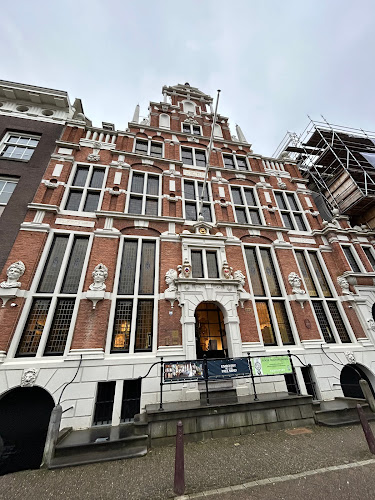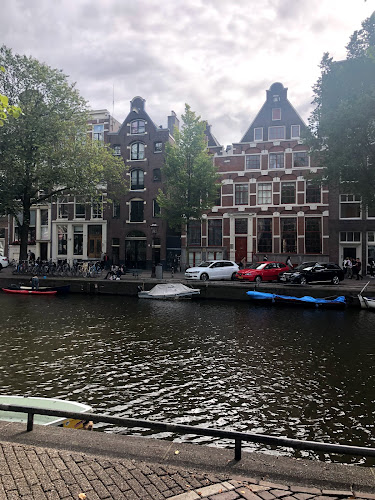
Het smalle Huisje at Oude Hoogstraat 22 is widely regarded as Amsterdam’s narrowest freestanding house: 2.02 meters (6 ft 8 in) wide at the front and about 5 meters deep. Since 2014 it has housed the tea shop Het Kleinste Huis (“The Smallest House”), so you can do more than photograph the facade. You can step inside, buy loose-leaf tea, and on the upper floors sit down for a cup.
I’ve walked past this facade countless times, and it still makes me look twice. It sits in the old center between Dam Square and Nieuwmarkt, on the edge of De Wallen. It stands right beside the gate to the Walloon Church and the Oost-Indisch Huis, the former headquarters of the Dutch East India Company (VOC).
Het smalle Huisje at a glance
| Address | Oude Hoogstraat 22, 1012 CE Amsterdam |
| Also known as | Het Kleinste Huis, the Smallest House in Amsterdam |
| Width | 2.02 m at the facade, about 2.15 m inside |
| Depth | About 5 m, on a plot of roughly 10 m² |
| Floors | Ground floor, two upper floors and an attic |
| First recorded | 1738 |
| Heritage status | National monument (rijksmonument no. 2010) |
| Current use | Tea shop with tea rooms on the upper floors |
| Cost | Free to see from the street; the shop charges only for what you buy |
| Nearest metro | Nieuwmarkt (lines 51, 53 and 54) |
History of the narrowest house
The house exists because of a leftover scrap of land. A building called “King David” once stood on the site of today’s numbers 20 and 22. It was demolished in 1733 to make way for the present number 20, which left the city with a remnant plot of about 10 square meters. The smallest house in Amsterdam was built on that sliver.
City archives first mention the house in 1738. In 1742 a watchmaker, Jan Tenking, rented it for 150 guilders a year. At first it had only a ground floor. The two upper floors and the attic were added between 1768 and 1787.
You will often hear that Amsterdammers built narrow houses because property tax was based on facade width. That story is repeated widely, and it probably helps explain why the city is full of slim canal houses. For this house, though, the recorded reason is simpler: the plot left over after 1733 was too small for anything wider.
The house also has a family history. From the early 1960s to the late 1970s, the family of current co-owner Kirsten ran a gift shop here. Later it became a home again. In 2014 Kirsten and Niels opened it as a tea shop.
What to look for outside
The facade looks like a scaled-down canal house. The national monument register describes it as a very small house with a 19th-century bell-shaped gable top. Part of the facade is built on the neighboring gateway to the Walloon Church. Look at the joint between the two and you can see how the little house leans on its grander neighbor.
That gateway is worth a look too. It was built in 1616 and is attributed to Hendrick de Keyser, one of the architects who shaped 17th-century Amsterdam. The Oost-Indisch Huis next door was the VOC’s headquarters, and the Bushuis, which the VOC used as a warehouse, stood beside it. The link to tea is real: the VOC brought tea to Amsterdam, and this block was at the center of that trade.
It’s easy to miss if you’re in a hurry. I’ve walked past without noticing it myself. Look for the lit shop window and the slim gable squeezed between two much larger buildings.
Visiting the tea shop inside
On the ground floor, a shop of only about 9 m² sells more than 200 teas and herbal blends, along with tea accessories and treats. A narrow staircase leads up to two small tea rooms, where you can order a pot of tea with homemade cake. The owners also hold tea tastings.
Remember that it’s a working shop, not a museum. The owners say they can’t always offer tours of the building, because the shop and tea rooms often get busy. Buying something, or sitting down upstairs, is the most reliable way to see the inside.
The shop’s own website lists slightly different hours on different pages. They range from Tuesday or Wednesday through Saturday, starting at 11:00 or 12:00 and closing around 17:30 to 18:00, with some Sunday openings. Check the official Het Kleinste Huis website before you go, or call +31 20 752 75 85. The exterior is free to see at any hour.
Narrowest house or narrowest facade?
Many guidebooks name Singel 7 as Amsterdam’s narrowest house. The facade you see from the canal there is only about a meter wide, but it is the back of the building, and the house gets much wider behind it. Kloveniersburgwal 26 is another well-known slim facade, at about 2.44 meters. Oude Hoogstraat 22 is the one that stays narrow along its whole length, which is why the city and most local sources call it the narrowest house.
| Address | Width | Why it’s famous | Can you go in? |
|---|---|---|---|
| Oude Hoogstraat 22 | 2.02 m | Narrowest freestanding house, narrow along its whole length | Yes, as a tea shop |
| Singel 7 | About 1 m at the visible facade | Narrowest facade; it is the back of a wider house | No |
| Kloveniersburgwal 26 | About 2.44 m | Very slim canal-house facade | No |
If slim, strange canal houses are why you came, pair this stop with our guide to the crooked houses of Amsterdam.
Best time to visit
Oude Hoogstraat is a busy, narrow shopping street on the main walking route between Dam Square and Nieuwmarkt. When you go makes a big difference, as it does for many of Amsterdam’s central attractions.
- For photos, go early on a weekday, before the street fills up. The street is too narrow to step back far, so a wide-angle lens or phone setting helps.
- To see inside, go on a weekday afternoon while the tea shop is open. The tea rooms are tiny and fill quickly on Saturdays.
- For atmosphere, go in the evening, when the lit shop window stands out against the dark facade. Weekend nights nearby in De Wallen are crowded and noisy, however.
- For fewer crowds overall, choose spring (April to mid-June) or autumn (September to November) rather than peak summer.
- In winter, the Amsterdam Light Festival runs from 26 November 2026 to 17 January 2027. The house isn’t on the official route, but the festival makes the old center livelier after dark.
Avoid weekend and holiday afternoons if you can. I’ve seen visitors jostling for the perfect shot here, and there isn’t much room to maneuver.
How to get there
Het smalle Huisje is in the old center, a short walk from both Dam Square and Nieuwmarkt. Walking or public transport is the easy option. Driving into this area is not.
On foot from Amsterdam Centraal
Allow about 15 minutes. Walk south along Damrak to Dam Square, then turn left into Damstraat. Keep going straight as Damstraat becomes Oude Doelenstraat and then Oude Hoogstraat, crossing the canals as you go. The house is on your right, next to the Kok antiquarian bookshop and the gate to the Walloon Church.
By metro or tram
By metro, take line 51, 53 or 54 to Nieuwmarkt and use the Nieuwe Hoogstraat exit. Walk along Nieuwe Hoogstraat, which continues into Oude Hoogstraat heading toward Dam Square. The house is on your left, a few minutes from the station.
By tram, take line 4 to Dam, then follow the walking route above from Damstraat. It takes about five minutes.
By bike or car
You can rent a bike near Centraal Station, but Oude Hoogstraat is crowded with people on foot, so walk the bike along the street itself. Cars can use Oude Hoogstraat only for loading and unloading, on weekdays from 07:00 to 11:00. If you must drive, the closest option is the underground garage at Waterlooplein, about an eight-minute walk away. A P+R site on the edge of the city, plus public transport into the center, usually costs less.
Nearby places to add
Walk east and you reach Nieuwmarkt, with Chinatown and the 15th-century Waag on the square. Go through the gate beside the house to reach the Walloon Church. The canals of De Wallen are one block west. You can make a short heritage loop by combining the smallest house, the VOC’s Oost-Indisch Huis, the Waag and a coffee near Nieuwmarkt.
Frequently asked questions
Is Het smalle Huisje the same as Het Kleinste Huis?
Yes. Both names refer to Oude Hoogstraat 22. Het Kleinste Huis (The Smallest House) is the more common Dutch name and is also the name of the tea shop inside.
Does it cost anything to visit?
No. Viewing the facade is free at any time, and there is no entry fee for the tea shop. You pay only for tea, cake or anything else you buy.
Can I get a tour of the house?
Not reliably. The owners say tours are not always possible because the shop and tea rooms are often busy. Sitting down in the upstairs tea rooms is the best way to see the interior.
Is the house accessible for people with limited mobility?
Only partly. The ground-floor shop is very small, and the tea rooms on the two upper floors are reached by a narrow staircase. Contact the shop before visiting if stairs are a concern.