Quick Guide to De Waag Amsterdam
| Feature | Details |
|---|---|
| Location | Nieuwmarkt Square, Amsterdam |
| Original Purpose | Medieval city gate (Sint Antoniespoort) |
| Built In | 1488 |
| Current Use | Restaurant-café, Waag Society (technology institute) |
| Best Time to Visit | April-June or September-October |
| Nearby Attractions | Red Light District, Zuiderkerk, Rembrandt House |
| Must See | Original guild stone tablets, octagonal tower, café interior |
| Entry Fee | Free to view exterior, restaurant prices vary |
Why De Waag Is a Must-Visit Historic Landmark
Step back in time at De Waag (The Weigh House), Amsterdam’s oldest non-religious building standing proudly in Nieuwmarkt Square. This imposing stone structure with eight distinctive towers tells the story of Amsterdam’s evolution across five centuries through its walls.
When you visit De Waag, you’re not just seeing an ancient building—you’re experiencing a landmark that has reinvented itself repeatedly throughout history. From medieval city gate to a bustling commercial weigh house, from guild hall for skilled craftsmen to the anatomical theater that inspired Rembrandt’s famous paintings, and now a captivating restaurant and technology institute.
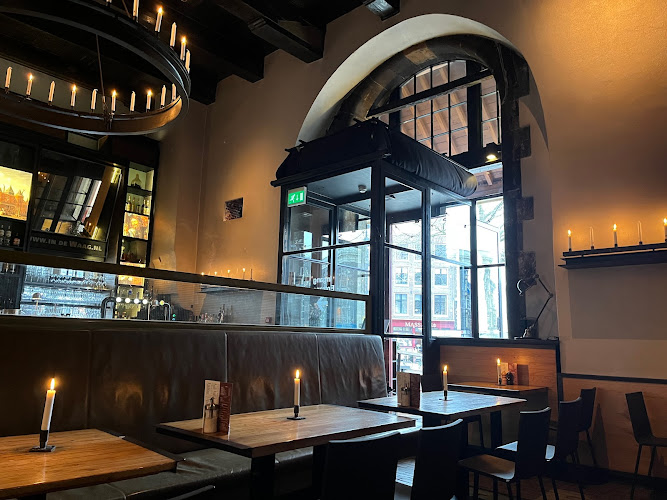
Unlike Amsterdam’s more touristy destinations, De Waag offers an authentic historical experience. Dine beneath ancient wooden beams by candlelight in the very space where Amsterdam’s history unfolded. The atmosphere has remained largely unchanged for centuries, creating a unique connection to the past that you simply can’t find elsewhere in the city.
The Fascinating History of De Waag
De Waag’s story began in 1488 when city builders constructed it as Sint Antoniespoort (Saint Anthony’s Gate), creating a formidable entrance in Amsterdam’s medieval wall. The massive stone structure, with nearly two meters thick walls, controlled all traffic in and out of the city at this strategic point.
When Amsterdam outgrew its original walls in the early 17th century, the city faced a choice: demolish the obsolete gate or find a new purpose. With characteristic Dutch pragmatism, officials transformed it around 1617 into a weigh house. In this commercial center, merchants brought their goods to be officially weighed and taxed before selling them in Amsterdam’s bustling markets.
A Center for Guilds and Medical Innovation
During Amsterdam’s Golden Age, De Waag became a hub for professional guilds again. Each guild—blacksmiths, painters, masons, and surgeons—claimed its tower, creating a center of craft excellence and innovation. Look closely at the façade today, and you’ll spot stone tablets bearing the emblems of these guilds, which are tangible connections to the craftspeople who once worked here.
The Surgeons’ Guild made the most lasting impact by establishing their Theatrum Anatomicum (anatomical theater) on the upper floor. During the winter months, when preservation was possible, they performed public dissections that advanced medical knowledge. These sessions weren’t just scientific—they became cultural events where Amsterdam’s citizens witnessed cutting-edge medical research.
This anatomical theater achieved immortality when Rembrandt van Rijn captured one such dissection in his 1632 masterpiece, “The Anatomy Lesson of Dr. Nicolaes Tulp.” The painting, showing a procedure performed within De Waag’s walls, connects this building directly to one of history’s most celebrated artists.
Modern Renaissance
After centuries of reinvention—serving as everything from a fire station to municipal archives—De Waag continues its tradition of adaptation in modern Amsterdam. Visit today, and you’ll find Restaurant-Café In de Waag on the ground floor, where candlelight flickers against ancient stones as you dine in the footsteps of history.
The building’s upper floors now house Waag Society, an innovative institute exploring the intersection of art, science, and technology. This contemporary role beautifully continues De Waag’s 500-year legacy of serving as both a practical space and a center for advancement, proving that the most sustainable buildings evolve with their communities.
When to Visit De Waag Amsterdam
Best Seasons for the Perfect Experience
Visit De Waag during spring (April-June) or early autumn (September-October) when Amsterdam shines with mild temperatures and fewer crowds than the packed summer months. During these shoulder seasons, you’ll experience Nieuwmarkt Square at its most vibrant—café tables spill onto sun-dappled cobblestones, locals linger over coffee, and the historic façade of De Waag stands in perfect contrast to the lively scene below.
Time of Day Recommendations
Capture De Waag at its most photogenic during early evening’s “golden hour,” when the setting sun bathes the ancient stonework in warm light, accentuating every architectural detail and medieval texture. As dusk deepens, the restaurant’s hundreds of candles flicker in the windows, creating a magical transition from day to night that tells the building’s story through light and shadow.
For a completely different experience, arrive before 9 AM when Nieuwmarkt Square rests in tranquility. Without the daytime crowds, you’ll have unobstructed views for photography and space for quiet contemplation of this historical treasure—a rare moment of serenity in the heart of Amsterdam.
Seasonal Events Worth Planning Around
If visiting in winter, try to coincide your trip with the Amsterdam Light Festival (typically December to January). While De Waag isn’t usually part of the display, the surrounding area often features beautiful light installations that create a festive backdrop for this historic monument.
On Saturdays, Nieuwmarkt Square hosts a bustling market where you can browse local products while enjoying views of De Waag—a perfect way to experience how this historic building remains integrated into the daily life of modern Amsterdam.
Getting to De Waag: Transportation Tips
Public Transportation Options
De Waag enjoys excellent accessibility via Amsterdam’s efficient public transportation system:
- Metro: Nieuwmarkt station (Lines 51, 53, and 54) exits directly onto the square where De Waag stands.
- Tram: Lines 4 and 14 stop at Nieuwmarkt, just steps away from the building.
- Walking: A scenic 10-15 minute walk from Amsterdam Central Station through charming streets.
By Bicycle (The Local Way)
Cycling like a local is one of the best ways to experience Amsterdam. Numerous bike rental shops throughout the city offer daily rentals (€10-15 per day), and De Waag is easily accessible via Amsterdam’s extensive network of bicycle lanes. Bike racks are available around Nieuwmarkt Square, though always lock your bicycle securely.
Walking Routes Worth Taking
For the most atmospheric approach to De Waag, enter Nieuwmarkt Square from Zeedijk Street. This route takes you through Amsterdam’s Chinatown before suddenly revealing De Waag in all its historical glory—a stark and beautiful contrast between the city’s development eras.
Insider Tips for Visiting De Waag
The Restaurant Experience
While De Waag’s exterior impresses with its historic grandeur, the interior of Restaurant-Café In de Waag delivers a truly unforgettable dining experience. Here, centuries-old wooden beams soar overhead while hundreds of candles cast dancing shadows across ancient stone walls—the only illumination in a space largely unchanged for hundreds of years.
For the most memorable visit:
- Reserve Early: Book your table 1-2 weeks ahead, especially for dinner or weekend visits when the restaurant frequently turns away walk-ins.
- Request Central Seating: Ask for a table in the main hall beneath the soaring ceiling for the most dramatic views of the historic architecture.
- Try Dutch Specialties: Sample authentic bitterballen (savory Dutch meatballs) or choose the seasonal menu featuring locally-sourced ingredients that connect you to Amsterdam’s culinary traditions.
- Budget Accordingly: With lunch dishes at €15-20 and dinner entrees €20-30, you’re paying a premium—but the exceptional atmosphere in this living museum justifies the cost for a once-in-a-lifetime dining experience.
Photography Tips
De Waag offers numerous photographic opportunities that capture its historical significance:
- Exterior: Late afternoon light enhances the texture of the ancient stonework.
- Details: Don’t miss the guild stone tablets embedded in the façade—the oldest dates back to 1488.
- Interior: If dining in the restaurant, arrive during daylight hours to capture the transition as the candles become the primary light source in the evening.
Free Experiences
While the restaurant offers a paid experience, there are plenty of ways to enjoy De Waag without spending money:
- Self-Guided Exterior Tour: Circle the building to observe the different towers and architectural details up close.
- Stone Tablet Hunt: Challenge yourself to find and identify all the guild emblems on the façade.
- Nieuwmarkt Atmosphere: Simply sitting in the square with a coffee from a nearby café provides hours of people-watching with De Waag as your backdrop.
Where to Stay Near De Waag
Luxury Options
- NH Collection Amsterdam Doelen (€250-350/night): Historic luxury hotel on the canals, 10-minute walk to De Waag.
- Hotel TwentySeven (€350-600/night): Ultra-luxury boutique hotel offering personalized service, 15-minute walk away.
Mid-Range Accommodations
- Hotel Estheréa (€150-250/night): Family-run hotel with uniquely decorated rooms, located along the Singel canal.
- The Hoxton Amsterdam (€180-300/night): Stylish hotel with a great restaurant and bar, within walking distance of De Waag.
Budget-Friendly Options
- ClinkNOORD Hostel (€30-80/night): Modern hostel across the free ferry from Central Station, just a short ride to Nieuwmarkt.
- St. Christopher’s at The Winston (€25-100/night): Lively hostel with private and dorm options, located just minutes from De Waag.
Nearby Attractions to Combine With Your Visit
Within 5 Minutes Walking Distance
- Nieuwmarkt Square: The vibrant market square surrounding De Waag hosts regular markets and events.
- Red Light District: Amsterdam’s infamous neighborhood begins just west of Nieuwmarkt.
- Zuiderkerk: This striking church features in several Monet paintings and offers tower tours with panoramic views.
Within 10-15 Minutes Walking Distance
- Rembrandt House Museum: Visit the former home and studio of the Dutch master who immortalized De Waag in his famous painting.
- NEMO Science Museum: Fantastic interactive science center housed in a distinctive ship-shaped building.
- Amsterdam’s Chinatown: Explore the vibrant streets, temples, and authentic restaurants just north of De Waag.
De Waag Through the Seasons
Summer (June-August)
The busiest season, with Nieuwmarkt Square filled with outdoor café seating and street performers. The long daylight hours mean De Waag is illuminated by natural light well into the evening. Restaurant reservations are essential during this peak period.
Autumn (September-November)
Perhaps the most photogenic season as falling leaves add color to the square and fewer tourists mean more peaceful viewing. The earlier sunsets enhance the cozy candlelit atmosphere inside the restaurant.
Winter (December-February)
The Amsterdam Light Festival transforms the surrounding area, while inside Restaurant-Café In de Waag becomes especially cozy with its hundreds of candles providing warmth against the winter chill. Dinner reservations are slightly easier to secure.
Spring (March-May)
As Amsterdam awakens from winter, the area around De Waag blooms with new energy. Café terraces reappear, and the increasing daylight offers excellent opportunities to admire the building’s architectural details.
Insider Tips: Avoid These Common Mistakes
Maximize your De Waag experience by avoiding these frequent visitor pitfalls:
- Interior Access Confusion: The building’s interior isn’t open for general tours—you can only experience it by dining at the restaurant or attending special events at Waag Society. Many disappointed visitors discover this too late.
- Peak Hour Crowds: Between 11 AM and 4 PM, Nieuwmarkt Square transforms from charming to chaotic. Visit before 10 AM or after 5 PM to actually enjoy the atmosphere without fighting through tour groups.
- Surface-Level Observation: Don’t just snap a quick photo and move on like most tourists. Take time to circle the building and discover the detailed guild emblems embedded in the façade, the original gable stone from 1488, and the unique configuration of the eight towers—each element tells part of De Waag’s story.
- Restaurant Rejection: Nothing ruins the experience faster than being turned away hungry from Restaurant-Café In de Waag because you didn’t reserve. Even in off-season, tables fill quickly, so always book at least several days ahead through their website.
Ready to step back in time at this historic Amsterdam landmark? Share your De Waag visit photos and experiences in the comments below or browse other travelers’ reviews for extra inspiration!
Essential Visit Information
Address: Nieuwmarkt 4, 1012 CR Amsterdam, Netherlands
Restaurant-Café In de Waag Hours:
- Monday-Thursday: 10:00 AM – 1:00 AM
- Friday-Saturday: 10:00 AM – 2:00 AM
- Sunday: 10:00 AM – 1:00 AM
Make a Reservation: +31 20 422 7772 or book online
Getting There: Nieuwmarkt Metro Station (Lines 51, 53, 54) exits directly at the square
Official Website: Restaurant-Café In de Waag
Photography Tips: Best exterior lighting at golden hour (1-2 hours before sunset)
Have you experienced the magic of dining by candlelight in De Waag? Share your story in the comments below!