Quick answer: The Schreierstoren at Prins Hendrikkade 94-95 is the only surviving defence tower from Amsterdam’s medieval city wall, built around 1487. Its name has nothing to do with crying. It comes from the Old Dutch schrayers houck, meaning “sharp angle,” describing the corner the wall turned at this spot. You can see it free from the street at any hour; there is no ticket, no interior tour, and no rooftop viewpoint.
What the Schreierstoren is
Amsterdam built its first stone fortifications from 1481 onward, and this brick tower went up around 1486-1487 at the point where the wall reached the open water of the IJ. It was the first defence tower the city raised on the harbour side, chosen for its sightlines over the anchorage. The wall it belonged to ran down the Geldersekade to the Sint Anthoniespoort on Nieuwmarkt and onward around the city via the Singel.
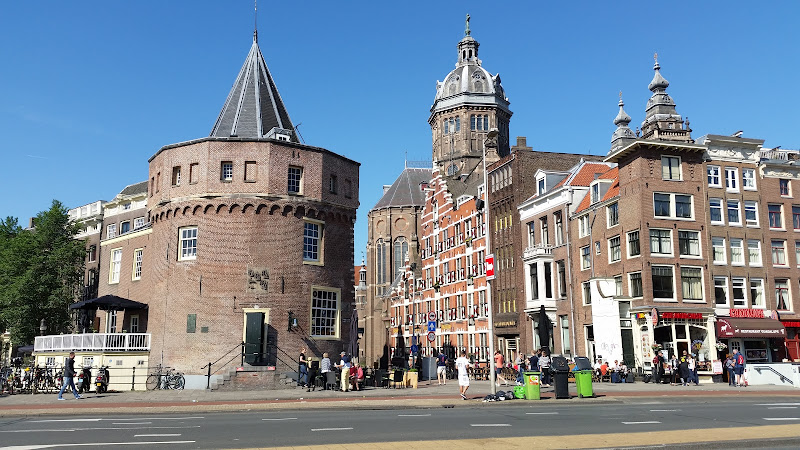
The shape tells you what it was for. The outer face is round, so cannon shot glances off it; the city-facing side is flat, because nobody expected an attack from behind. Battlements originally topped the brick arch frieze, but these were replaced in 1532 by the upper storey you see today. When the quay was later raised, a section of the heavy masonry base disappeared below street level, which is why the tower looks slightly squatter than its builders intended.
Amsterdam’s great expansion of 1585 made the wall obsolete, and demolition began around 1600. Every other tower on that circuit came down. This one survived because the city kept finding uses for it, which is the real reason it is still standing.
Why “Weeping Tower” is a mistranslation
The oldest records call the spot Screyhouck or Scrayhouck, and the tower Schrayershoucktoren. Broken down: schray or schrey meant sharp or skewed, houck meant angle or corner, toren meant tower. The sharp angle in question is where the Geldersekade meets the Oudezijds Kolk, and the wall pivoted southwest.
Over the centuries speakers dropped the houck from the middle. That left Schreierstoren, which sounds almost identical to a phrase meaning “tower of those who weep,” because schrey (sharp) and schreien (to cry) were pronounced the same way in Old Dutch. A geographic description quietly turned into a love story through nothing more than syllable loss.
The legend the tower tells about itself
Dismissing the myth entirely would be its own kind of error, because the tower carries a carved stone that endorses it. Set into the wall is a relief dated 1569 showing a woman with a cloth, facing a departing ship. Local tradition attaches it to a woman who is said to have lost her reason on this spot after watching her husband sail, and it has long been read as proof that wives gathered here in tears.
Two things are worth separating. The etymology is settled and does not support the weeping reading. The farewell tradition is a genuine piece of Amsterdam folklore, documented for centuries and physically inscribed on the building. One is history; the other is heritage. The stone is the single most rewarding thing to look for when you stand at the base, and it is easy to walk past.
The Henry Hudson connection, stated accurately
A commemorative plaque on the tower marks Henry Hudson’s 1609 departure from Amsterdam aboard the Halve Maen, the voyage that took him to the river now carrying his name and to the ground that became New York. The plaque was placed in the twentieth century by an American historical society, and it is the reason so many visitors from the United States seek the tower out.
Be careful with how this gets retold. Hudson sailed from Amsterdam, and the IJ waterfront directly in front of this tower was the harbour he left from. That is a real and specific link. It is not evidence that his crew boarded at this exact doorstep, and pages that stage the scene that precisely are decorating the record. The honest version is still remarkable: the founding voyage of Dutch New York began on the stretch of water you are looking at.
What the tower has been used for
| Period | Use |
|---|---|
| c. 1487-1600 | Defence tower on the medieval city wall |
| 1600-1683 | Guild house for the board of the pewterers’ guild, until it moved to the Haringpakkerstoren |
| 1656-1835 | Office of the chief commissioners of harbours, quays and cranes |
| 1835-1960 | Harbourmaster’s office |
| Late 20th century onward | Hospitality use, most recently a café and maritime-themed bookshop |
That unbroken run of occupants is the whole explanation for its survival. A tower with a tenant is a tower nobody demolishes.
Can you go inside?
The Schreierstoren is not a museum and has no ticketed interior, no exhibition and no public viewing platform. Access depends entirely on whichever hospitality business is trading in the ground floor at the time, and that has changed hands more than once. Treat the exterior as the attraction and any coffee inside as a bonus.
When to go
Because this is a street-level monument, timing is about light and crowds rather than opening hours.
- Early morning gives you the quietest photographs, before the Centraal Station foot traffic builds along Prins Hendrikkade.
- Late afternoon puts the sun behind you if you shoot from the Geldersekade bridge, which is the angle that shows both the round outer face and the water together.
- Avoid the middle of the day in July and August, when the pavement here is a thoroughfare rather than a viewpoint.
- Winter afternoons are genuinely good, since the low sun hits the brickwork and the canal reflections are strongest, though Amsterdam snow is rare enough that you should not plan around it.
Fifteen minutes is enough for the tower itself. Pair it with the Nieuwmarkt and the Waag, which belonged to the same defensive circuit, to make the walk worth the trip.
How to get there
Address: Prins Hendrikkade 94-95, 1012 AE Amsterdam, on the corner with the Geldersekade.
- On foot from Amsterdam Centraal: leave the front of the station, turn left along Prins Hendrikkade and keep the water on your left. It is roughly a 5 to 7 minute walk east.
- By public transport: Centraal Station is the practical stop for every tram, metro and bus line, and walking from there is faster than changing services.
- By bike: there is cycle infrastructure the length of Prins Hendrikkade, but this is a busy junction with tram tracks, so dismount to look rather than stopping in the lane.
- From the Nieuwmarkt area: walk north along the Geldersekade or the Zeedijk and the tower appears at the end, which is the most atmospheric approach.
- By car: don’t. Use a P+R site on the city edge and come in by public transport, as central Amsterdam parking is both expensive and scarce.
Frequently asked questions
What does Schreierstoren mean?
It comes from the Old Dutch Schrayershoucktoren, meaning tower at the sharp angle, from schray (sharp) and houck (corner). The wall turned a sharp corner here. The popular translation as Weeping Tower is a mix-up with schreien, meaning to cry.
How old is the Schreierstoren?
It was built around 1486 to 1487 as part of the city wall begun in 1481, making it well over 500 years old.
Can you go inside the Schreierstoren?
There is no museum, exhibition or public viewing platform. Interior access depends on whichever hospitality business occupies the ground floor, so check its current status before travelling.
Is the Schreierstoren connected to New York?
A commemorative plaque marks Henry Hudson’s 1609 departure from Amsterdam aboard the Halve Maen, the voyage that reached the Hudson River and the site of New York. He sailed from this harbour front.
Is it the last piece of Amsterdam’s city wall?
It is the only surviving defence tower from the medieval wall, which was demolished from around 1600 after the 1585 city expansion. Some wall fragments survive elsewhere, but no other tower does.