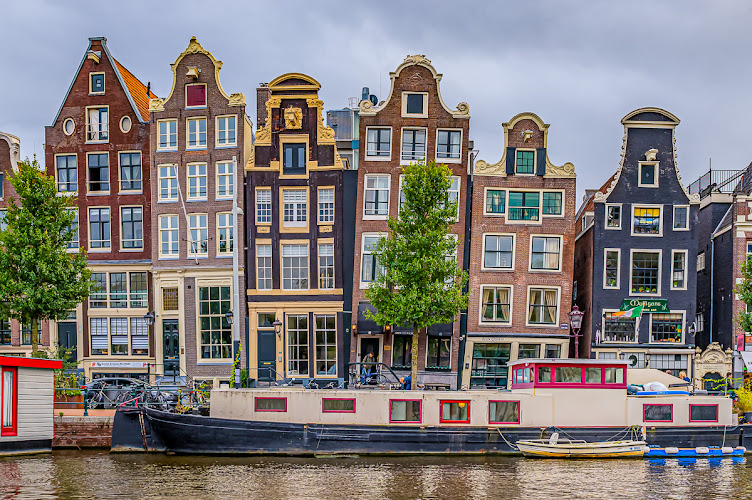
Amsterdam has two separate rows of leaning canal houses that people call the Dancing Houses, and knowing which one you want saves you a wasted walk. The row in almost every photograph is on the east side of the Damrak, the wide water between Amsterdam Centraal and Dam Square: walk down the Damrak from the station and they are on your left. The second row is on the Amstel at numbers 100 to 112, beside the Blauwbrug, about 20 minutes away on foot. Both are private homes and offices, both are free to look at from the street or from a canal boat, and neither can be visited inside. They lean for two reasons at once: Amsterdam building rules once required facades to tilt forward, and the wooden piles under them have settled unevenly for three centuries.
| The famous row | East side of the Damrak, between Amsterdam Centraal and Dam Square |
| The second row | Amstel 100 to 112, 1017 AD Amsterdam, next to the Blauwbrug |
| Also called | Gingerbread houses (Damrak), Blauwbrug houses (Amstel), crooked houses, leaning houses |
| Built | 17th and 18th centuries |
| Cost | Free. There is no ticket, gate or opening time |
| Can you go inside? | No. They are private residences and offices |
| Nearest station, Damrak row | Amsterdam Centraal, about a 3 minute walk south |
| Nearest station, Amstel row | Waterlooplein metro station, about a 4 minute walk |
| Best light | Early morning and the hour before sunset |
| Why they lean | Deliberate forward tilt required by old building rules, plus uneven settling of wooden foundation piles |
Which Dancing Houses do you mean, the Damrak row or the Amstel row?
Two different places in Amsterdam answer to the same nickname, and most guides pick one without telling you the other exists. If you have seen a picture of tall, narrow, brightly gabled houses reflected in green water with the tops leaning at odd angles, that is the Damrak. If you have read about the Blauwbrug houses on the Amstel, that is the other row. This site’s own guide to the crooked houses of Amsterdam maps the Amstel row at numbers 100 to 112, and the Google record behind this page gives Amstel 102II as its pin.
| Damrak row | Amstel row | |
|---|---|---|
| Where | East side of the Damrak, facing the water | Amstel 100 to 112, beside the Blauwbrug |
| Other names | Gingerbread houses, Damrak canal houses | Blauwbrug houses |
| What you see | A dense run of narrow gabled facades rising straight out of the water | A shorter terrace set back behind a quay and a road |
| Best viewpoint | The Damrak pavement and the bridge at the Dam end | The far bank of the Amstel, or the Blauwbrug itself |
| Walk from Centraal | About 3 minutes | About 20 minutes |
| Crowds | Heavy all day. This is the main tourist artery | Much quieter |
| Reflections in the water | Yes, the houses meet the water directly | Yes, from the opposite bank |
There is a historical reason the two get mixed up, and it is the most useful thing on this page. The Damrak was the original mouth of the Amstel, the stretch where the river ran out into the IJ before the city dammed and filled it. Photo captions and stock libraries that describe the Damrak houses as standing on “the Amstel river” are repeating a piece of geography that was true four hundred years ago. Both rows genuinely do stand on the Amstel. Only one of them still calls it that.
How do you find the Damrak Dancing Houses?
Leave Amsterdam Centraal by the main entrance, cross to the Damrak and walk south towards Dam Square with the water on your left. Within about three minutes the row appears across that water: narrow houses in green, red, cream and grey, gables at mismatched heights, several of them visibly out of plumb. You are looking at their water-facing sides, which is why they photograph better than they do from the street behind them.
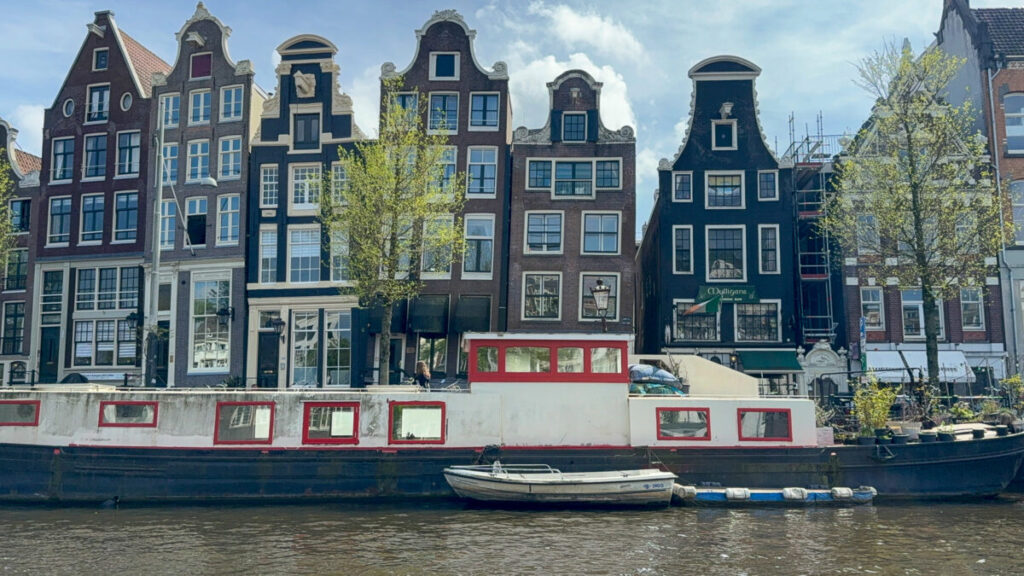
The far end of the Damrak opens onto Dam Square, and the Beurs van Berlage sits on the other side of the water at Beursplein, so this stretch is easy to fold into a walk you were making anyway. Two metro stations bracket it, Centraal at the north end and Rokin at the south, which means you can arrive at one and leave from the other without doubling back.
Where exactly are the Dancing Houses on the Amstel?
The Amstel row runs at numbers 100 to 112, on the west bank, immediately south of the Blauwbrug. The nearest station is Waterlooplein, about four minutes away on foot, and the bridge itself is the simplest landmark to aim for. Stand on the opposite bank or partway across the Blauwbrug and the terrace lines up side-on, which is the angle that shows the lean.
This is the quieter of the two, and it rewards a slower look. Within a few minutes’ walk you have the Rembrandt House Museum, the Waterlooplein flea market, and De Sluyswacht, a 1695 lock-keeper’s house that leans harder than anything on either Dancing Houses row because it stands free with no neighbours to prop it up.
Why do the Dancing Houses lean?
Two causes stack on top of each other, and only one of them is an accident.
The first is deliberate. Amsterdam building regulations required houses to be built leaning forward, a practice the Dutch call op de vlucht bouwen, and the rule held until the early 19th century. The regulations went as far as specifying how much lean was required, and corner houses had to tilt forward on both open sides. The reason was practical: almost every canal house has a hoisting beam at the top of the gable, staircases inside are steep and narrow, and furniture still goes in through the windows today. A facade that leans out means a load on a rope swings clear of the windows below instead of scraping down them.
The second cause is the ground. Amsterdam is built on peat and clay, so these houses stand on wooden piles driven down to a firmer sand layer. Piles rot where they meet air, neighbouring building work changes the water table, and no two piles settle at the same rate. Three centuries of that produces the sideways and backward tilts, which is why the row reads as a crowd of dancers rather than a rank of soldiers all leaning the same way.
One honest gap is worth stating. English-language sources agree the old regulation named a specific permitted amount of forward lean, but none of them publishes the figure, and this page will not invent one. If you see a page quoting a precise maximum tilt in degrees for these houses, ask where the measurement came from, because the buildings have never been surveyed as a group in any published record we could find.
What do people call the Dancing Houses in other languages?
Roughly a fifth of the searches that reach this page are not in English, and the names travel badly. The table below is taken from the search terms readers actually type, recorded in this site’s own Google Search Console data, rather than from a dictionary.
| Language | What people search | Literally |
|---|---|---|
| Spanish | casas danzantes, casas bailarinas, casas inclinadas | dancing houses, dancer houses, leaning houses |
| French | maisons dansantes | dancing houses |
| Italian | case danzanti, case storte | dancing houses, crooked houses |
| German | tanzende Haeuser | dancing houses |
| Dutch | scheve huizen | crooked houses |
Two practical notes for non-English speakers. Spanish and French searchers most often add ubicacion or adresse, and Italian searchers ask dove sono, so the question behind the name is nearly always “where”, not “what”. And the Dutch themselves rarely use a translation of “dancing houses” at all. Ask a local for the scheve huizen and you will get a straight answer; ask for the dansende huizen and you may get a blank look.
When is the best time to photograph them?
Early morning is the single best window on the Damrak, because it is the only time the pavement is clear enough to step back and frame the whole row. The Damrak carries most of the foot traffic between the station and the centre, and by mid-morning you will be shooting between heads.
| Time | What you get | Worth it for |
|---|---|---|
| Early morning, roughly 07:00 to 09:00 | Low light, still water, few people | The clean wide shot of the whole row |
| Midday | Flat light, heavy crowds, boats moving | Seeing the houses from a canal cruise |
| The hour before sunset | Warm light across the gables, long shadows | Picking out the tilt against the sky |
| After dark | Lit windows doubled in the water | Reflection shots |
| After rain, any time | Wet stone and puddles | Reflections without needing the canal |
Season matters less than weather here. Winter gives you the emptiest pavements and the earliest golden hour, summer gives you the longest evening light and the worst crowds, and a grey day flattens the gables badly enough that the lean stops reading in a photograph. A wide lens helps, because the row is long and you cannot back up far on the Damrak. Including a boat, a bike or a person gives the frame a sense of scale that the houses alone do not.
Can you see the Dancing Houses from a canal boat?
Yes, and for the Damrak row the water is the better vantage point, because from a boat you see the facades square on instead of at the sharp angle the pavement forces on you. Most standard city cruises leave from jetties on the Damrak itself or from opposite Centraal, and the route out of the harbour runs straight past. You do not need a tour that advertises the Dancing Houses by name; any cruise that starts on the Damrak passes them in the first few minutes. Our guide to the Amsterdam canals covers which waterways the main routes cover.
For the Amstel row, a boat helps less. The terrace sits back from the quay, so a wider view from the far bank or the Blauwbrug shows more of it than a passing hull does.
How do the Dancing Houses compare with Amsterdam’s other leaning buildings?
The Dancing Houses are the crowd shot. Several single buildings elsewhere in the city lean more dramatically than any individual house in either row.
| Where | What makes it lean | Go for |
|---|---|---|
| Dancing Houses, Damrak | Required forward tilt plus uneven pile settling across a whole row | The classic Amsterdam photograph |
| Dancing Houses, Amstel 100 to 112 | The same, on a quieter stretch of water | The same view without the crowd |
| De Sluyswacht, Jodenbreestraat 1 | Built free-standing in 1695 with no neighbours to lean against | The steepest single tilt, and a cafe inside it |
| Staalmeestersbrug | Not a leaning house, but the bridge view Monet painted | A quiet canal view five minutes from the Amstel row |
| Seven Bridges View Point | Not leaning either, but the best sightline on the Reguliersgracht | Pairing with the Amstel row on one walk |
Our crooked houses of Amsterdam guide maps seven of them together if you want to make a route out of it rather than a single stop.
How do you get there on public transport?
For the Damrak row you do not need public transport at all once you reach the centre: Amsterdam Centraal is the north end of the street and Rokin metro station is a short walk past the south end, so every train, metro and tram that reaches the centre puts you within a few minutes of it. For the Amstel row, Waterlooplein metro station is the closest stop, and the walk from it to the Blauwbrug is signposted.
You no longer need a plastic transport card for any of this. Dutch public transport runs on OVpay, so you tap in and out with the contactless bank card or phone you already carry. Our OVpay guide covers the fares, the daily cap and the tap-out rule that catches visitors out.
What should you know before you go?
Every house in both rows is lived in or worked in. There is no visitor entrance, no ticket desk and nobody to ask. Photographing a facade from a public street is fine; standing in a doorway, ringing a bell or aiming a lens through a ground-floor window is not, and ground-floor curtains in Amsterdam are open far more often than visitors expect.
The Damrak pavement is narrow and busy with people wheeling luggage to and from the station. Stepping backwards to widen a shot without looking is the most common way visitors cause a collision here. The Amstel bank is calmer, but it carries a cycle lane, and cyclists in Amsterdam do not slow down for a raised camera.
Frequently asked questions
Where are the Dancing Houses in Amsterdam?
Two rows share the name. The row in most photographs is on the east side of the Damrak, between Amsterdam Centraal and Dam Square, about a three minute walk from the station. The second row is on the Amstel at numbers 100 to 112, 1017 AD Amsterdam, next to the Blauwbrug and about four minutes from Waterlooplein metro station.
Why are they called the Dancing Houses?
Because they tilt in different directions rather than all the same way, so the row reads as a line of figures leaning into one another. The forward tilt was required by Amsterdam building rules until the early 19th century, and the sideways and backward tilts come from wooden foundation piles settling unevenly in soft ground over three centuries.
Can you go inside the Dancing Houses?
No. They are private residences and offices with no public access, and there is no ticket or tour that takes you in. They are viewed from the street or from the water.
How much does it cost to see the Dancing Houses?
Nothing. Both rows are visible from public streets and bridges at any hour, with no gate, ticket or opening time. The only thing you can pay for is a canal cruise that passes them.
Are the Dancing Houses the same as the gingerbread houses?
Yes, when people mean the Damrak. “Gingerbread houses” is a nickname for that same waterfront row, used for the ornate gables and the close-packed colours. It is not applied to the Amstel row.
Are the Dancing Houses safe, or are they falling down?
They are occupied buildings under the same municipal monument and structural rules as the rest of the old centre, and foundation repair is routine work in Amsterdam rather than an emergency. A visible lean in this city is normal and old, not a sign a house is about to go.
Where is the best place to photograph them?
For the Damrak row, from the pavement on the west side of the water looking east, or from a canal boat leaving the Damrak jetties. For the Amstel row, from the far bank or from the Blauwbrug. Early morning gives the emptiest pavement and the stillest water in both cases.
How long do you need there?
Ten to fifteen minutes for the Damrak row, since it is a viewpoint on a street you are already walking. Allow half an hour for the Amstel row if you are walking out specifically, or fold it into a loop with the Rembrandt House Museum and Waterlooplein.
Last updated: August 2026, and what changed
Checked in August 2026. Confirmed this time: that two distinct rows carry the Dancing Houses name, the Damrak row’s position on the east side of the water between Centraal and Dam Square, the Amstel row at numbers 100 to 112, the Blauwbrug and Waterlooplein as its landmarks, free public access to both, the absence of any interior access, the historical requirement to build facades leaning forward until the early 19th century, and the wooden-pile settlement that produces the sideways tilt.
Corrections made in this update. An earlier version gave the address as Amstel 218-220 in its facts list while its own answers said Amstel 102 to 112; the row is at 100 to 112 and the conflicting figure has been removed. The page also never mentioned the Damrak, which is where most readers looking for the Dancing Houses are actually going. Four claims were dropped because nothing outside this page supports them: a maximum tilt of 15 degrees, a viewing platform said to have been installed at Nieuwe Keizersgracht in late 2024, a water taxi stop said to have been added in 2024, and a quoted comment attributed to a named local architect. First-person accounts of visits and of guiding visitors were removed for the same reason. Buildings settle and streets change, so check anything time-sensitive on the day.