The Concertgebouw is Amsterdam’s principal classical music venue, sitting at the southern edge of Museumplein at Concertgebouwplein 10, and it stages more than 700 concerts a year across two halls. Its Main Hall is routinely grouped with Vienna’s Musikverein and Boston’s Symphony Hall as one of the finest-sounding rooms ever built. You do not need an expensive ticket to hear it: the venue runs a free 30-minute Lunchtime Concert most Wednesdays at 12:30, outside July and August, and you can reserve a free seat online up to a week ahead.
Quick answers before you book
| Address | Concertgebouwplein 10, 1071 LN Amsterdam |
| Nearest stop | Museumplein (trams 3, 5, 12) — directly in front of the main entrance |
| Halls | Main Hall (Grote Zaal, ~1,970 seats) and Recital Hall (Kleine Zaal, ~440 seats) |
| Resident orchestra | Royal Concertgebouw Orchestra (Koninklijk Concertgebouworkest) |
| Concerts per year | 700+ |
| Cheapest way in | Free Lunchtime Concert, Wednesdays 12:30, ticket required |
| Late arrivals | Held outside until a break in the programme |
What the Concertgebouw actually is
“Concertgebouw” simply means “concert building” in Dutch. It opened on 11 April 1888, designed by architect Adolf Leendert van Gendt in a neoclassical style, and was built on open pasture outside the city limits at the time — which is why it faces a square rather than a canal. Because Amsterdam sits on soft, waterlogged ground, the building rests on roughly 2,186 wooden piles driven down to a firm sand layer. Those piles were replaced with concrete foundations during a major restoration in the 1980s, after the original timber began to fail.
There is a naming distinction worth knowing, because it confuses ticket buyers constantly. Het Concertgebouw is the building and the organisation that programmes it. The Royal Concertgebouw Orchestra is a separate organisation that happens to be the resident ensemble. Both were founded in 1888, both received the “Royal” designation at their centenary in 1988, and both sell tickets — so if you specifically want to hear the orchestra rather than a visiting ensemble, check the performer name on the listing, not just the venue.
The acoustics, explained plainly
The Main Hall’s reputation comes down to shape and luck. It is a “shoebox” — a tall, narrow rectangle with a flat floor and hard plaster surfaces — which sends sound bouncing off the side walls and back to the audience with very little delay. The result is a long reverberation time of roughly 2.6 seconds when the hall is empty and about 2.0 seconds with an audience in it. That is generous for orchestral repertoire and part of why late-Romantic music, Mahler especially, sounds enormous here.
The trade-off is real and worth knowing before you buy: that same reverberation can blur fast, densely detailed music, and the stage’s steep rear steps mean brass and percussion sit high and can dominate in some seats. Van Gendt was reportedly working from measurements of Vienna’s Musikverein rather than any acoustic science — the hall’s quality was as much fortunate as engineered.
Which hall and which seats to book
Main Hall (Grote Zaal)
This is where symphonic programmes happen, seating roughly 1,970 people. Seats behind and beside the orchestra are the cheapest and give you a conductor’s-eye view, but the balance is unnatural — you hear a lot of timpani and horn and comparatively little violin. The most even sound is generally in the middle of the stalls and the front of the first balcony. The organ above the stage, built by Michaël Maarschalkerweerd and inaugurated in 1890, has around 3,000 pipes and is used for both recitals and orchestral works that call for it.
Recital Hall (Kleine Zaal)
An oval room seating around 440, modelled on the Musikverein’s Brahms-Saal and used for chamber music, song recitals, and solo piano. If you want to hear a string quartet or a lieder programme properly, book here rather than waiting for a big-name orchestral night. Tickets are usually far cheaper and the room’s intimacy is the point.
How to hear the hall for free
The Free Lunchtime Concert is the single best-value thing the Concertgebouw does, and most visitors never hear about it. Programmes run weekly at 12:30 and last about thirty minutes, alternating between the Main Hall and the Recital Hall depending on the performer.
- When: usually Wednesdays at 12:30, every week except July and August.
- Who plays: open rehearsals by the Royal Concertgebouw Orchestra, conservatory ensembles, and early-career chamber musicians.
- Tickets: free but mandatory — book online from one week before, maximum two per person. A small transaction fee may apply at checkout.
- Doors: open roughly 20 to 30 minutes before the start.
- Strategy: the orchestra’s open rehearsals are the ones to target, since they put you in the Main Hall listening to a world-class ensemble at no cost.
Because tickets are released a week out and the limit is two per person, popular dates disappear quickly. Set a reminder for the release rather than checking the day before.
When to go
The classical season runs from roughly September through June, and that is when the programming is deepest. September to November and February to April combine full schedules with lower tourist pressure on the Museum Quarter generally. July and August are the weakest months for a serious concertgoer: the main season is over, the Lunchtime Concerts stop entirely, and the venue leans on its lighter summer series.
| Period | What’s on | Booking difficulty |
|---|---|---|
| Sep–Nov | Season opening, full orchestral programmes, Lunchtime Concerts running | Moderate |
| Dec–Jan | Holiday programming, high demand for festive concerts | High for marquee dates |
| Feb–Apr | Peak repertoire season, Easter sacred music programmes | Moderate |
| May–Jun | Season close, Holland Festival crossover in June | Moderate |
| Jul–Aug | Summer series only; no Lunchtime Concerts | Low |
One caveat about the Mahler Festival, which some older guides list as an annual January fixture: it is not. It is a rare event, held in 1920, 1995, 2020 and 2025, and there is no scheduled next edition. Do not plan a trip around it without checking the venue’s own calendar first.
Getting there
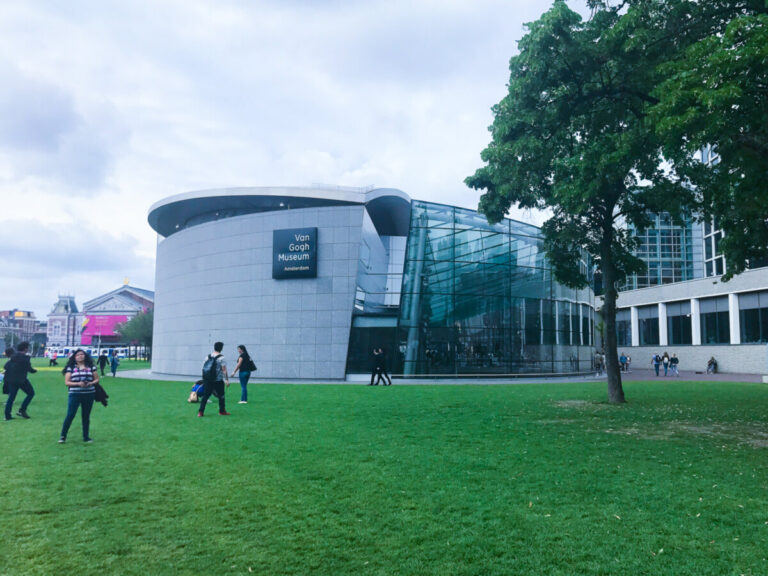
The Concertgebouw stands at the far southern end of Museumplein, opposite the Rijksmuseum and a two-minute walk from the Van Gogh Museum and Stedelijk. Nearly everyone arrives by tram.
- Tram (best option): trams 3, 5 and 12 stop at Museumplein, directly in front of the main entrance. Tram 2 stops at Van Baerlestraat, about four minutes’ walk away.
- From Centraal Station: tram 12 runs direct to Museumplein; tram 2 also serves the area via Van Baerlestraat.
- From Amsterdam Zuid: tram 5 direct to Museumplein.
- From Schiphol: train to Amsterdam Zuid (about 8 minutes), then tram 5 — faster and cheaper than a taxi.
- Metro: line 52 to Vijzelgracht, then roughly an 11-minute walk, or change to tram 3 or 12. Only worth it if you are coming from Amsterdam Noord or the far south.
- Bike: racks are available around Museumplein. Use two locks and secure the frame to a fixed object.
- Car: the venue has no parking of its own. The Museumplein Q-Park garage is the nearest option, but Amsterdam city-centre parking rates make this the most expensive way to attend by a wide margin.
Arrive early — this rule is enforced
Latecomers are not seated during a movement. You will wait in the foyer until a suitable break in the programme, which for a single-movement opener can mean missing twenty minutes. Aim to be inside 20 minutes before the start, which also gives you time to collect a drink for the interval — ordering in advance is the standard way to avoid the bar queue.
Mistakes worth avoiding
- Booking a “Concertgebouw” ticket assuming the resident orchestra is playing. Check the ensemble named on the listing.
- Choosing the cheapest choir-stall seats for a large Romantic symphony, where brass and percussion will overwhelm the strings.
- Planning a visit in July or August and expecting the free Lunchtime Concerts — they do not run then.
- Turning up for a free Lunchtime Concert without a reserved ticket. Admission still requires one.
- Assuming there is a strict dress code. There isn’t; smart-casual is entirely normal, and evening dress is the exception rather than the rule.
Pairing it with the rest of the Museum Quarter
A Wednesday lunchtime concert slots neatly between two museums: the Van Gogh Museum in the morning, the concert at 12:30, and the Rijksmuseum in the afternoon, all within a five-minute radius. Evening concerts pair better with dinner in the Oud-Zuid streets behind the hall — Van Baerlestraat and the Cornelis Schuytstraat area — which are quieter and better value than Leidseplein, ten minutes north.
Do I need to book tickets for the Concertgebouw in advance?
For paid concerts, yes — popular orchestral programmes and visiting soloists sell out weeks ahead. For the free Wednesday Lunchtime Concerts, tickets are released one week in advance with a limit of two per person and go quickly, so book the moment they open.
Are the lunchtime concerts at the Concertgebouw really free?
Yes. They run weekly at 12:30 and last about thirty minutes, and admission costs nothing. You still need to reserve a ticket online, and a small transaction fee may be charged at checkout. They do not take place in July and August.
What is the dress code at the Concertgebouw?
There is no enforced dress code. Most of the audience wears smart-casual clothing, and jeans are common at lunchtime and late-night concerts. Some people dress formally for gala or opening-night performances, but it is never required.
Which tram goes to the Concertgebouw?
Trams 3, 5 and 12 stop at Museumplein, directly outside the main entrance. Tram 2 stops at Van Baerlestraat, roughly four minutes’ walk away. From Schiphol, take the train to Amsterdam Zuid and change to tram 5.
What is the difference between the Concertgebouw and the Royal Concertgebouw Orchestra?
The Concertgebouw is the building and the organisation that programmes it, hosting more than 700 concerts a year by all kinds of performers. The Royal Concertgebouw Orchestra is a separate, independent ensemble that is resident in the hall. Buying a ticket at the venue does not automatically mean you are hearing the orchestra.
Where are the best seats in the Concertgebouw Main Hall?
The most balanced sound is generally in the centre of the stalls and the front rows of the first balcony. Seats behind or beside the orchestra are cheaper and offer a striking view of the conductor, but the balance favours brass and percussion over strings.
Can you visit the Concertgebouw without attending a concert?
The building is not open for general walk-in sightseeing, but guided tours of the halls and backstage areas are offered on selected dates and must be booked in advance. Otherwise, a free Lunchtime Concert is the simplest way to see the interior.