A place where 102,000 stolen lives are remembered by name
Along Weesperstraat, in what was once the beating heart of Amsterdam’s Jewish Quarter, stands the Netherlands’ first memorial to individually commemorate every Dutch Holocaust victim. The National Holocaust Names Memorial opened on 19 September 2021, when King Willem-Alexander and Dutch Auschwitz Committee chairman Jacques Grishaver unveiled this long-awaited tribute to the approximately 102,000 Jewish victims and 220 Roma and Sinti who perished during the Nazi occupation between 1940 and 1945.
Before the Second World War, nearly everyone who lived on this cobblestoned street was Jewish—merchants, bankers, and families who haggled at nearby Waterlooplein and worshipped at the Portuguese Synagogue. Today, the memorial transforms this anonymous modern thoroughfare back into sacred ground, where the magnitude of loss becomes tangible through individual names rather than abstract numbers.
The vision of Daniel Libeskind
Polish-American architect Daniel Libeskind designed the memorial, bringing deeply personal meaning to the commission. Born in Łódź, Poland, in 1946, Libeskind is the son of Holocaust survivors. His parents, Dora and Nachman, lost 85 family members during the genocide. This heritage has shaped his architectural career, which includes the Jewish Museum in Berlin, the World Trade Center masterplan in New York, and Holocaust memorials in Ottawa and Ohio.
“My personal connection as a child of Holocaust survivors has made it increasingly important to be a part of this significant project,” Libeskind has said. “I hope it will become a place for contemplation, hope, and an important reminder to fight hate in all its forms for the people of the Netherlands and beyond.”
The 1,550-square-metre memorial emerged from a 15-year effort by the Dutch Auschwitz Committee, which faced legal challenges from local residents before the Netherlands’ highest court ruled in 2019 that the monument’s significance outweighed neighbourhood objections. Amsterdam architectural firm Rijnboutt served as the coordinating and executive architect, translating Libeskind’s vision into built reality.
Design and symbolism
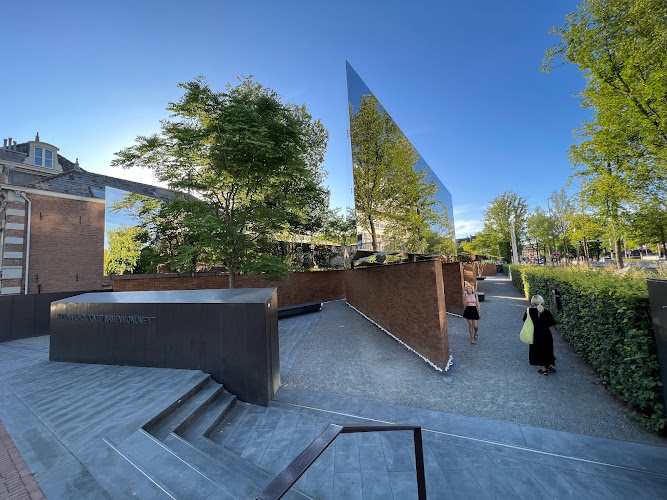
The memorial consists of four volumes crafted from mirror-finished stainless steel, hovering above zigzagging brick walls. Viewed from above, these metallic forms spell the Hebrew letters לזכר—meaning “In Memory Of.” The polished steel reflects the surrounding historic red-brick buildings, connecting Amsterdam’s past and present in a continuous dialogue of remembrance.
Below the gleaming letters, two-metre-high walls of amber and red-brown brick—materials quintessential to Dutch architecture—create a labyrinth of passages. Each of the 102,000 bricks bears the laser-engraved name, date of birth, and age at death of a victim. The inscriptions are positioned so visitors can touch each name, transforming abstract statistics into individual lives that can be physically acknowledged.
An additional 1,000 bricks remain blank, reserved for victims whose names may yet be discovered through ongoing historical research. This detail acknowledges that the full extent of loss continues to be uncovered decades later.
The memorial’s recessed position between Nieuwe Herengracht, Weesperstraat, and Nieuwe Keizersgracht creates an intimate outdoor space. As visitors walk the brick corridors, a sense of disorientation mirrors the confusion and chaos experienced by those who were taken. Simple stone blocks placed throughout the passages provide spots for contemplation and reflection.
Notable names and personal connections
Among the 102,000 names are those of Anne Frank and her sister Margot, whose bricks draw visitors seeking to pay respects to the famous diarist. Yet the memorial’s power lies equally in the unknown names—entire families erased from history, with no descendants left to remember them. The Jewish tradition of placing small stones atop the bricks has become a common gesture of honour, leaving visible traces of ongoing remembrance.
Visitors can search for specific names using QR codes located throughout the memorial. For 50 euros, individuals can also “adopt” a name, with proceeds supporting ongoing maintenance and educational programmes. Many families of survivors have found meaningful closure in locating their relatives’ bricks and finally having a place to grieve.
The Netherlands’ tragic history
The memorial stands as a stark reminder of a devastating chapter in Dutch history. Of the 140,000 Jews living in the Netherlands in 1940, approximately 102,000 did not survive the war—a loss rate of roughly 75%, the highest percentage of any Western European country. Most were deported via the Westerbork transit camp to extermination centres at Auschwitz-Birkenau, Sobibor, and other death camps. Others died from illness, hunger, exhaustion, or slave labour.
This staggering toll resulted from a combination of factors: efficient Nazi occupation administration, comprehensive population registration that made identification easy, the flat geography that offered few hiding places, and varying degrees of collaboration and indifference among the Dutch population. The memorial confronts this history directly, situated in the very neighbourhood from which so many were taken.
Location within the Jewish Cultural Quarter
The memorial occupies a thoughtfully chosen site adjacent to the H’ART Museum (formerly the Hermitage Amsterdam) and the verdant Hoftuin garden. It sits within walking distance of Amsterdam’s major Jewish heritage sites, creating opportunities for deeper exploration of this history.
Nearby attractions include:
The Jewish Museum on Nieuwe Amstelstraat, which traces Jewish life in the Netherlands from 1600 to the present through art, artefacts, and personal stories. The museum includes the Jewish Museum Junior, designed specifically for younger visitors.
The Portuguese Synagogue on Mr. Visserplein, a magnificent 17th-century structure that remains one of Europe’s largest synagogues. Built by Sephardic Jews who fled the Spanish and Portuguese Inquisitions, it still conducts services by candlelight.
The National Holocaust Museum on Plantage Middenlaan, which opened in March 2024 in a former teacher training college. During the war, hundreds of Jewish children were smuggled from the adjacent daycare to safety through this building—the spot where their rescue began.
The Hollandsche Schouwburg, a former theatre that the Nazis used as a deportation centre where tens of thousands of Jews were assembled before transport to camps. Now a memorial with free entry, it includes exhibitions documenting Jewish life under occupation.
The Auschwitz Monument by artist Jan Wolkers in nearby Wertheim Park, consisting of six broken glass mirrors placed atop ashes from Auschwitz.
Planning your visit
The National Holocaust Names Memorial is an outdoor space freely accessible to the public. While there are no admission fees or timed entry requirements, the site’s significance calls for respectful behaviour. Photography is permitted but should be conducted thoughtfully, with awareness that this remains an active place of mourning for families and survivors.
Time to allow: Most visitors spend between 30 minutes and two hours at the memorial, depending on whether they search for specific names. If combined with the nearby Jewish Cultural Quarter attractions, a full day provides a comprehensive understanding of Amsterdam’s Jewish heritage.
What to bring: The memorial offers no shelter from weather, so appropriate clothing for rain or sun is advisable. Many visitors find the experience emotionally demanding—tissues and water are practical considerations. Small stones to place on bricks, following Jewish mourning tradition, are a meaningful gesture.
Accessibility: The memorial is wheelchair accessible when approached from the Nieuwe Herengracht entrance, north of the H’ART Museum, which avoids the stairs on the Weesperstraat side.
Getting there
- By metro: Lines 51, 53, and 54 stop at Waterlooplein station. Exit via Nieuwe Amstelstraat and walk approximately three minutes to the memorial. From Amsterdam Centraal, the journey takes just two minutes.
- By tram: Tram 14 stops at Waterlooplein, within a short walk of the memorial. Alternatively, alight at Mr. Visserplein for direct access to the Portuguese Synagogue before continuing to the memorial.
- On foot: From Dam Square, the walk takes approximately 15-20 minutes through the historic centre. The route passes the Rembrandthuis and crosses several picturesque canals—a journey that provides context for the neighbourhood’s transformation.
- By bicycle: Bicycle racks are available along Weesperstraat and near the H’ART Museum. Lock your bicycle securely, as theft remains common in Amsterdam.
- By car: Driving is not recommended. Parking in central Amsterdam is expensive and difficult. If necessary, the Markenhoven, ParkKing Waterlooplein, or Stadhuis-Muziektheater underground garages are nearby.
Commemorative events
The memorial serves as a gathering point for remembrance throughout the year. International Holocaust Remembrance Day on 27 January and Yom HaShoah (Holocaust Remembrance Day in the Jewish calendar, typically in April or May) bring ceremonies and commemorations that deepen understanding of the memorial’s significance.
Around 4 and 5 May, the Netherlands’ National Remembrance Day and Liberation Day, the Jewish Cultural Quarter organises “Open Jewish Houses”—intimate gatherings in homes, shops, and schools where Jews once lived and worked, where current residents share memories of former inhabitants.
A lasting warning
As Jacques Grishaver stated at the unveiling: “This monument gives the victims back their names 76 years after the end of the war and proves they lived.” Dutch Prime Minister Mark Rutte added: “No, we will not forget you. No, we will not allow your names to be erased. No, evil does not have the last word.”
The National Holocaust Names Memorial stands as both a place of mourning and a permanent warning about the consequences of racism and discrimination. In the labyrinth of brick walls, each name recovered from anonymity insists that these were not statistics but individuals—children, parents, grandparents, neighbours—whose lives were violently stolen.
For Amsterdam, a city that lost so much of its Jewish population, this memorial finally provides a physical space where that loss is made visible, touchable, and impossible to forget.
Frequently asked questions
How many names are on the Holocaust Names Memorial? The memorial bears approximately 102,000 names of Jewish victims and 220 names of Roma and Sinti victims from the Netherlands who were murdered during the Holocaust. An additional 1,000 blank bricks are reserved for names that may be discovered through future research.
Is the National Holocaust Names Memorial free to visit? Yes. The outdoor memorial has no entrance fee and is freely accessible to the public.
Can I search for specific names at the memorial? Yes. QR codes throughout the memorial allow visitors to search for specific names. The official website also maintains a searchable database.
What other Holocaust memorials exist in Amsterdam? Amsterdam has several significant Holocaust sites, including the Hollandsche Schouwburg (a former deportation centre), the National Holocaust Museum, the Auschwitz Monument in Wertheim Park, the Anne Frank House, and numerous Stolpersteine (brass memorial plaques embedded in sidewalks at former Jewish residences).
Who designed the National Holocaust Names Memorial? Polish-American architect Daniel Libeskind, working with Amsterdam firm Rijnboutt. Libeskind, the son of Holocaust survivors, is renowned for the Jewish Museum Berlin and the World Trade Center masterplan in New York.
When was the memorial unveiled? King Willem-Alexander unveiled the memorial on 19 September 2021, alongside Jacques Grishaver, chairman of the Dutch Auschwitz Committee, in the presence of survivors and their descendants.
Address: Weesperstraat, Amsterdam (between Nieuwe Herengracht and Nieuwe Keizersgracht)
Nearest transport: Waterlooplein metro station (lines 51, 53, 54); Waterlooplein or Mr. Visserplein tram stops (tram 14)
Cost: Free
Website: holocaustnamenmonument.nl