Just a 25-minute journey from Amsterdam’s center, the Cobra Museum of Modern Art in Amstelveen stands as a powerful testament to one of Europe’s most explosive artistic movements. Opened on November 8, 1995—deliberately echoing the Cobra movement’s founding date in 1948—this striking museum designed by architect Wim Quist preserves and celebrates the raw energy of artists who dared to reimagine art after World War II’s devastation.
The Birth of Rebellion: CoBrA’s Origins
In November 1948, a group of artists from Copenhagen, Brussels, and Amsterdam gathered to sign a manifesto that would shake the European art world. The CoBrA movement—its name derived from the first letters of these three cities—emerged from the rubble of war with a revolutionary vision: art should be spontaneous, experimental, and free from academic constraints.
Though the movement officially lasted only until 1951, its impact reverberates through contemporary art. The Cobra artists rejected the intellectualism of Surrealism and the rigid geometry of Constructivism, instead embracing childlike spontaneity, primitive forms, and explosive color. They sought to tap into humanity’s collective unconscious, creating art that was both deeply personal and universally resonant.
Karel Appel’s Living Legacy
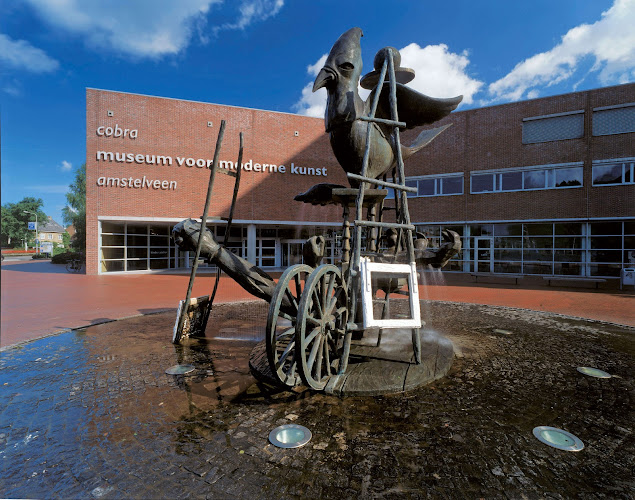
Before entering the museum, visitors encounter Karel Appel’s monumental work “The Fountain”—a five-meter-high sculpture that embodies Cobra’s exuberant spirit. This unique piece, the only fountain Appel ever created, features four water outlets integrated into a colorful, dynamic form that seems to dance despite its massive scale. It serves as a perfect introduction to the energy awaiting inside.
Within the museum, Appel’s paintings explode with color and emotion. His thick impasto technique creates tactile surfaces where paint becomes sculpture, while his subjects—often childlike figures and animals—convey both playfulness and underlying darkness. Appel famously declared, “I paint like a barbarian in a barbarous age,” and his works in the collection demonstrate this raw, unfiltered approach to creation.
Constant’s Visionary Worlds
Constant Nieuwenhuys, known simply as Constant, brings a different dimension to the Cobra collection. While sharing the movement’s spontaneous approach, Constant’s work often explores architectural and spatial concepts. His paintings create imaginary landscapes and cities that seem to float between dream and reality, anticipating his later New Babylon project—a utopian vision of future society.
The museum’s Constant holdings trace his evolution from early Cobra experiments to more complex compositions that blur boundaries between painting, architecture, and social commentary. His use of color remains vibrant throughout, but his forms grow increasingly sophisticated, revealing an artist constantly pushing boundaries.
A Living Collection
The Cobra Museum’s collection extends beyond its namesake movement, encompassing works from related groups like Vrij Beelden (1945) and Creatie (1950-1955). This broader scope reveals how Cobra emerged from and influenced Dutch experimental art, creating a comprehensive narrative of post-war artistic rebellion.
Masterpieces by Corneille, with his bird-filled paradise paintings, and Asger Jorn, whose Nordic mythology meets abstract expressionism, complement works by Lucebert, who brought poetry into visual form. The collection rotates regularly, ensuring repeat visitors always discover new perspectives on familiar artists.
Wim Quist’s Architectural Canvas
The museum building itself deserves recognition as a work of art. Architect Wim Quist created a space that honors Cobra’s spirit while providing optimal viewing conditions. Natural light floods gallery spaces through carefully positioned skylights, while the building’s clean lines create a neutral backdrop that allows the explosive artwork to dominate.
The layout encourages both focused contemplation and dynamic movement between galleries, mirroring the tension between chaos and control that characterizes Cobra art. Intimate spaces for smaller works alternate with grand galleries where large canvases can breathe, creating a rhythm that enhances the viewing experience.
Contemporary Dialogues
While rooted in historical preservation, the Cobra Museum actively engages with contemporary art through rotating exhibitions. These shows often pair Cobra works with contemporary artists who share similar concerns or approaches, demonstrating the movement’s ongoing relevance. International artists inspired by Cobra’s spontaneity and social engagement find their work contextualized within this historical framework.
Educational programs bring Cobra’s experimental spirit to new generations. Workshops encourage visitors to embrace spontaneous creation, while lectures and symposiums explore the movement’s political dimensions and its critique of post-war European society.
Beyond the Canvas
The museum shop offers an exceptional selection of Cobra-related publications, from scholarly monographs to accessible introductions. Reproductions allow visitors to take home the movement’s explosive energy, while the café provides a space for reflection with views over Amstelveen’s modern landscape—a fitting contrast to the primitive power of the art within.
Amstelveen’s Cultural Anchor
The museum’s location in Amstelveen, rather than central Amsterdam, reflects the Netherlands’ commitment to cultural decentralization. This suburban setting, easily accessible by public transport, brings world-class art to a residential community while offering visitors a different perspective on Dutch cultural life beyond Amsterdam’s tourist center.
The surrounding area has developed into a cultural quarter, with the museum anchoring Amstelveen’s identity as more than just Amsterdam’s suburb. Local pride in hosting this internationally significant collection manifests in community engagement and support for the museum’s programs.
A Continuing Revolution
More than 75 years after Cobra’s founding, the movement’s call for spontaneous, authentic expression resonates powerfully. In our digital age of filtered images and curated personas, Cobra’s raw honesty feels revolutionary anew. The museum ensures this spirit remains accessible, challenging each visitor to embrace their own creative instincts.
For art lovers, the Cobra Museum offers essential insight into a movement that bridged European modernism and contemporary art. For casual visitors, it provides an accessible entry point into experimental art, where emotional impact matters more than academic knowledge. In preserving Cobra’s legacy while encouraging contemporary dialogue, the museum fulfills its founders’ vision: keeping the movement’s rebellious spirit alive for future generations to discover, interpret, and continue.