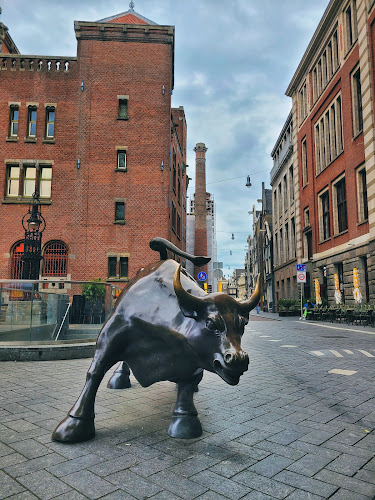
Beursplein is a small, free, always-open public square in Amsterdam’s Centrum district, sitting between Damrak and Rokin about a 10-minute walk south of Amsterdam Centraal Station. Two exchange buildings face it: the red-brick Beurs van Berlage of 1903, now an exhibition and events venue, and Beursplein 5 of 1913, still the home of Euronext Amsterdam. The bronze bull outside Beursplein 5 is a Charging Bull by Arturo Di Modica, placed on the square in 2012. Underneath your feet is a municipal bicycle garage with room for 1,700 bikes, free for the first 24 hours. There is no ticket, no gate and no opening time for the square itself.
Beursplein Amsterdam at a glance
| What it is | Public square in Amsterdam-Centrum, between Damrak and Rokin |
| Name | Dutch for Exchange Square (beurs = exchange, plein = square) |
| Cost and hours | Free, open 24 hours, no ticket |
| Landmarks on the square | Beurs van Berlage (1903), Beursplein 5 / Euronext (1913), Di Modica’s Charging Bull (2012) |
| Nearest tram | Dam, served by lines 4, 14 and 24 on the Rokin side |
| Nearest metro | Rokin, line 52 (North/South line) |
| From Centraal Station | About 10 minutes on foot, straight down the Damrak |
| Bicycle parking | Underground municipal garage, 1,700 places, free for 24 hours |
| Time needed | 10 to 15 minutes for the square; 1 to 2 hours with an exhibition or a café stop |
| Best time | Before 09:00 on a weekday, when the square belongs to commuters |
Why is Beursplein worth stopping for?
Beursplein is where Amsterdam’s claim to have invented the stock market is written into the buildings. Shares in the Dutch East India Company (VOC) began changing hands in 1602, at first out in the open on the Nieuwe Brug over the Damrak, with traders sheltering in the Sint Olofskapel when the weather turned. The city commissioned Hendrick de Keyser to build a proper exchange on the Rokin in 1611. That building sank and was demolished in 1835, a replacement by Jan David Zocher opened in 1845, and Berlage’s exchange followed in 1903. Every one of those four locations sits within a few hundred metres of where you are standing.
Most visitors walk across the square on the way from Centraal Station to Dam Square without noticing any of it. Ten minutes and a short explanation change that.
Which building is which? Beurs van Berlage vs Beursplein 5
This is the single most common mix-up on the square, and most guides get it wrong. The Beurs van Berlage and Beursplein 5 are two separate exchange buildings from two different decades, and the stock market has been in the second one since 1913.
| Beurs van Berlage | Beursplein 5 | |
|---|---|---|
| Opened | 1903 | Opened 22 December 1913; trading began 2 January 1914 |
| Architect | Hendrik Petrus Berlage | Jos. Th. J. Cuypers |
| Built for | All Amsterdam trade under one roof, including commodities and securities | Securities trading only, after traders outgrew Berlage’s floor |
| Today | Exhibitions, concerts, conferences, cafés | Head office of Euronext Amsterdam; the trading bell still rings here |
| Can you go in? | Yes, for exhibitions and events, and for the cafés | Only on a booked Amsterdam Exchange Experience tour |
| How to spot it | Long red-brick front with the 40 m clock tower | Lighter stone front behind the Charging Bull |
Berlage broke with the ornamental style of his contemporaries and used sober brick, exposed structure and restrained decoration, an approach that fed straight into the Amsterdam School. He also treated the building as a Gesamtkunstwerk, a single work of art combining architecture, sculpture and poetry, and worked with the poet Albert Verwey on the inscriptions and decorative programme.
Look up at the clock tower, roughly 40 metres (131 feet) high, and the tower carries a different line on each side. Arriving from Centraal Station you read Duur uw uur, use your hour. Coming from the city you read Beidt uw tijd, wait your time. Both lines come from a poem Verwey wrote for the tower, and almost nobody on the square looks up long enough to find them.
Berlage, a socialist, hoped his exchange would one day become a people’s palace open to everyone rather than a trading floor. It largely has: the building now works as a cultural and event venue, with exhibitions typically open daily from 10:00 to 18:00 and Bistro Berlage keeping a terrace on the Beursplein side. Admission depends on which exhibition is running, so check the current programme before you plan around it.
Who put the Charging Bull on Beursplein, and is there a bear?
The bronze bull outside Beursplein 5 is the work of Italian-American sculptor Arturo Di Modica (1941 to 2021), and he installed it on the square without permission in 2012. It is a replica of the Charging Bull he placed outside the New York Stock Exchange, also unannounced, in 1989. Amsterdam was a deliberate choice: the exchange belonged to the transatlantic NYSE Euronext group at the time, and Di Modica wanted to send the same message he had sent in New York after Black Monday, which was to stay optimistic through a bad market year.
The bull broke a leg at the end of 2019 and spent time away being repaired before returning to its place at the exchange entrance. A bull and a bear are the standard pairing in stock-market imagery, the bull tossing prices up with its horns and the bear dragging them down with its claws, but the sculpture on Beursplein is a bull on its own. Amsterdam’s older exchange emblem was not a bull at all: it was Mercury, who stood for balanced prices and a steady market rather than a rising one.
What changed when the square was rebuilt?
The Beursplein you walk across is a reconstruction, and the reason is buried underneath it. To build the underground bicycle garage, the square had to be excavated, and the 21 mature trees standing on it could not be saved because their roots ran as far as 12 metres from the trunks. Rather than replace the square with something contemporary, the city rebuilt it from Berlage’s own 1898 design for the space in front of his exchange.
Fifteen trees went back in: eight trees of heaven on the square itself and seven elms along the Damrak. Two natural-stone fountains, originally drinking troughs for horses, were restored, along with six monumental cast-iron lanterns. The bull went back to its spot. If the square looks older than the paving under it, that is why.
The square itself is comparatively young. Beursplein was created in the late nineteenth century when part of the Damrak, the original mouth of the Amstel, was filled in to make room for the new exchange. The ground you stand on used to be water.
Can you go inside the Amsterdam stock exchange?
Yes, but only on a booked guided tour, and it is set up for groups rather than individual walk-ins. Euronext runs the Amsterdam Exchange Experience inside Beursplein 5, an interactive visit that covers the history of the exchange, how share trading developed, how a company lists, and what the indices mean, and it includes the trading floor itself.
- Length: roughly 60 to 75 minutes
- Price: €250 per group, not per person
- Group size: designed around school groups, with a maximum of 25 to 30 students and one adult supervisor per 15 pupils
- Language: Dutch, with English tours listed from September 2026
- Facilities: cloakroom with individual lockers; wheelchair access can be arranged on request
- Booking: through Euronext’s Amsterdam Exchange Experience booking tool
If you are visiting as a couple or a family, the realistic option is the Beurs van Berlage instead: walk into the exhibition space or the café, and you are inside the building that made Berlage’s name.
How do you get to Beursplein?
Walking is usually fastest. From Amsterdam Centraal the route is a straight line south down the Damrak, about 10 minutes on foot, and Beursplein opens on your left before you reach Dam Square. By tram, the nearest stop is Dam: lines 4, 14 and 24 use the Rokin side of the stop, and lines 2, 12, 13 and 17 use the Nieuwezijds Voorburgwal side, which is a slightly longer walk back. By metro, take line 52 to Rokin, a few hundred metres south of the square.
For fares, tap in and out with a contactless bank card or phone using OVpay, or buy a GVB ticket if you plan to ride a lot in one stretch. GVB 2026 prices for unlimited travel on trams, buses and the metro:
| GVB ticket | Price (2026) | Worth it if |
|---|---|---|
| 24 hours | €10.00 | You make roughly four or more journeys in a day |
| 48 hours | €16.00 | Two full sightseeing days on public transport |
| 72 hours | €21.50 | A long weekend without a bicycle |
| 96 hours | €27.50 | Four days, staying outside the centre |
| Pay as you go | Per journey | You are mostly walking, which in this part of town you will be |
Contactless tapping is the simplest option for most visitors, and our OVpay guide covers how it works, what it costs and the daily cap.
Arriving by bicycle
Beursplein has one of the better bike parking situations in the centre, because the garage is directly under the square. It is a City of Amsterdam facility with space for 1,700 bicycles, free for the first 24 hours, with the main entrance on the Damrak side to the south-west of the square and a pedestrian link through to the Beurs and De Bijenkorf. The stairs have heated bicycle gutters so wheels do not slip in freezing weather.
Use the garage rather than the racks at street level. Bicycle theft is a genuine problem across the centre, a locked frame plus a chain through something fixed is the standard local precaution, and anything left on the street overnight in this area is a gamble.
What is worth seeing within a 10-minute walk?
Beursplein is a stop rather than a destination, so it works best as the start of a short loop. Everything below is within about 10 minutes on foot.
| Place | Where | Why go |
|---|---|---|
| Tony’s Chocolonely Super Store | Oudebrugsteeg 15, in the Beurs van Berlage | Make your own bar in the building where Amsterdam’s cocoa trade sat; open 10:00 to 21:00 |
| Beurs van Berlage | On the square | Exhibitions, the clock tower inscriptions, Bistro Berlage’s terrace |
| De Bijenkorf | Dam side of the Damrak | Upper-floor windows give an elevated view over Beursplein and the rooftops |
| Dam Square | 300 m south-west | Royal Palace, Nieuwe Kerk, the National Monument |
| Oude Kerk | 350 m east | Amsterdam’s oldest building, now also a contemporary art space |
| Begijnhof | About 800 m south | Enclosed courtyard with Het Houten Huis, one of the city’s oldest wooden houses |
| Haesje Claes | Spuistraat 273 to 275 | Traditional Dutch cooking across six linked historic houses; kitchen 12:00 to 22:00 |
| Dwaze Zaken | Prins Hendrikkade 50 | Long-running social-enterprise café near the station; Wednesday to Monday 10:00 to 21:30, closed Tuesdays |
The Begijnhof is still residential, so keep your voice down inside. Het Houten Huis dates from around 1528 rather than the 1400s often quoted, a correction that also matters for the rest of the city’s crooked and leaning houses.
When is the best time to visit Beursplein?
Weekday mornings before 09:00, when the square is still doing its day job. Commuters cut across it, the cafés are setting up, and the low light hits the brick front of the Beurs van Berlage from the Damrak side. By midday it turns into a thoroughfare between Centraal Station and Dam Square and the experience flattens out.
| Season | What it is like |
|---|---|
| Spring (March to May) | The trees on the square and the elms along the Damrak come into leaf; mild days, terrace weather returns |
| Summer (June to August) | Busiest, with street performers and the heaviest foot traffic between the station and Dam |
| Autumn (September to November) | Fewer visitors, softer light, the best balance of weather and quiet |
| Winter (December to February) | Cold and damp, but the shortest queues everywhere nearby; expect single-digit °C (roughly 35 to 45 °F) |
One date to plan around or avoid: King’s Day on 27 April, when this whole stretch of the centre turns into an orange street party and moving through the area takes several times longer than usual.
Frequently asked questions about Beursplein
What is Beursplein in Amsterdam?
Beursplein is a public square in Amsterdam-Centrum between Damrak and Rokin. The name is Dutch for Exchange Square. Two exchange buildings stand on it: the Beurs van Berlage of 1903, now an exhibition and events venue, and Beursplein 5 of 1913, which is still the home of Euronext Amsterdam. The square is free and open at all hours.
Who made the bull statue on Beursplein?
The bronze Charging Bull outside Beursplein 5 was made by the Italian-American sculptor Arturo Di Modica and placed on the square without permission in 2012. It is a replica of the bull he installed outside the New York Stock Exchange in 1989. It broke a leg in late 2019 and returned to the square after repair. There is no matching bear sculpture.
Is the Beurs van Berlage the same as the Amsterdam stock exchange?
Not any more. Berlage designed his exchange for all Amsterdam trade and it opened in 1903, but securities traders outgrew the floor within a decade. They moved to a purpose-built securities exchange at Beursplein 5, designed by Jos. Th. J. Cuypers, which opened on 22 December 1913 with trading starting on 2 January 1914. Euronext still occupies that building.
Can you visit the trading floor at Beursplein 5?
Only on a booked tour. Euronext runs the Amsterdam Exchange Experience inside Beursplein 5, lasting about 60 to 75 minutes and including the trading floor. It is priced per group at 250 euro rather than per person and is built around school groups of up to 25 to 30 students. Tours run in Dutch, with English listed from September 2026.
How do you get to Beursplein by public transport?
Walk about 10 minutes south from Amsterdam Centraal down the Damrak, or take tram 4, 14 or 24 to the Dam stop on the Rokin side, or metro line 52 to Rokin station. A GVB 24-hour ticket costs 10 euro in 2026, with 48 hours at 16 euro and 72 hours at 21.50 euro, or you can tap in and out with a contactless card using OVpay.
Where can you park a bicycle at Beursplein?
In the City of Amsterdam bicycle garage directly under the square, which holds 1,700 bikes and is free for the first 24 hours. The main entrance is on the Damrak side, to the south-west of the square, and a passage links it to the Beurs and De Bijenkorf. The access stairs have heated bicycle gutters for icy weather.
Last updated: July 2026, and what we corrected
This page was rechecked against primary sources in July 2026, and several long-standing errors came out of it. The bull is not part of a bull-and-bear pair installed in 1998 for a Euronext anniversary, as this page and many others have claimed; it is Arturo Di Modica’s Charging Bull, placed on the square in 2012, and Euronext did not exist under that name until 2000. The Beurs van Berlage was not the stock exchange until 1998 either: securities trading left it in 1913 for Beursplein 5. GVB ticket prices were stale and have been replaced with 2026 figures. The underground bicycle garage is a City of Amsterdam facility under the square with its entrance on the Damrak, not a De Bijenkorf garage entered from Warmoesstraat.
We also removed claims we could not verify, including a specific bicycle-theft percentage, a fixed price and timetable for public tours of the Beurs van Berlage, and a list of city-centre bus routes that no longer serve this stop. Sources used: Euronext and the Amsterdam Exchange Experience, the Beurs van Berlage, the Dutch exchange-history archive Beursgeschiedenis, GVB fare pages, the City of Amsterdam, and the architects behind the Beursplein bicycle garage. Opening hours and prices change, so confirm anything time-critical before you travel.