The Zuiderkerkhofpoortje is a small early-17th-century stone gate on Sint Antoniesbreestraat that once led into the churchyard of the Zuiderkerk. Look up at the arch and you’ll see carved skulls, bones and a draped coffin, which still tell you what used to lie behind it. The gate is outdoors and free to see. It also works as a shortcut from the street into the Zuiderkerkhof, the quiet square around the church.
| What it is | Former entrance gate to the Zuiderkerk churchyard (Zuiderkerkhof) |
| Where | Sint Antoniesbreestraat, opposite Huis De Pinto, between Nieuwmarkt and Waterlooplein |
| Age | Early 17th century; the churchyard took its first burial in 1602 |
| Attributed to | Nicholas Stone, pupil and son-in-law of city architect Hendrick de Keyser |
| Look for | Skulls and bones above a coffin draped with a pall and two shields, under a broken pediment |
| Cost | Free, open-air |
| Nearest metro | Nieuwmarkt (lines 51, 53 and 54) |
| Time needed | 5 to 10 minutes, longer if you continue to the Zuiderkerk |
What the name means
Zuiderkerkhof means “South Church churchyard,” and poortje means “little gate.” Put together, the name describes the gate exactly: the small entrance to the burial ground of the Zuiderkerk (South Church). The square behind the gate is still called the Zuiderkerkhof, although the graves are long gone.
History of the gate
The churchyard came before the church. The city needed burial space for its fast-growing population, so the first burial took place here in June 1602. Building work on the Zuiderkerk began the following year, and the church was finished in 1611 to a design by Hendrick de Keyser. It was the first church in Amsterdam built for Protestant worship, and De Keyser himself is buried inside.
The churchyard had two entrances, one on Zandstraat and one on Sint Antoniesbreestraat. The Sint Antoniesbreestraat gate is usually attributed to Nicholas Stone, an English sculptor who trained under De Keyser and married his daughter Maaike in 1613. Until 1640, everyone who died east of the Rokin was buried here. The city closed all its inner-city burial grounds in 1866, and after the Zuiderkerkhof was cleared, the Zandstraat entrance disappeared. The Sint Antoniesbreestraat gate stayed.
The gate has also moved. It was put into storage during the Second World War. Around 1977 the area was cleared for the construction of the Amsterdam metro. When that work finished in 1985, the gate went back up, but not in quite its original position, and it now stands among modern buildings. The housing block along this stretch of Sint Antoniesbreestraat sits directly above the metro tunnel.
What to look for
Most people walk past without looking up. Stop at the gate and check the area just above the opening, under the broken pediment. There you’ll find a carved coffin covered with a pall (the cloth used to cover a coffin) with two shields on it, and above that a pile of skulls and bones. It was a very direct way of labelling a cemetery entrance in the 1600s, and a reminder to passers-by that they would die too.
Once you’ve looked at the street side, walk through and turn around. There are skulls on the back of the gate as well, and many people who use it as a shortcut never notice them.
Ghost-walk guides sometimes say the skulls belonged to hanged criminals and were put up as a warning. That’s a good story for a night tour, but the skulls you can see are carved stone, made to fit the gate’s role as the entrance to a burial ground.
One correction to a common description: the gate does not show the Amsterdam coat of arms. The city’s three crosses under the imperial crown appear on the Leprozenpoort, a similar gate a few minutes away at Sint Antoniessluis. The Leprozenpoort also came from De Keyser’s workshop and may be by Stone too, which is why the two gates are easy to mix up.
Seen from Sint Antoniesbreestraat, the arch frames the Zuiderkerk tower rising behind it. That view is the classic photo here. On the other side of the gate, the Zuiderkerkhof is a traffic-free square with homes, the Zuiderkerk and a water-curtain fountain, which makes it a quieter place to stop than the busy shopping street.
How to get there
The gate is on Sint Antoniesbreestraat, the street that links Nieuwmarkt with Waterlooplein, and stands opposite Huis De Pinto, a merchant’s house. It’s in Amsterdam’s old centre, a few minutes’ walk from the Waag on Nieuwmarkt square.
- By metro: take line 51, 53 or 54 to Nieuwmarkt. From the square, walk south along Sint Antoniesbreestraat. The gate is on your right after a few minutes.
- From Waterlooplein: walk north along Sint Antoniesbreestraat. The gate is on your left, opposite Huis De Pinto.
- On foot from Amsterdam Centraal: allow roughly 15 to 20 minutes, heading towards Nieuwmarkt first.
- By bike: the area is easy to cycle, but cross tram tracks at a sharp angle so your wheel doesn’t get caught, and don’t ride through the gate when it’s busy with people on foot.
When to visit
There are no opening hours, so you can pass by whenever it suits your walk. For photos, early morning and early evening are good choices: the street is quieter, and low, soft light brings out the relief in the carvings better than harsh midday sun. Bring a rain jacket, since Amsterdam weather changes quickly and there’s no shelter at the gate.
If you also want to climb the Zuiderkerk tower, go in the warmer months. Guided tower climbs only run seasonally, roughly from spring to autumn, and the schedule changes from year to year, so check the current times before you plan around them.
What’s nearby
The gate takes a few minutes to see, and it sits in one of the best walking areas in the centre. These stops are all within about ten minutes on foot.
- Zuiderkerk: the church through the gate no longer holds services and is used for events and exhibitions. The guided tower climbs start from the Zandstraat side and reach an outdoor platform at about 35 metres.
- Staalmeestersbrug: the small bridge over the Groenburgwal with the Zuiderkerk view that Claude Monet painted around 1874.
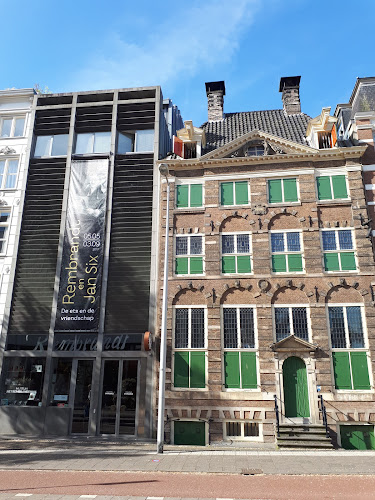
- Rembrandt House Museum: the painter’s former home and studio at Jodenbreestraat 4, a short walk south.
- Waterlooplein: home to the Netherlands’ oldest flea market, open Monday to Saturday from 9:30 to 18:00.
- Leprozenpoort: the related 17th-century gate at Sint Antoniessluis, carved with figures of lepers and topped with the Amsterdam coat of arms.
For more of the neighbourhood, see our Nieuwmarkt neighbourhood guide, or compare this gate with other sites on our list of historical landmarks in Amsterdam. If small details like this are what you enjoy, our off-the-beaten-path Amsterdam attractions guide has more like it.
Frequently asked questions
Is it free to visit the Zuiderkerkhofpoortje?
Yes. The gate stands outdoors on Sint Antoniesbreestraat and leads to the public Zuiderkerkhof square, so there is no ticket and no opening time.
Why are there skulls on the Zuiderkerkhofpoortje?
The gate was the entrance to the Zuiderkerk churchyard, where burials began in 1602. The carved skulls, bones and draped coffin marked it as a cemetery gate and reminded passers-by of death.
Are there still graves at the Zuiderkerkhof?
No. The churchyard closed in 1866 along with Amsterdam’s other inner-city burial grounds and was later cleared. The Zuiderkerkhof is now a square with homes around the church, although Hendrick de Keyser is still buried inside the Zuiderkerk.
Can you climb the Zuiderkerk tower?
Yes, but only on seasonal guided tours, roughly from spring to autumn. Tours start from the Zandstraat side and reach an outdoor platform at about 35 metres. Schedules change, so check current times before you go.