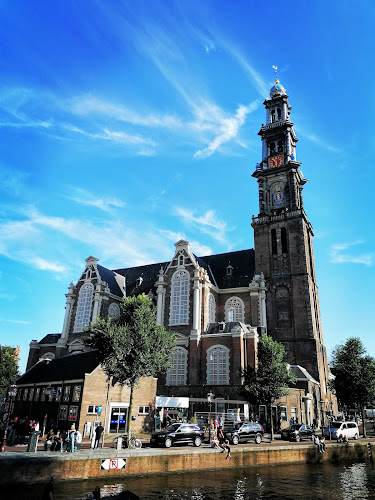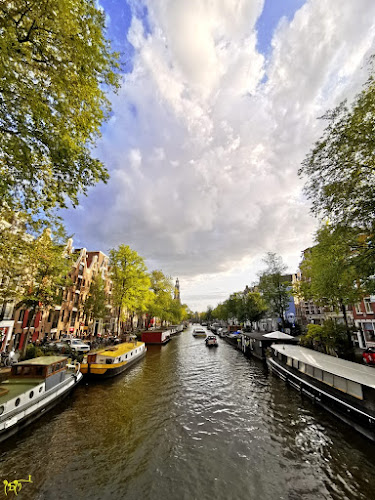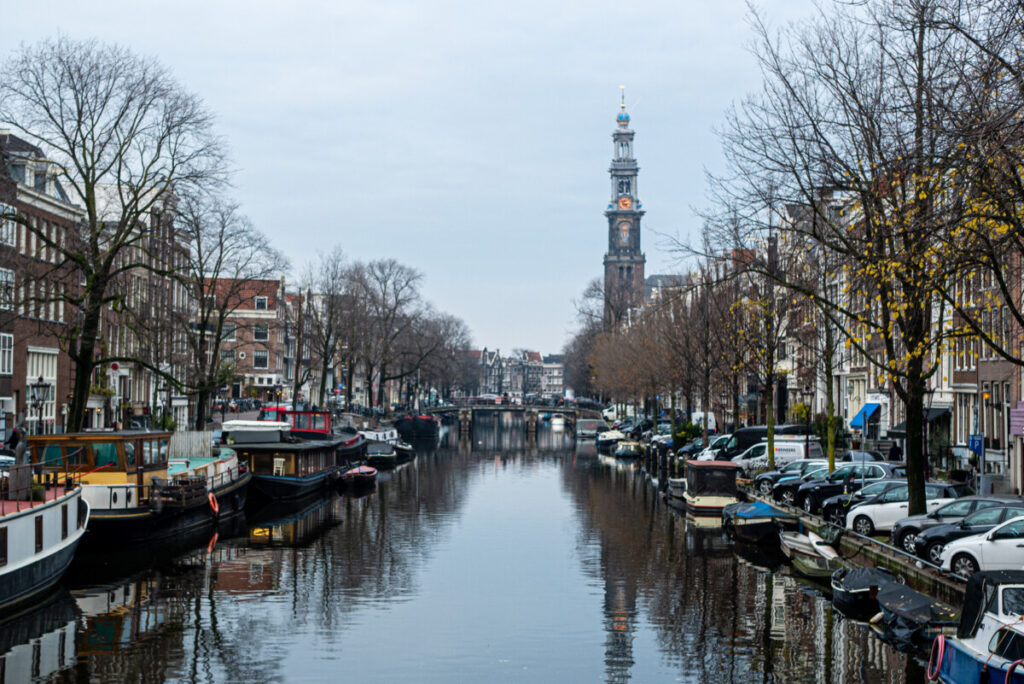
The Westertoren is the tower of the Westerkerk on the Prinsengracht and the tallest church tower in Amsterdam: 85 meters, or 87 meters including the weathervane. Completed in 1638 and topped by a blue imperial crown, it holds the heaviest bell in the city, a carillon that marks every quarter hour day and night, and the clock Anne Frank could hear from her hiding place around the corner. The church is free to visit on weekdays, but the tower climb is closed until further notice.
For people in the Jordaan, the tower is simply the Ouwe Wester (Old Wester), and its bells have set the rhythm of the neighborhood for close to 400 years.
Westertoren at a glance
| Detail | Information |
|---|---|
| Location | Westerkerk, Prinsengracht 279-281, on the Westermarkt, Amsterdam-Centrum |
| Height | 85 m (87 m including the weathervane) |
| Completed | 1638 (the crowned spire is dated 1637) |
| Architects | Designed by Hendrick de Keyser; completed under Pieter de Keyser and Cornelis Danckerts de Rij |
| Owner | City of Amsterdam (the tower), separate from the church |
| Carillon | 51 bells; the 14 heaviest cast by François Hemony in 1658 |
| Heaviest bell | Hour bell, 7,509 kg, cast by Assuerus Koster in 1636 |
| Live carillon recital | Usually Tuesdays, 12:00-13:00 |
| Tower climb | Closed until further notice |
| Church entry | Free, usually Monday to Friday, 11:00-15:00 |
How the Westertoren was built
The city government commissioned the Westerkerk from its master builder Hendrick de Keyser, and the church went up between 1620 and 1631 in Dutch Renaissance style. It was one of the first churches in Amsterdam built specifically for Protestant worship, and it remains the largest church in the Netherlands built for Protestants. The church opened on Pentecost Sunday, 8 June 1631.
De Keyser never saw it finished. He died in 1621, about a year after construction began, and the work was completed under his son Pieter de Keyser and city mason Cornelis Danckerts de Rij. The tower followed in 1638. Its brick base supports three lanterns that get smaller as they rise: the first in sandstone, the top two in wood clad with lead.
Who designed the spire you see today is not known. De Keyser’s drawings show an octagonal lantern that was never built, and the current form is often linked to Jacob van Campen, who was involved when the tower was completed.
The church below is worth a visit in its own right. Rembrandt was buried there on 8 October 1669, although the exact location of his grave is lost. Our guide to the Westerkerk covers the interior, the organs and the Rembrandt memorial.
The imperial crown on top
The crown on the spire refers to Amsterdam’s coat of arms. In 1489, Maximilian of Austria gave the city the right to place a crown in its arms, as thanks for its support during the Hook and Cod wars. He was not crowned emperor until 1508, so the crown was a heraldic privilege rather than a gift of an actual crown. The version on the tower is modeled on the Rudolfine imperial crown.
Its color has changed over time. For the Rembrandt year of 1906, the crown was painted golden yellow. During the 2006 restoration, it was returned to its original blue, along with the decorative vases beside the clock faces and the ornaments around the coats of arms.
The crowned spire was finished in 1637, the same year Joost van den Vondel wrote in his play Gijsbrecht van Aemstel that the city would raise “haer kroon tot aen den hemel toe” (her crown up to the heavens).
The Westertoren bells and carillon
The tower holds three separate groups of bells, and they do different jobs. Knowing which is which helps make sense of what you hear from the street.
The carillon
The carillon hangs in the lantern just above the clock faces. Amsterdam’s city government bought it in 1658 from François Hemony, who with his brother Pieter was the first bell founder to tune carillon bells precisely, overtones included. Only the 14 heaviest Hemony bells are still played. By 1959 the smaller bells had been badly damaged by air pollution from coal fires and canal fumes, so the Eijsbouts foundry in Asten replaced them and extended the instrument to four octaves. Three more bells were added in 1991.
Most references, including the Dutch and English Wikipedia entries, give a total of 51 bells, while the national monuments register and the restoration contractor list 50. The difference probably depends on whether the pedal-connected swinging bell is counted. The retired Hemony bells and the 17th-century keyboard are kept inside the tower.
The hour and half-hour bells
Two strike bells, cast by Assuerus Koster in 1636, sound the hour and the half hour. They are not part of the carillon. The hour bell weighs 7,509 kg and is the heaviest bell in Amsterdam. Its inscription reads “VERBUM DOMINI MANET IN ETERNUM – ASSUERUS KOSTER ME FECIT AMSTELDAMI 1636”: “The word of the Lord endures forever – Assuerus Koster made me in Amsterdam, 1636.” The first line comes from 1 Peter 1:25 and was a Protestant motto at the time. The half-hour bell, estimated at about 3,500 to 3,700 kg, hangs at the very top of the spire, just below the crown.
The swinging bells
Lower down, behind the louvers at roughly the height of the church roof, three swinging bells hang in an oak frame. Hemony cast all three in 1658. The largest cracked and was recast in 1686 by his pupil and nephew Claude Fremy. These bells are rung by hand for five minutes before church services and during the Lord’s Prayer.
Why the bells ring all night
An iron drum made by Jurriaen Spraeckel of Zutphen in 1659 still plays the carillon automatically, sounding a short tune every quarter hour. The Westertoren has the only carillon in Amsterdam that chimes around the clock, a tradition Jordaan residents have asked to keep. When someone complained about the night-time chimes around Christmas a few years ago, the neighborhood put up posters of the tower reading “In de Jordaan geen Stille nacht” (No Silent Night in the Jordaan). The city carillonneur writes new arrangements for the drum twice a year.
The carillon is also played live. City carillonneur Boudewijn Zwart usually gives a one-hour recital on Tuesdays from 12:00 to 13:00, and you can hear it well from the Westermarkt and the Prinsengracht.
Anne Frank and the Westertoren
Anne Frank hid with her family and four others in the Secret Annex at Prinsengracht 263, a few doors from the church. From the attic, she could see the tower’s clock face, and she mentions the Westertoren often in her diary. On 11 July 1942, a few days after going into hiding, she wrote:
“Father, Mother and Margot still can’t get used to the chiming of the Westertoren clock, which tells us the time every quarter of an hour. Not me, I liked it from the start; it sounds so reassuring, especially at night.”Anne Frank, diary entry of 11 July 1942 (Definitive Edition)
On 10 August 1943, she recorded that the sound had stopped:
“We’ve all been a little confused this past week because our dearly beloved Westertoren bells have been carted off to be melted down for the war, so we have no idea of the exact time, either night or day.”Anne Frank, diary entry of 10 August 1943 (Definitive Edition)
Anne believed the bells were gone for good, and many towers across the Netherlands did lose their bells to the German occupiers. The Westertoren story turned out differently. According to the Anne Frank House, a source shows that a swinging bell was removed at the end of 1942 while the strike bells stayed in place. That bell was never melted down: it was put back on 30 July 1943 and was ringing again by the end of November that year. The Hemony carillon was never removed. Why the tower fell silent during the week Anne described is not recorded.
A bronze statue of Anne by Mari Andriessen now stands on the Westermarkt, against the south wall of the church. Mayor Ivo Samkalden unveiled it with Otto Frank, Anne’s father, on 14 March 1977. If you plan to visit the hiding place itself, read our Anne Frank House guide first, because tickets are sold online only and go quickly.
Why the Jordaan calls it the Ouwe Wester
No church tower in Amsterdam has been sung about or written about more. Locals call it Lange Jan (Tall John), de Ouwe Wester or de Parel van de Jordaan (the Pearl of the Jordaan). Jordaan singers Johnny Jordaan and Willy Alberti sang about “de Parel van onze Jordaan,” and a plaque for Alberti hangs at the foot of the tower. In Theo Thijssen’s novel Kees de jongen, the young hero dreams that the tower collapses.
The tower has a different owner from the church. The Westerkerk refers all tower questions to the City of Amsterdam, which owns the Westertoren.
The tower that set Dutch time
From 1 May 1909, the Netherlands had a single legal time based on the mean solar time of Amsterdam. In practice, it was calculated from the meridian of the Westertoren, which put Dutch clocks 19 minutes and 32.13 seconds ahead of Greenwich Mean Time, usually rounded to 20 minutes. On 1 July 1937, the reference shifted to the 5-degree-east meridian, which runs almost exactly through Loenen and Gorinchem. The Westertoren’s role as the country’s reference point therefore lasted from 1909 to 1937. The +20-minute “Amsterdam Time” itself stayed in use until the German occupation authorities replaced it in May 1940.
The 2023-2025 restoration
The tower was wrapped in scaffolding from early 2023 until early 2025 for a major restoration. Boudewijn Zwart gave the last carillon concert before the work on 21 March 2023. The rusted bell frame was removed, and the bells were rehung in the lantern windows as old prints show them, with some hammers for the automatic drum visible on the outside. The restoration did not change the bells themselves. By October 2024, the weekly recitals and the automatic chimes had resumed.
Visiting the Westertoren
Climbing the tower is currently not possible. Before the restoration, small groups could climb with a guide to the first balcony in the summer months, which gave views over the old city and the Jordaan. As of 2026, the Westerkerk and I amsterdam both say the tower is closed to climbers until further notice, so check with the City of Amsterdam before you plan a visit around it. Ticket sites that still list a tower climb may be out of date.
- Church: the Westerkerk is usually open Monday to Friday from 11:00 to 15:00 and is free to enter (donations welcome). The entrance at Prinsengracht 279 is wheelchair accessible. The church is closed on Boxing Day, New Year’s Day, King’s Day, Ascension Day and Whit Monday. See the official Westerkerk visitor page for current hours.
- Carillon: for the live recital, stand on the Westermarkt or the Prinsengracht on a Tuesday between 12:00 and 13:00. The quarter-hour tunes play all day and all night.
- Getting there: trams 13 and 17 do not stop at Westermarkt until at least 28 February 2027 because of the Oranje Loper roadworks (see GVB’s Oranje Loper page). Walking from Dam Square takes about 10 minutes, and from Amsterdam Centraal about 15 to 20 minutes.
- Nearby: the Anne Frank House is next door, and Café Chris, the Jordaan’s oldest café, is a short walk away.
Frequently asked questions
Is the Westertoren the same as the Westerkerk?
No. The Westerkerk is the church, and the Westertoren is its tower. The City of Amsterdam owns the tower, so the church interior and the tower are managed separately. The church is free to visit on weekdays, but the tower is currently closed to climbers.
What do the Roman numerals on the Westertoren spire mean?
The gold numerals above the crowned coats of arms on all four sides of the spire read anno CIƆ IƆ C XXX VII. This is an older way of writing Roman numerals, where CIƆ means 1,000 and IƆ means 500, so the date is 1637: the year the crowned spire was finished.
Does the Westertoren lean?
Yes, slightly. Measured at the height of the crown, the tower is about 88 cm out of plumb. The lean was not considered a cause for concern during the most recent restoration.