Directly under the bridge that carries 1e Constantijn Huygensstraat across the northern tip of Vondelpark sits a steel-doored entrance most people walk past without a second glance. Behind those blast doors lies the Vondelbunker, an underground cultural space carved out of a 1947 nuclear fallout shelter and run, since 2011, by a non-hierarchical collective of volunteers. There are no tickets, no DJs spinning for a cover charge, no commercial machinery of any kind. Events are free, the space is autonomous, and the project exists, in its own words, as a statement against the increasingly commercial direction of central Amsterdam.
This guide is written for travelers and locals who want to understand exactly what the Vondelbunker is, what it isn’t, and how to visit in a way that respects how the collective actually runs the space.
A bomb shelter built for 2,600 people
To understand the Vondelbunker, you have to look first at what the architecture was originally meant to do. At the start of the Cold War in 1947, the nuclear shelter that now hosts the Vondelbunker autonomous space was built directly beneath Vondelpark, developed as a nuclear fallout shelter for up to 2,600 locals to seek refuge in the event of nuclear war. At the time, there were at least 40 nuclear fallout bunkers across Amsterdam, each ready to shelter anyone who could make it inside before the doors were closed.
The shelter is part of a forgotten layer of post-war Dutch civil defense architecture, threaded under canal bridges and parks across the city. Walk up to the Vondelbunker today and the heavy metal blast doors at the entrance still give the building away. So does the temperature: the bunker stays cool year-round thanks to its concrete shell and underground position, regardless of what the weather is doing above.
If you ever wondered why so many of Amsterdam’s most interesting subcultural venues sit in unlikely buildings, the answer usually traces back through this same lineage: postwar infrastructure, government abandonment, a housing crisis, and a squatters’ movement that turned ignored buildings into civic infrastructure of a different kind.
From Beatkelder Lijn 3 to Studio 7
Before the Vondelbunker existed under that name, the space cycled through several lives, each one shaped by Amsterdam’s restless music scene.
During the 1950s, the bunker briefly functioned as a cafe where youth would dance and listen to rock and roll. In the 1960s, it became a concert venue known as “Beatkelder Lijn 3,” named after the Line 3 tram that runs through Vondelpark over the top of the bunker. Although the venue only lasted a year, it hosted many live shows, including Pink Floyd. The Line 3 detail is worth pausing on: the tram that gave the venue its name has since been renumbered, but the route still rumbles overhead, which is part of what gives the space its distinct low-frequency rattle during events.
After Beatkelder Lijn 3, the space became known as Studio 7 until 1971, when the club closed down. In the 1980s, the bunker was converted into a recording studio and practice room for musicians. By that point, the wider Dutch squatters’ movement had reached its peak. During the 1980s “squatter war,” an estimated 20,000 people were squatting hundreds of abandoned spaces across Amsterdam, including nuclear shelters like the Vondelbunker.
How the collective got the keys: Schijnheilig and 2011
The Vondelbunker as it exists today is a direct legacy of a specific event in Dutch counterculture history: the eviction of the Schijnheilig collective from Passeerdersgracht 23BG.
Schijnheilig was a nomadic collective dedicated to claiming neglected spaces and transforming them into creative, freely accessible and non-commercial places. After their Passeerdersgracht squat was violently evicted by police, members began organizing around the nuclear bunker underneath Vondelpark. In May 2011, the collective signed the contract for the Vondelbunker. The bunker in its current form has been open since June 2011, hosting an unruly and dynamic cultural programme.
A point that’s often misreported: the Vondelbunker is no longer a squat. The bunker is run by a small collective of volunteers in a non-hierarchical manner, none of whom get paid. Since it is not a squatted space and does not receive funding, basic expenses still need to be covered. This is why the collective asks for donations: to pay rent, electricity bills, and other costs that total more than €1,100 each month. The lease is legal. The donations are what keep the lights on.
What actually happens at the Vondelbunker
The programme is deliberately wide and deliberately uncommercial. The Vondelbunker is one of the most vital locations in which Amsterdam’s alternative culture can be found, in the form of band nights, DJ sets, 16mm film screenings, activist meetings, art shows and theatre performances, among others. All activities are free of charge, and a donation system ensures you pay what you can.
In practice, a typical month might include experimental noise concerts, queer film nights, anti-fascist organizing meetings, theatre rehearsals, performance art, anti-authoritarian martial arts workshops, and album launches by artists who would not have an obvious home elsewhere in the city. The collective frames the project as a statement against gentrification and commercial ideals in the city center, open to experiments and new ideas.
The space is also explicit about who it is for. Everyone is welcome in the Vondelbunker, but the collective is intolerant of racism, transphobia, body shaming, sexism, xenophobia and ableism. Read the room before you arrive: this is a political space first, a music venue second, and the etiquette inside reflects that.
Visiting the Vondelbunker: what you need to know
The Vondelbunker is not a drop-in attraction. It opens for programmed events on Friday and Saturday evenings only. There are no weeknight hours, no daytime tours, and the collective does not run events on King’s Day. If your trip lands on a Tuesday afternoon, the doors will be shut.
A short list of practical things to know before you go:
- Check the schedule first. The collective publishes upcoming events on vondelbunker.nl and on the venue’s Instagram and Facebook pages. Programming shifts week to week.
- Entry is free. The collective never charges the public or the event organizers, but encourages donations to support the artists for their time, energy and expenses.
- Bring cash. The Vondelbunker is cash-only. Donations, in particular, are what keep the rent paid and the programme running, so come prepared.
- Dress for an underground concrete space. It stays cool inside, even in summer. A light layer is sensible most of the year.
- Arrive early for popular events. The room is small. Capacity fills quickly for high-demand programming, especially live music.
- Respect the collective. This is a volunteer-run autonomous space, not a business. Clean up after yourself, listen to the people running the night, and read the venue’s stated principles before you arrive.
How to find the entrance
The entrance is genuinely easy to miss, which is part of why so many visitors walk by without realizing what’s beneath their feet.
The address is Vondelpark 8A, 1071 AA Amsterdam, in the Museumkwartier on the Oud-Zuid side of the park. Several light rail (tram) lines pass nearby, including lines 1, 2, 3, and 5, alongside bus routes 18, 65, 347, 357 and 397, and metro line 52. The most direct option from the city center is Tram 1 to Jan Pieter Heijestraat or 1e Constantijn Huygensstraat, then a short walk into the northern entrance of Vondelpark.
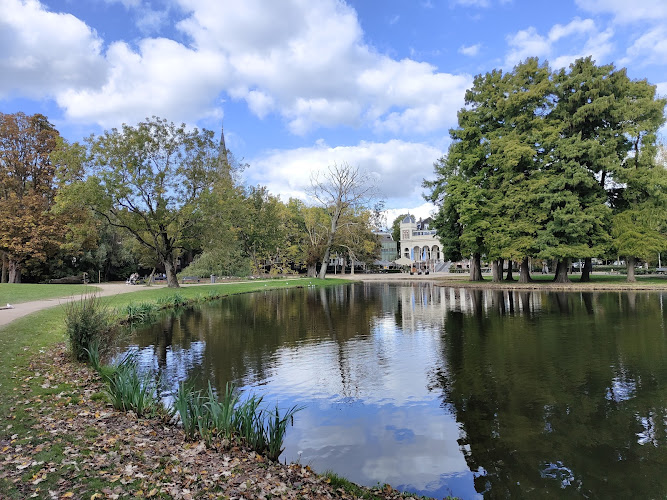
Once you’re inside the park, look for the bridge that carries the street over the path. Descend the staircase tucked against the side of the bridge. The blast doors are at the bottom. If they are closed, the venue is not currently programmed.
For visitors arriving from Leidseplein, the walk into the park from the northeast entrance takes around ten minutes. Cyclists can park along Stadhouderskade or just inside the park entrance.
Nearby in Oud-Zuid
The Vondelbunker sits in one of Amsterdam’s most concentrated cultural neighborhoods, which makes a Friday or Saturday evening visit easy to combine with the rest of the area. Within a fifteen-minute walk you have the Rijksmuseum, the Van Gogh Museum, the Stedelijk Museum, the Concertgebouw, and the cafés and brown bars of the streets around Roelof Hartplein. The Vondelpark Open Air Theatre, which runs free summer programming above ground in the same park, is a useful daytime counterpart to the bunker’s evening character.
If you’re building a day around the visit, an early-evening stroll through Vondelpark itself, dinner somewhere in De Pijp or Oud-West, and a late stop at the Vondelbunker covers a fuller picture of what Amsterdam looks like outside the canal-belt tourist core.
FAQ
Is the Vondelbunker open every day?
No. The Vondelbunker is open only on Friday and Saturday evenings, during programmed events. There are no weekday hours and no daytime tours. The collective also does not open on King’s Day. Always check the current schedule on vondelbunker.nl before traveling to the venue.
Is the Vondelbunker free to visit?
Yes. All events at the Vondelbunker are free. The space runs on a donation system, with contributions going toward rent, utilities and supporting the artists who perform there. Donations are voluntary but strongly encouraged.
Does the Vondelbunker accept card payments?
No. The Vondelbunker is cash-only. Bring euros if you intend to donate to the space or to the artists performing.
Is the Vondelbunker still a squat?
No. The Vondelbunker has not been a squat since the collective signed a legal lease in May 2011. It operates as an autonomous cultural center on a non-commercial basis, paying over €1,100 per month in rent and utilities through community donations.
What kind of events does the Vondelbunker host?
Programming includes live music, DJ sets, 16mm film screenings, theatre performances, art exhibitions, activist meetings, workshops and discussions. The focus is on experimental, underground and non-commercial work that does not have an obvious home in larger Amsterdam venues.
Where exactly is the Vondelbunker located?
The Vondelbunker is at Vondelpark 8A, 1071 AA Amsterdam, in the Museumkwartier neighborhood of Oud-Zuid. The entrance is built into the side of the bridge that carries 1e Constantijn Huygensstraat across the northern end of Vondelpark. Look for the staircase descending against the side of the bridge.
How do I get to the Vondelbunker by public transport?
Tram line 1 stops at Jan Pieter Heijestraat and 1e Constantijn Huygensstraat, both within a short walk of the entrance. Trams 2, 5 and 12 stop at nearby Van Baerlestraat or Leidseplein, from which the Vondelbunker is roughly a ten-minute walk through the park. The northern entrance to Vondelpark from Stadhouderskade puts you closest to the bridge.
Is the Vondelbunker an inclusive space?
Yes. The collective explicitly welcomes everyone but does not tolerate racism, transphobia, body shaming, sexism, xenophobia or ableism. The venue functions as a politically engaged, anti-fascist space, and visitors are expected to behave accordingly.
Can I host my own event at the Vondelbunker?
Possibly. The collective works with organizers as equals and offers the space free of charge for experimentation and non-commercial programming. Anyone interested in proposing an event can contact the collective through vondelbunker.nl.
Plan your visit
The Vondelbunker is one of the few remaining places in central Amsterdam where a free, volunteer-run, non-commercial cultural space still operates inside a piece of Cold War infrastructure. Visiting on a Friday or Saturday evening, with cash for a donation and a willingness to engage with whatever the night’s programming is, gives you a part of Amsterdam that no museum ticket will. Check the current schedule before you go, find the staircase, and step into one of the most distinctive underground spaces in the city.