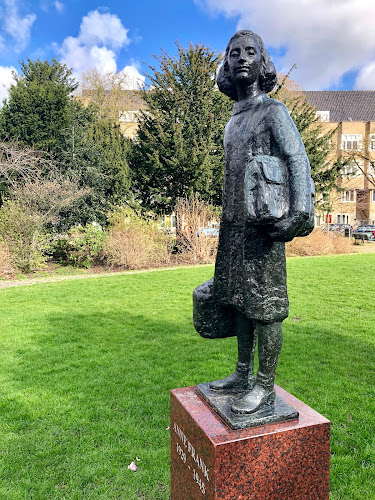
Standing in the quiet residential square of Merwedeplein in Amsterdam-Zuid, a bronze sculpture of a young girl captures a single moment frozen in time: the morning of July 6, 1942. The figure depicts Anne Frank, laden with layers of clothing, turning to look one last time at her childhood home before disappearing into hiding. Created by Dutch sculptor Jet Schepp and unveiled in 2005, this poignant memorial honors both the teenage diarist who touched millions and the thirteen thousand Jewish neighbors from this district who perished in the Holocaust.
The story behind the sculpture
The Anne Frank sculpture at Merwedeplein exists because of a community that refused to forget. In 2004, local bookseller Gert-Jan Jimmink submitted a citizens’ initiative to the Amsterdam ZuiderAmstel district council, backed by hundreds of supporting signatures. Jimmink operates Boekhandel Jimmink at Rooseveltlaan 62—the very bookshop (then called Boekhandel Blankevoort) where Otto Frank purchased the red-checkered diary that would become one of history’s most influential documents. On June 11, 1942, the day before her thirteenth birthday, Anne selected that diary herself from its shelves.
Jet Schepp, a sculptor residing in the Rivierenbuurt neighborhood, originally created the statue in 1994 with hopes of placing it at Merwedeplein. When the municipality declined at the time, an earlier version was installed in Purmerend in 1996. Jimmink’s successful petition brought a new version to its intended home. On July 9, 2005, Mayor Job Cohen unveiled the sculpture at 5:00 PM. The ceremony began with a minute of silence, led by district council chairman Erik Koldenhof, honoring the victims of the London bombings just two days earlier—a reminder of how violence and intolerance echo through generations.
What the sculpture depicts
The bronze figure, smaller than life-size, stands atop a high red granite rectangular base. Unlike the more familiar statue of Anne at Westermarkt (created by Mari Andriessen in 1977, which shows her standing upright with hands behind her back), Schepp’s interpretation captures a specific narrative moment. Anne wears multiple layers of clothing, exactly as she described in her diary:
“I was wearing two vests, three pairs of pants, a dress and over that a skirt, a jacket, a raincoat, two pairs of stockings, heavy shoes, a cap, a scarf and lots more. I was suffocating even before we left the house, but no one bothered to ask me how I felt.”
The Frank family wore as many clothes as possible that Monday morning because carrying suitcases would have attracted dangerous attention during their walk to the secret annex at Prinsengracht 263. Anne’s sister Margot had already departed earlier with helper Miep Gies. The sculpture shows Anne looking back toward Merwedeplein 37-II—the apartment that had been her home since February 1934, the place where she had laughed with friends, attended birthday parties, and lived an ordinary childhood until Nazi occupation shattered that normalcy.
Merwedeplein: Anne Frank’s childhood neighborhood
The Frank family moved to Amsterdam in late 1933, fleeing the rising tide of antisemitism after Hitler’s Nazi party seized power in Germany. Otto Frank arrived first to establish the Dutch branch of Opekta, a company producing pectin for homemade jam. Edith Frank followed on December 5, 1933, moving into the modern apartment at Merwedeplein 37-II. Margot joined them later that month, and four-year-old Anne arrived in February 1934, famously described as being “lifted onto the table as a birthday present” for her older sister.
The Rivierenbuurt (River District) was then a newly built neighborhood, with housing blocks constructed between 1920 and 1933. The Frank family’s apartment featured central heating and hot water on tap—modern conveniences proudly advertised by the Hilwis property company. Many Dutch and German Jewish families settled in this area, creating a vibrant community. By some estimates, approximately 17,500 Jewish residents lived in this neighborhood before the war; around 14,000 of them were murdered during the Holocaust.
Today, four Stolpersteine (stumbling stones) mark the pavement in front of Merwedeplein 37-II. These small brass plaques, installed on February 26, 2015 as part of artist Gunter Demnig’s Europe-wide memorial project, commemorate each member of the Frank family:
- Otto Frank (1889–1980): went into hiding July 6, 1942; arrested August 4, 1944; deported to Auschwitz; survived
- Edith Frank-Holländer (1900–1945): murdered January 6, 1945, at Auschwitz
- Margot Frank (1926–1945): died of typhus in Bergen-Belsen, March 1945
- Anne Frank (1929–1945): died of typhus in Bergen-Belsen, March 1945
The apartment today
In 2004, housing corporation Ymere purchased the Frank family’s former apartment and restored it to its original 1930s style in partnership with the Anne Frank House. Researchers carefully selected period-appropriate furniture that the Frank family might have used. The Anne Frank House took over ownership in 2017, but the apartment is not open to public tours because it serves a different purpose.
Since 2005, the Dutch Foundation for Literature has used the apartment to house refugee writers who cannot work freely in their own countries. A new writer-in-residence arrives each year, finding safety and creative space in the very rooms where Anne once dreamed of becoming a famous author. The apartment where Anne began filling her red-checkered diary has become a sanctuary for persecuted writers to continue their own work—a living tribute that Anne herself might have appreciated.
Visitors can explore a virtual 360-degree tour of the restored apartment through Google Arts & Culture, viewing rooms furnished as they might have appeared when the Frank family lived there.
Visiting the sculpture
Location
The sculpture stands in the green park area at the center of Merwedeplein, a wedge-shaped residential square in the Rivierenbuurt neighborhood of Amsterdam-Zuid.
Address: Merwedeplein, 1078 Amsterdam
Getting there
By tram: Take tram 4 from Amsterdam Centraal Station (direction Station RAI) and exit at the Waalstraat stop. Walk into Waalstraat for approximately three minutes until you reach Merwedeplein. The journey takes about 18-20 minutes from Centraal Station.
By metro: Take the Noord/Zuidlijn (line 52) to Europaplein, then walk approximately 10 minutes northeast to Merwedeplein.
By bicycle: The ride from central Amsterdam takes approximately 15-20 minutes, heading south through the charming streets of the city. Bike racks are available throughout the residential area.
On foot: Walking from Dam Square takes roughly 45 minutes. Head south along Rokin, continuing through Vijzelstraat and Vijzelgracht, then follow Ceintuurbaan before turning onto Waalstraat.
Best times to visit
Early morning hours offer the quietest experience at the memorial. Unlike the busy Anne Frank House museum at Prinsengracht, Merwedeplein remains a functioning residential neighborhood, meaning you can often have contemplative moments alone with the sculpture.
Visiting on Anne’s birthday, June 12th, brings a different experience. Locals sometimes gather to leave flowers at the statue, creating an informal but touching commemoration that connects past and present. July 6th, the anniversary of the day the Frank family went into hiding, also holds significance for those who know the story.
The sculpture is accessible year-round as outdoor public art. Spring brings blooming trees that frame the memorial beautifully, while winter visits—especially after snowfall—create a stark, moving atmosphere.
Nearby points of interest
Boekhandel Jimmink (Rooseveltlaan 62): The historic bookshop where Anne chose her diary stands just a short walk from the square. Now operated by Gert-Jan Jimmink (who initiated the campaign for the sculpture), this small shop specializes in history books and maintains a display about Anne Frank in multiple languages.
Merwedeplein 37-II: Walk to the eastern edge of the square to see the apartment building where the Frank family lived. Look for the Stolpersteine embedded in the pavement in front of the entrance.
The Wolkenkrabber (Skyscraper): The distinctive residential tower at the end of Vrijheidslaan, visible from the square, provided the central heating for the neighborhood’s apartment buildings during the 1930s.
A memorial with purpose
The Anne Frank sculpture at Merwedeplein serves multiple purposes beyond remembrance. It marks the location where Anne lived her everyday life before circumstances forced her family into hiding. It honors the thousands of Jewish residents from this neighborhood who did not survive. And it stands as a community-driven response to history—created not by government mandate but by residents who gathered signatures and lobbied their local council because they believed their neighborhood should acknowledge what happened there.
The statue’s deliberately small scale emphasizes Anne’s youth and vulnerability. She was a thirteen-year-old girl with ordinary teenage preoccupations—boys, friendships, arguments with her mother—who found herself caught in extraordinary circumstances. Standing at Merwedeplein, away from the tourist crowds of the city center, visitors can imagine the streets as Anne knew them, picture her walking to school or playing with friends in the park, and understand that the Holocaust happened not in distant, abstract places but in regular neighborhoods where regular families lived.
Practical information
- Accessibility: The sculpture stands in a flat, paved area easily accessible to wheelchair users and those with mobility challenges.
- Cost: Free (public outdoor memorial)
- Facilities: No on-site facilities. Cafés and restaurants are available on nearby streets including Maasstraat and Rijnstraat.
- Photography: Permitted
- Etiquette: This is a residential neighborhood. Visitors should maintain respectful noise levels and avoid leaving litter.
Connecting Anne Frank sites in Amsterdam
Visitors interested in Anne Frank’s complete Amsterdam story can create a meaningful walking tour connecting multiple locations:
- Merwedeplein – Childhood home and sculpture (1933-1942)
- Boekhandel Jimmink (Rooseveltlaan 62) – Where the diary was purchased
- Anne Frank House (Prinsengracht 263) – The secret annex where Anne wrote her diary (1942-1944)
- Anne Frank statue at Westermarkt – Mari Andriessen’s 1977 sculpture near the Anne Frank House
The walk from Merwedeplein to Prinsengracht follows roughly the same route the Frank family took on that July morning in 1942, offering an opportunity to trace their footsteps through the city.