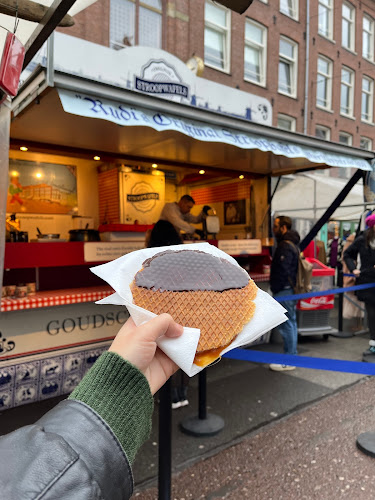
The aroma hits you before you see the food truck. Sweet, buttery, with hints of cinnamon and caramelized sugar, a scent that cuts through the bustle of Amsterdam’s busiest street market and pulls you toward a blue-and-red food truck near Albert Cuypstraat 182. This is Rudi’s Original Stroopwafels, and for nearly five decades, this family-run stall has been serving what many locals and visitors consider the finest stroopwafels in the Netherlands.
Rudi’s Original Stroopwafels at a glance
| Known for | The last traditional stroopwafel bakery in Amsterdam, baking fresh to order since 1978 |
| Price | Original €2, chocolate €2.50, 25 cm Superstrooper €5, Delft Blue gift tin €4.95 |
| Where | Blue-and-red food truck in the Albert Cuyp Market, opposite Albert Cuypstraat 182 (De Pijp) |
| Hours | Mon, Tue, Fri 11:00–17:00; Sat 11:00–17:30; closed Wed, Thu, Sun |
| Payment | Cash and card |
| Best time to visit | Right at the 11:00 opening or after 15:00 to skip the Saturday queue |
From Swiss clocks to Dutch waffles: the Rudi’s story
The history of Rudi’s Original Stroopwafels begins with an unexpected career change. Ruud, the founder, worked as a sales representative for Swiss clocks when he learned his company faced bankruptcy. Rather than seek another corporate position, he decided to forge his own path. When an acquaintance mentioned stroopwafels, Ruud realized something remarkable: authentic, freshly baked stroopwafels were nearly impossible to find in his hometown of Amsterdam.
Determined to fill this gap, Ruud traveled to Gouda, the city where stroopwafels originated in the late 18th century. After tasting offerings from various bakers, he met Nico, a stroopwafel master who had spent decades perfecting his craft. Nico recognized Ruud’s passion and agreed to teach him the centuries-old techniques of traditional stroopwafel making.
After years of apprenticeship, Nico retired and entrusted Ruud with something extraordinary: his secret recipe, considered by experts to be among the most authentic in the country. In 1978, Ruud set up his food truck at the Albert Cuyp Market and began baking stroopwafels the old-fashioned Gouda way. Today, the business operates as a true family affair, with Ruud’s son Dennis and son-in-law Alex continuing the tradition. Even Ruud’s grandchildren are eager to learn the craft, ensuring this piece of Dutch culinary heritage will thrive for generations to come.
What makes Rudi’s stroopwafels exceptional
Rudi’s Original Stroopwafels stands as the last traditional stroopwafel bakery in Amsterdam, a distinction that carries significant weight. The difference between these handcrafted treats and mass-produced alternatives becomes apparent with the first bite.
Each stroopwafel is baked fresh to order directly in front of you. The process follows the authentic Gouda method: a ball of dough is pressed in a hot waffle iron until golden and crisp, then carefully split horizontally while still warm. A generous layer of gooey caramel syrup, made with brown sugar, butter, and cinnamon, is spread between the two thin wafers before they’re pressed together. The result is a perfectly balanced combination: crispy exterior yielding to chewy warmth, with caramel that reaches all the way to the edges.
The menu offers several options:
- The Original Big Stroopwafel: The classic version that built Rudi’s reputation, featuring the authentic Gouda recipe (€2)
- Chocolate Stroopwafel: The same fresh-baked wafel topped with premium melted milk chocolate and Belgian chocolate (€2.50)
- The Superstrooper: A massive 25-centimeter (nearly 10-inch) stroopwafel, the largest in the country (€5)
- 10-pack Original Stroopwafels: Standard-size wafels for taking home or gifting
- Delft Blue Tin: A decorative gift box containing 10 pre-baked stroopwafels (€4.95)
Many visitors note the striking value compared to other Amsterdam stroopwafel vendors. While some tourist-oriented shops charge significantly more for pre-made wafels with elaborate toppings, Rudi’s focuses on freshness and authentic flavor at accessible prices.
The Dutch way to enjoy a stroopwafel
There’s a traditional Dutch technique for savoring stroopwafels that enhances the experience considerably. Place your stroopwafel on top of a steaming cup of coffee, tea, or hot chocolate for one to two minutes. The rising steam gently warms the wafel and melts the syrup filling, recreating the fresh-from-the-iron texture and flavor even hours after purchase.
Eating stroopwafels at markets connects to Dutch childhood memories, nearly every Dutch person recalls begging parents for these warm treats while shopping at local markets. At Rudi’s, you can watch the entire baking process unfold before you, making the anticipation part of the experience.
Albert Cuyp Market: context and history
Rudi’s food truck operates within the Albert Cuyp Market, one of Europe’s largest daily street markets. The market traces its origins to 1904, when the De Pijp neighborhood, originally built for Amsterdam’s working class, attracted street vendors to its broad Albert Cuypstraat. By 1905, the city government formalized these gatherings into an official market, initially operating only on Saturday evenings. In 1912, it expanded into a daily market, and despite starting as Amsterdam’s smallest, it has grown into the country’s busiest.
Today, approximately 260 stalls line both sides of Albert Cuypstraat, selling everything from fresh fish and produce to textiles, electronics, and international cuisine. The market reflects Amsterdam’s multicultural character, with vendors representing Dutch, Surinamese, Turkish, Moroccan, and Mediterranean communities. Many stalls are family operations passed down through generations.
You’ll find Rudi’s food truck in the middle of the market, positioned directly in front of Brouwerij de Engel, a striking former church converted into a craft brewery, identifiable by the large golden angel atop its roof. Look for the blue-and-red truck and the bakers dressed in traditional attire.
Practical visitor information
Opening hours
Rudi’s operates on a limited schedule:
- Monday, Tuesday, Friday: 11:00 – 17:00
- Saturday: 11:00 – 17:30
- Closed: Wednesday, Thursday, Sunday
The Albert Cuyp Market itself operates Monday through Saturday, roughly 9:30 to 17:00. Note that Rudi’s opens later than the market, so plan accordingly.
Getting there
You tap any contactless bank card or phone on the reader to ride Amsterdam’s metro and trams, so you do not need a paper ticket. Our OVpay guide explains how it works and what a single ride costs.
- Metro: Take line 52 (Noord/Zuidlijn) to De Pijp station. Both exits lead directly to Albert Cuypstraat and the market entrance.
- Tram: Line 4 stops at Albert Cuypmarkt on Van Woustraat, cross the street and proceed into Albert Cuypstraat. Lines 3 and 12 stop at Ceintuurbaan, from which you can head north a short distance to reach the market.
- By bicycle: The market lies approximately 2 kilometers south of Dam Square, about 10 minutes by bike using Amsterdam’s cycle paths. Secure bike parking is available nearby, lock thoroughly, as bicycle theft remains common.
- On foot: From Amsterdam Centraal, the walk takes roughly 25-30 minutes through the city center. From the Rijksmuseum or Vondelpark area, it’s about 15 minutes.
Timing your visit
A queue is likely, especially on Saturdays and during lunch hours. Wait times typically range from 10 to 15 minutes, though the line moves steadily. For shorter waits, arrive when the stall opens at 11:00. Late afternoon visits after 15:00 also tend to be less crowded.
The market is closed Sundays, and Rudi’s follows an even more limited schedule. Double-check opening days before planning your visit to avoid disappointment.
Address and contact
Location: Albert Cuyp Straat, across from number 182 (near Brouwerij de Engel with the golden angel)
Neighborhood: De Pijp, Amsterdam-Zuid
Website: originalstroopwafels.com
The stroopwafel’s Gouda origins
Understanding the stroopwafel’s history adds depth to the Rudi’s experience. These iconic Dutch treats originated in the city of Gouda during the late 18th or early 19th century. Local lore credits baker Gerard Kamphuisen with the invention, possibly as early as 1784, when he repurposed leftover breadcrumbs and spices by sweetening them with syrup.
Initially called “armenkoeken” (poor man’s cookies) because of their humble ingredients and affordable price, stroopwafels gradually gained popularity across social classes. By the mid-19th century, nearly 100 stroopwafel bakers operated in Gouda alone. The invention of specialized waffle irons and later industrial production helped spread the treat throughout the Netherlands and eventually worldwide.
Today, Gouda still maintains four stroopwafel factories, and one traces its lineage directly back to Kamphuisen himself. Rudi’s commitment to the authentic Gouda recipe, learned directly from a master baker, connects each wafel to this rich culinary heritage.
Rudi’s vs Van Wonderen vs Lanskroon: which Amsterdam stroopwafel?
Three names come up most often when visitors search for the best stroopwafel in Amsterdam. Rudi’s is the market food truck that bakes to order at the lowest price; Van Wonderen is the topping-loaded shop wafel popular on social media; Lanskroon is a historic city-centre bakery. All three were open and trading in 2026.
| Vendor | Location | Style | Price | Best for |
| Rudi’s Original Stroopwafels | Albert Cuyp Market, De Pijp | Food truck, baked fresh to order, Gouda recipe | From €2 | Authentic, warm, best value |
| Van Wonderen | Kalverstraat 190, centre | Shop wafels half-dipped in chocolate with toppings (Oreo, Biscoff, sprinkles) | About €11.50–14.50 | Photogenic, loaded toppings |
| Lanskroon | Singel 385, centre | Historic bakery (since 1804), large take-away wafels | A few euros each | Bakery classic, open 7 days |
If you want the traditional article at the fairest price and do not mind a short queue, Rudi’s wins on both counts. Choose Van Wonderen for a topping-heavy photo, or Lanskroon when you are already in the centre and want a bakery classic seven days a week.
What visitors say
Reviews consistently praise several aspects of the Rudi’s experience:
- Freshness matters: Visitors frequently note the substantial difference between stroopwafels baked fresh at Rudi’s versus pre-made versions from shops and supermarkets. The warm, gooey texture simply cannot be replicated.
- Value and authenticity: Many reviewers contrast Rudi’s affordable prices with more expensive tourist-oriented vendors, noting that the latter often serve pre-made wafels despite charging three times as much.
- Family atmosphere: The welcoming, personable service from the family running the stall regularly receives mentions. Staff members are known for joking with customers and sharing their passion for the craft.
- Worth the wait: While queues can extend during peak hours, the consensus holds that watching your stroopwafel being made, and eating it moments later, justifies the wait.
Nearby attractions
A visit to Rudi’s pairs naturally with exploration of the De Pijp neighborhood and surrounding areas:
- Sarphatipark: A peaceful green space just blocks from the market, ideal for enjoying your stroopwafel on a bench
- Heineken Experience: The interactive brewery tour occupies the former Heineken brewery, a short walk from Albert Cuypstraat
- Ferdinand Bolstraat: The main shopping street of De Pijp, lined with boutiques, cafés, and restaurants
- Brouwerij de Engel: The craft brewery directly behind Rudi’s stall, housed in a beautifully converted former church
Last updated: July 2026 (what we verified)
We reconfirmed that Rudi’s is open and still bakes to order at Albert Cuypstraat 182, along with the 2026 prices (Original €2, chocolate €2.50, Superstrooper €5, gift tin €4.95) and opening days (Mon, Tue, Fri, Sat; closed Wed, Thu, Sun) against Yelp, Tripadvisor and the vendor’s own site, originalstroopwafels.com. We also confirmed both comparison vendors, Van Wonderen (Kalverstraat 190) and Lanskroon (Singel 385), were open in 2026. Prices at a street stall can change, so check on the day.
Frequently asked questions
Where can I buy Rudi’s Original Stroopwafels?
Rudi’s Original Stroopwafels are available exclusively at their food truck in the Albert Cuyp Market. They do not currently ship or sell through other retailers.
What’s the difference between Rudi’s stroopwafels and supermarket versions?
Rudi’s uses the authentic Gouda recipe and bakes each stroopwafel fresh per customer. Supermarket versions are mass-produced and can be weeks or months old. The freshness affects both texture, crispy yet chewy versus brittle, and the gooey quality of the caramel filling.
Are there vegetarian options?
Yes. The classic stroopwafel is suitable for vegetarians. For those avoiding eggs, an eggless version is sometimes available, ask the staff.
Is there seating available?
No. Rudi’s operates as a food truck within the market, with no dedicated seating. Most visitors eat while walking or find a spot nearby, Sarphatipark is a pleasant option in good weather.
How do I recognize the stall among all the market vendors?
Look for the blue-and-red food truck with staff in traditional baker’s clothing. It’s located in the middle of the market, directly in front of the building with the golden angel on its roof (Brouwerij de Engel). The sweet aroma of fresh wafels often guides visitors there as well.
Can I buy stroopwafels to take home?
Yes. In addition to fresh wafels, Rudi’s sells 10-packs and decorative Delft Blue tins of pre-baked stroopwafels, perfect for gifts or enjoying at home. These maintain quality better than supermarket alternatives.
Is Rudi’s or Van Wonderen the better stroopwafel?
They aim at different things. Rudi’s bakes a traditional Gouda-recipe stroopwafel fresh to order from €2 and is prized for authenticity and value. Van Wonderen sells a photogenic wafel half-dipped in chocolate and loaded with toppings for roughly €11.50 and up. For the classic warm article most people point to Rudi’s; for a topping-covered treat, Van Wonderen.
What payment methods are accepted?
The stall accepts both cash and card payments, though having some euros on hand is always advisable at street markets.