Martin Luther Kingpark is a free public park on the west bank of the Amstel in Amsterdam-Zuid, between the river and the Rivierenbuurt. It opened in 1936 and was renamed in 1968, the year Martin Luther King Jr. was assassinated. There is no gate, no ticket and no closing time. The park splits into two halves either side of the Nieuwe Utrechtsebrug: large grass fields, mature trees, picnic spots, a children’s playground and a big off-lead dog area. Barbecuing is not allowed. It is best known for De Parade, the travelling theatre festival that fences off part of the park for about two and a half weeks each summer, and it holds a bronze statue of King that an artist installed one January morning in 2020 without asking anyone. The closest tram stop is Victorieplein on tram 4, about 15 minutes on foot.
| Detail | Martin Luther Kingpark |
|---|---|
| What it is | Public city park, Amsterdam-Zuid, on the Amstel |
| Where | Amsteldijk, postcode area 1079; coordinates 52.3404, 4.9102 |
| Opened | 1936 |
| Renamed | 1968, after Martin Luther King Jr. |
| Entry | Free. No gate, no ticket, no published closing time |
| Layout | Two halves, divided by the Nieuwe Utrechtsebrug |
| Best known for | De Parade theatre festival, late July to early August |
| Dogs | Off the lead in a large part of the park |
| Barbecue | Not allowed |
| Nearest tram | Victorieplein, tram 4, about 15 minutes on foot |
| Nearest bus | Amsteldijk at Vrijheidslaan, buses 62 and 65, about 8 minutes on foot |
Is this the Martin Luther King Park in Amsterdam, or one of the American ones?
This page is about the Amsterdam park. Dozens of cities in the United States have a Martin Luther King Park, so the plain search term returns a mix of them. The Amsterdam one is written as one word in Dutch, Martin Luther Kingpark, and it is located on the Amsteldijk in Amsterdam-Zuid, on the west bank of the Amstel river, with the Rivierenbuurt behind it. If a map result shows a park beside a wide river in the south of Amsterdam, roughly four kilometres from Dam Square, that is this one.
One further source of confusion is local rather than international, and it is covered further down: from 1949 to 1968 this park was called Amstelpark, and a completely different park in Buitenveldert now carries that name.
How do you get to Martin Luther Kingpark?
Take tram 4 from Centraal Station towards Station RAI and get off at Victorieplein, then walk about 15 minutes east to the river. That is the route De Parade gives its own visitors, and journey planners agree with it. No tram stop is close enough to call the park walkable in a couple of minutes, and the buses get you nearer than the tram does.
A note on one specific mistake, because it is easy to make: tram 4 does have a stop called Amstelkade, one stop before Victorieplein. The name suggests the river, but the stop is on Van Woustraat, roughly a kilometre west of the Amstel, and it leaves you further from the park than Victorieplein does. If you are counting stops, stay on for one more.
| Route | Get off at | Walk |
|---|---|---|
| Tram 4 from Centraal Station towards Station RAI | Victorieplein | About 15 minutes |
| Bus 62 or 65 | Amsteldijk, at the Vrijheidslaan junction | About 8 minutes |
| Train, metro 51, 53 or 54, or tram 12 | Amsterdam Amstel station, then cross the Berlagebrug and follow the Amsteldijk south | About 15 minutes |
| Train, metro 50 or 51, or tram 4 | Station RAI | About 20 minutes to the northern half |
| Metro 52 (the north-south line) | Europaplein, then head east toward the river | Walking time not published |
| Bike | Ride the Amsteldijk south along the river | The park has bike parking at its entrances |
| Tram to a stop beside the park | Not possible | No tram line runs along the Amsteldijk here |
Tram, bus and metro fares are all charged the same way now: tap in and out with a bank card or phone. Our OVpay guide covers what it costs and where it catches people out. From De Pijp the park is a straightforward ride or a walk of roughly half an hour; the whole area sits inside Amsterdam-Zuid.
Is Martin Luther Kingpark free, and what time does it close?
It is free, and the city publishes no opening or closing times for it. This is an open public park with entrances off the Amsteldijk and the surrounding streets rather than a fenced garden with gates, so there is no ticket at any point in the year and nothing to book.
There is one exception, and it is a big one. For about two and a half weeks in mid-summer, De Parade fences off a section of the park as a festival ground and charges admission to that section. The rest of the park stays open and free. Outside those weeks, and outside the build-up and break-down either side of them, nothing in the park costs money.
What is De Parade, and when does it take over the park?
The park hosts De Parade, a travelling theatre festival that pitches a field of tents in Martin Luther Kingpark every summer, and the 2026 edition ran from 24 July to 9 August. It has already finished for this year. The City of Amsterdam’s own description of the park says it is best known for this festival, which is a fair summary: for most of the year the park is a quiet local green space, and for a fortnight and a half it is one of the busiest cultural sites in the city.
Around 95 theatre, dance, mime and music performances run across the tents, most of them made for the festival and not shown anywhere else. Tickets for individual shows are bought separately from the entry fee, which is the part most first-time visitors misread.
| De Parade Amsterdam | 2026 edition |
|---|---|
| Dates | 24 July to 9 August 2026 (finished) |
| Grounds open | Sunday to Thursday 14:00 to 00:00; Friday and Saturday 14:00 to 02:00 |
| Opening day exception | Friday 24 July opened at 18:00 |
| Closing day exception | Sunday 9 August, gates shut at 22:00 |
| First hour | Free, except on the opening Friday |
| Entry after the first hour | €10 adult, €3 ages 12 to 17, free under 12, €5 after 22:00 |
| City entertainment levy | €1.50 per visit, charged on top of entry |
| Actual gate price, one adult | €11.50, before a single show ticket |
| Performances | Around 95 |
Two things worth knowing before you plan around it. The first hour is free but the opening Friday is not, so arriving at 14:00 on a Tuesday and leaving by 15:00 costs nothing except the levy, while the same trick on day one does not work. And the €1.50 levy is a municipal charge rather than a festival one, which is why it appears as a separate line and why quoted prices elsewhere rarely include it.
If a summer festival is what you are after and you are here at a different time of year, Amsterdam’s event calendar is dense: the Grachtenfestival runs on the canals in August, and Amsterdam Dance Event takes over the city in October.
Is there a statue of Martin Luther King in the park?
Yes, and it was put there without permission. The park was named after King in 1968. For the next fifty-two years it contained no image of him at all. That changed early on the morning of 15 January 2020, King’s 91st birthday, when the artist Airco Caravan, the working name of Maria Koning, installed a bronze statue of him in the park without telling the borough. Stadsdeel Zuid had not approved it. After roughly six months of deliberation the city decided it could stay, and it was officially unveiled on 5 July 2020.
It was the second King figure to stand in the park. The first belonged to the artist’s 2018 project Monument for Martin Luther King, marking fifty years since the assassination: fifty identical half-metre figurines placed in cities across Europe and North America, in places connected to slavery or to the fight against racism. The Amsterdam one stood on a large wooden pedestal and was always temporary. The 2020 bronze is a permanent replacement and, at roughly four feet, still a modest thing rather than a civic monument on a plinth. Visitors regularly walk past it.
| The 2018 figurine | The 2020 bronze | |
|---|---|---|
| Artist | Airco Caravan (Maria Koning) | Airco Caravan (Maria Koning) |
| Context | One of fifty identical figures placed internationally, fifty years after King’s death | A permanent piece made for this park |
| Size | About half a metre, on a large wooden pedestal | About four feet, roughly 1.2 metres |
| Placed | 2018 | Early morning, 15 January 2020, King’s 91st birthday |
| Permission | Part of a declared temporary project | None. The borough had not been asked |
| Outcome | Temporary by design | Allowed to remain after about six months; unveiled 5 July 2020 |
Amsterdam has form here. The bronze bull on Beursplein was also placed overnight without a permit, in 2012, and also ended up staying. In both cases the city’s response was to argue about it for months and then leave the thing where it was.
Why is it called Martin Luther Kingpark, and what was it called before?
The park was renamed in 1968, the year King was assassinated, and before that it was called Amstelpark. That older name has since moved to a different park, which is the single most common local mix-up about this place.
The land was laid out in the 1930s as a work-creation scheme for people who had lost their jobs in the Depression, and the park opened to the public in 1936. It picked up the name Amstelpark in 1949 for the obvious reason that it runs along the Amstel. When King was killed in April 1968, Amsterdam renamed it after him. Three years later, in 1971, the name Amstelpark was given to the new park in Buitenveldert built for the Floriade, and it has stayed there ever since.
| Year | What happened |
|---|---|
| 1930s | Laid out as a Depression-era employment project |
| 1936 | Opens to the public |
| 1949 | Named Amstelpark |
| 1968 | Renamed Martin Luther Kingpark after King’s assassination |
| 1971 | The name Amstelpark passes to the new park in Buitenveldert |
| 2005 | Major renovation begins |
| 2018 to 2019 | Further renovation |
| 2020 | Bronze statue of King installed without permission, then allowed to stay |
| 2021 | City council adopts a long-term vision for the park |
Can you barbecue here, and can dogs run off the lead?
Barbecuing is not allowed in Martin Luther Kingpark, and dogs may run off the lead across a large part of it. The barbecue rule is not specific to this park: Amsterdam permits barbecues in only two of its parks, Westerpark and Noorderpark, and everywhere else, including here, it is prohibited. People do it anyway on hot days, which does not make it legal.
The off-lead area is one of the genuinely good reasons to come. It covers a large share of the park rather than a fenced corner, which is unusual this close to the centre, and it is a big part of why the space is busy with locals on weekday mornings. The city maps its off-lead and dog-free zones online if you want the exact boundaries before you unclip.
| Activity | Here |
|---|---|
| Picnics | Yes, there are dedicated picnic spots |
| Barbecues | No. Allowed only in Westerpark and Noorderpark citywide |
| Dogs off the lead | Yes, across a large part of the park |
| Playground | Yes, and the equipment is scheduled for replacement |
| Entry fee | None, except inside the De Parade grounds in summer |
| Fixed opening hours | None published |
What is there for children?
There is a children’s playground, and family guides to the park describe play areas in more than one spot rather than a single fenced enclosure. The honest caveat is that the equipment is old: replacing it is written into the city’s own 2023 to 2027 programme of works for the park, which is not something a council commits to for equipment it considers in good shape.
The other thing families should know is the summer clash. De Parade runs a dedicated children’s programme, the KinderParade, inside the festival ground, so for those weeks the park is arguably more child-friendly than usual, but part of it is ticketed and busy well into the evening.
How does it compare with Amsterdam’s better-known parks?
Martin Luther Kingpark is not a sight. Nobody should reorganise a short trip around it. It is a working local park with a frontage along the Amstel river, and it earns a detour on three counts: the off-lead dog area, the river itself, and De Parade if your dates line up. For a full day outdoors on a much bigger scale, the Amsterdamse Bos south of the city is the usual choice instead.
| Park | Where | Go for |
|---|---|---|
| Martin Luther Kingpark | Amsteldijk, Amsterdam-Zuid | River frontage, a large off-lead dog area, De Parade in summer |
| Vondelpark | Oud-Zuid and Oud-West | Amsterdam’s best-known park, and the busiest |
| Sarphatipark | De Pijp | Small, central, good for a short sit |
| Beatrixpark | Zuid, near the RAI | The quiet alternative nearby |
| Oosterpark | Oost | Monuments and city events |
| Westerpark | West | One of only two parks where you may barbecue |
| Rembrandtpark | West | Space, with fewer visitors than Vondelpark |
| Park Frankendael | Oost | A country house and formal gardens |
What is changing in the park before 2027?
The park is midway through a rebuild. Amsterdam’s city council adopted a long-term vision for Martin Luther Kingpark in 2021, and the practical programme that follows from it, the Agenda Martin Luther Kingpark, covers 2023 to 2027. A renovation and management plan has been completed under it.
The published aims are specific: greener surroundings and clearly marked entrances, better cycling and walking paths through the park, replacement of the old playground equipment, more capacity to hold rainwater, planting chosen to draw birds and insects, and a strip of rougher nature along the Amstel linking the park to other green areas. If you visit before 2027 and find a path fenced off or a play area stripped out, this is why.
The reason behind the spending is the part travel pages leave out. Roughly 7,500 new homes are planned on the far side of the Amstel, and their residents will use this park. A quiet local green space is being prepared to absorb a new neighbourhood. Planting for birds and insects also makes the park a more interesting stop for anyone tracking Amsterdam’s urban wildlife.
What is the park like outside the summer?
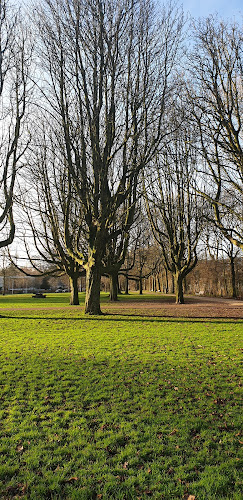
Amsterdam lawns stay green all winter, so the park does not turn brown the way visitors from drier climates expect. What it does lose is cover. The trees here are deciduous and bare from roughly November to April, which makes the park lighter, more open and much emptier, and makes the river visible from further back among the trees.
Practically, the quiet months are the ones to choose if you are coming for the walk or the dogs rather than the festival. There is no cafe or kiosk inside the park, no shelter to speak of, and Dutch weather between October and March gives you no reason to assume a dry hour, so bring what you need with you. Early mornings along the Amsteldijk are the best of it in any season.
Quick answers about Martin Luther Kingpark
Where exactly is Martin Luther Kingpark?
On the Amsteldijk in Amsterdam-Zuid, on the west bank of the Amstel, with the Rivierenbuurt behind it and the postcode area 1079. Different listings give different street numbers because the park is an open space with several entrances rather than a single address; the coordinates 52.3404, 4.9102 will put you in it.
Do you have to pay to get in?
No. The park is free all year. The only paid area is the De Parade festival ground for about two and a half weeks in summer, and that is a separate ticketed enclosure inside the park.
What time does the park close?
The city publishes no closing time. It is an open park rather than a gated garden.
When is De Parade in Martin Luther Kingpark?
The 2026 edition ran from 24 July to 9 August and has finished. The festival returns to this park each summer, usually from the last full week of July, and dates are announced in advance on the festival’s own site.
Which tram goes to Martin Luther Kingpark?
Tram 4, towards Station RAI, and you want Victorieplein rather than the earlier Amstelkade stop. From Victorieplein it is about 15 minutes on foot. Buses 62 and 65 stop closer, on the Amsteldijk at Vrijheidslaan, about 8 minutes away.
Can dogs go off the lead?
Yes, in a large part of the park. Amsterdam publishes an online map of its off-lead and dog-free zones if you want the boundaries.
Can you barbecue in the park?
No. Westerpark and Noorderpark are the only two Amsterdam parks where barbecuing is permitted.
Is the Martin Luther King statue easy to find?
Not especially. It stands about four feet high, so it reads as a small figure rather than a landmark, and plenty of people cross the park without noticing it.
Is it worth going out of your way for?
If you have a dog, are staying in Zuid or the Rivierenbuurt, or your dates overlap with De Parade, yes. As a sight in its own right on a three-day trip, no. It is a good park, not an attraction.
Sources and what we checked
Opening year, naming history, park layout, the barbecue prohibition and the off-lead rules come from the City of Amsterdam’s park pages and the Dutch-language record of the park. Festival dates, opening times, entry prices and the municipal entertainment levy come from De Parade’s own 2026 visitor information. The renovation programme and the figure for new homes across the Amstel come from the city’s published vision for the park and the 2023 to 2027 agenda that implements it. The statue details come from the artist’s own project and contemporary Dutch reporting on the 2020 installation. Transport routes were checked against De Parade’s arrival directions, GVB line data and journey planners.
Three claims that circulate about this park could not be verified anywhere and are deliberately absent from this page: a water-play feature with ground jets, an outdoor gym or fitness area, and the idea that you can arrive by boat or on a canal tour that stops at the park. If you have seen any of them there, we would rather hear about it than guess.
Last updated 13 August 2026. Festival dates, prices and the municipal levy were checked against De Parade’s published 2026 information; park rules and the renovation programme against the City of Amsterdam. Prices and dates for future editions will change, so check the festival’s own site before travelling.