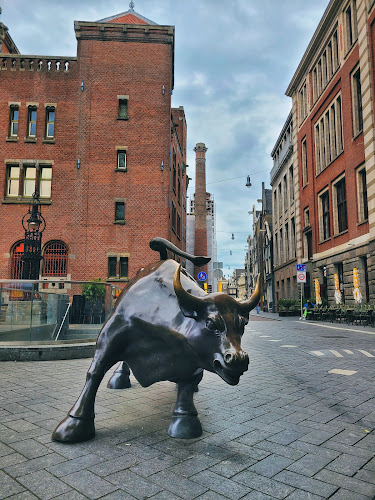
The Charging Bull in Amsterdam is a 2,500 kg bronze bull standing on Beursplein, the small public square outside Beursplein 5, the building Euronext Amsterdam still trades from. It is by the Italian-American sculptor Arturo Di Modica, the same artist who made the famous bull near Wall Street, and he put it here overnight on 4 to 5 July 2012 without asking anyone first. It is free, outdoors and always accessible, there is no ticket and no gate, and most people spend five minutes with it. It is a scaled-down version of the New York bull, not the New York bull, and the two are often confused.
Charging Bull Amsterdam at a glance
| What it is | Bronze bull sculpture by Arturo Di Modica |
| Where | Beursplein, outside Beursplein 5, Amsterdam-Centrum (postcode area 1012) |
| Placed | Overnight, 4 to 5 July 2012, without a permit |
| Weight | About 2,500 kg (roughly 5,500 lb) |
| Cost and hours | Free, outdoors, no ticket, visible at any hour |
| Time needed | 5 minutes for the bull, 15 minutes with the square |
| Nearest tram | Dam, lines 4, 14 and 24 on the Rokin side |
| Nearest metro | Rokin, line 52 |
| From Centraal Station | About 10 minutes on foot, straight down the Damrak |
| Quietest time | Before 09:00 on a weekday |
Where exactly is the Charging Bull in Amsterdam?
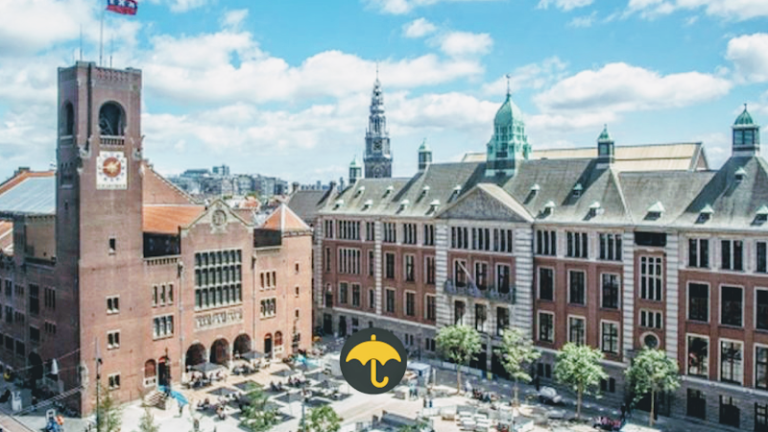
The bull stands on Beursplein, on the side of the square in front of Beursplein 5. That is the 1913 securities exchange designed by Jos. Th. J. Cuypers, and it is still the home of Euronext Amsterdam. The red-brick building with the clock tower on the other side of the same square is the Beurs van Berlage of 1903, which is now an exhibition and events venue rather than an exchange. People routinely mix up the two buildings, so if you are looking for the bull, aim for the modern stone facade rather than the brick tower.
Beursplein sits between the Damrak and the Rokin, about ten minutes on foot south of Amsterdam Centraal and roughly 300 metres short of Dam Square. Almost everyone walking that route passes within a few metres of the bull, which is why it has more foot traffic than its size suggests.
Is this the same bull as the one on Wall Street?
No. They are two separate sculptures by the same artist. The New York bull has stood at Bowling Green, in Lower Manhattan's Financial District, since December 1989 and has never left the city. The Amsterdam bull is a smaller cast, made and installed 23 years later. What the two share is the artist, the pose and the method: Di Modica installed both of them at night, without permission, as a gift and as a message about staying optimistic after a market shock.
| New York | Amsterdam | |
|---|---|---|
| Installed | Night of 14 to 15 December 1989 | Night of 4 to 5 July 2012 |
| Where it stands now | Bowling Green, Lower Manhattan | Beursplein, outside Beursplein 5 |
| Weight | 3,200 kg (7,100 lb) | About 2,500 kg |
| Size | 3.4 m high, 4.9 m long | Scaled down from the New York cast |
| Permission | None. Dropped outside the New York Stock Exchange | None. Placed on the square overnight |
| What happened next | Removed by police the same day, reinstalled at Bowling Green on 20 December 1989 | Moved a few metres to clear the traffic route, then allowed to stay |
| The trigger | The 1987 stock market crash | The 2012 European debt crisis |
| Cost to the artist | About 360,000 US dollars of his own money, two years of work | Not published |
Who put the bull on Beursplein, and why?
Arturo Di Modica did, on his own initiative and at his own expense, during the night of 4 to 5 July 2012. Amsterdam woke up to a bronze bull that nobody had approved. His stated reason was a message to a Europe in the middle of a debt crisis: stay positive, push through the bad years. It was the same argument he had made in New York after the 1987 crash known as Black Monday, transplanted to a continent having a bad decade.
Amsterdam was not a random choice. The Amsterdam exchange was part of the transatlantic group NYSE Euronext at the time, so the city was formally linked to Wall Street. Amsterdam also has the better claim to being where exchange trading began, with shares in the Dutch East India Company changing hands here from 1602. Di Modica’s spokesman put it plainly: as the birthplace of the stock exchange, Amsterdam could not do without a bull.
The city’s first reaction was that it had to go. The district authority for Centrum objected that the sculpture blocked the traffic route across the square. The compromise was to shift the 2.5-tonne bull a few metres to one side, and after consultation with the Amsterdam arts fund it was allowed to stay. It kept its place through the reconstruction of Beursplein in 2017 and 2018, when the square was dug up for the underground bicycle garage and rebuilt to Berlage’s own 1898 design.
Di Modica chose a bull rather than any other animal for a reason he explained often. A charging bull attacks with its head down and throws its target upward, which is the same movement as a rising market. That is where the term bull market comes from, and it is why the pose has the head lowered and the body coiled rather than standing square.
What happened to the bull in 2019?
It broke a leg at the end of 2019 and was taken away for repair. The work took about a year and a half, and the bull came back to Beursplein in March 2021. Euronext marked the return on 19 March 2021.
The timing turned the homecoming into something closer to a memorial. Arturo Di Modica died on 19 February 2021, aged 80, one month before his Amsterdam bull was put back on its plinth. He was born in Vittoria, Sicily, on 26 January 1941. If you visit now, you are looking at a sculpture that outlived its maker by a month at this address.
How many Charging Bulls did Di Modica make?
Three public ones, in three financial capitals, over 23 years. Amsterdam’s is the last of them.
| City | Year | Where |
|---|---|---|
| New York | 1989 | Bowling Green, Lower Manhattan, after one day outside the New York Stock Exchange |
| Shanghai | 2010 | The Bund, Shanghai’s waterfront financial strip |
| Amsterdam | 2012 | Beursplein, outside the Euronext building |
The Shanghai bull, usually called the Bund Bull, differs from the other two: it was commissioned rather than smuggled into place, and it is a different, redder cast with its own pose. Only New York and Amsterdam got the guerrilla treatment.
Is there a bear, or a Fearless Girl, in Amsterdam?
Neither. Amsterdam’s bull stands alone. There is no companion bear sculpture on Beursplein, and there never has been, despite a persistent claim on travel pages that the square holds a matching bull and bear pair. There is also no Fearless Girl here. That statue, by Kristen Visbal, was placed facing the New York bull in March 2017 and has since moved to a spot outside the New York Stock Exchange. It is a New York story, not an Amsterdam one.
The bull-versus-bear image is real, but it is a figure of speech rather than a pair of statues: the bull tosses prices up with its horns, the bear drags them down with its claws. Amsterdam’s own historic exchange emblem was not either animal. It was Mercury, the god of trade, who stood for balanced prices and a steady market rather than a market going one way hard.
Can you touch the bull for good luck?
Nothing stops you. The bull sits on the open square with no barrier, no fence and nobody watching the way there is in New York, where the crowd, the queue and the polished bronze on the nose, horns and rear are all part of the experience. The rubbing-for-luck ritual belongs to the Bowling Green bull. Amsterdam never developed an official equivalent, so you can usually walk straight up and get a photograph without waiting.
Two practical points. The sculpture has already been through one expensive repair after a broken leg, so climbing on it is a bad idea and is not tolerated. And because it is a full-size animal in a tight square, a phone camera struggles to fit it in from close range: step back toward the Beurs van Berlage side and shoot along the length of the body rather than head-on.
When is the best time to see it?
Before 09:00 on a weekday. Beursplein is a thoroughfare between Centraal Station and Dam Square, so the crowd around the bull is the crowd walking past it, and that builds through the morning and peaks in the middle of the day. Early on a weekday the square is still doing its day job, the light comes in low off the Damrak, and you can shoot the bull without anyone else in the frame.
After dark the square is lit and the bronze picks up the light well, which is a genuine second option in Dutch winter when the sun sets before 17:00. Season matters less than time of day here, because the bull is outdoors and permanently accessible. Winter in Amsterdam runs to single-digit °C, roughly 35 to 45 °F, and summer sits around 17 to 22 °C, roughly 63 to 72 °F.
How do you get to the Charging Bull?
Walking is usually fastest. From Amsterdam Centraal, head straight south down the Damrak for about ten minutes and Beursplein opens on your left before you reach Dam Square. There is no metro station called Dam Square, which is worth knowing because several guides say there is. The nearest metro stop is Rokin on line 52, a few hundred metres south of the square. By tram, get off at Dam: lines 4, 14 and 24 stop on the Rokin side, and lines 2, 12, 13 and 17 stop on the Nieuwezijds Voorburgwal side, which leaves you a slightly longer walk back.
For fares, tap in and out with a contactless bank card or phone using OVpay, or buy a GVB ticket if you plan to ride a lot in one stretch. GVB 2026 prices for unlimited travel on trams, buses and the metro:
| GVB ticket | Price (2026) | Worth it if |
|---|---|---|
| 24 hours | €10.00 | You make roughly four or more journeys in a day |
| 48 hours | €16.00 | Two full sightseeing days on public transport |
| 72 hours | €21.50 | A long weekend without a bicycle |
| Pay as you go | Per journey | You are mostly walking, which in this part of town you will be |
Arriving by bicycle is easy here for once. The municipal bicycle garage sits directly under Beursplein, holds 1,700 bikes and is free for the first 24 hours, with the main entrance on the Damrak side of the square.
What else is worth seeing on the same square?
| Place | Where | Why go |
|---|---|---|
| Beurs van Berlage | On the square | Berlage’s 1903 exchange, now exhibitions and events; each face of the clock tower carries a different line of verse |
| Beursplein 5 | Behind the bull | Euronext Amsterdam’s building since 1913; the trading floor can be seen on the booked Amsterdam Exchange Experience tour |
| De Bijenkorf | Dam side of the Damrak | Upper-floor windows look out over Beursplein and the rooftops |
| Dam Square | 300 m south-west | Royal Palace, Nieuwe Kerk and the National Monument |
| Oude Kerk | 350 m east | Amsterdam’s oldest building, now also a contemporary art space |
| Tony’s Chocolonely Super Store | Oudebrugsteeg 15, inside the Beurs van Berlage | Make your own bar in the building that once handled Amsterdam’s cocoa trade; open 10:00 to 21:00 |
Charging Bull Amsterdam FAQ
Where is the Charging Bull in Amsterdam?
The Charging Bull stands on Beursplein in Amsterdam-Centrum, on the side of the square in front of Beursplein 5, the building Euronext Amsterdam trades from. Beursplein sits between the Damrak and the Rokin, about 10 minutes on foot south of Amsterdam Centraal and roughly 300 metres before Dam Square. It is outdoors, free and visible at any hour.
Is the Amsterdam Charging Bull the same as the Wall Street bull?
No. They are two different sculptures by the same artist, Arturo Di Modica. The New York bull has stood at Bowling Green in Lower Manhattan since December 1989 and weighs 3,200 kg. The Amsterdam bull is a scaled-down cast weighing about 2,500 kg, placed on Beursplein overnight on 4 to 5 July 2012. Di Modica installed both of them without permission.
Who made the Charging Bull on Beursplein and why?
The Italian-American sculptor Arturo Di Modica (26 January 1941 to 19 February 2021). He placed it during the night of 4 to 5 July 2012, at his own initiative and expense, as a message to a Europe in the middle of a debt crisis: stay positive in bad economic times. Amsterdam was chosen because its exchange was then part of NYSE Euronext and because share trading began in the city in 1602.
Is there a bear or a Fearless Girl statue next to the Amsterdam bull?
No to both. Amsterdam’s bull stands alone and has never had a companion bear, despite a claim repeated on many travel pages that Beursplein holds a bull-and-bear pair. The Fearless Girl by Kristen Visbal is a New York work, placed facing the Bowling Green bull in March 2017. Amsterdam’s own historic exchange emblem was Mercury, the god of trade.
What happened to the Amsterdam Charging Bull in 2019?
It broke a leg at the end of 2019 and was removed for repair. After about a year and a half of restoration it returned to Beursplein, and Euronext marked the return on 19 March 2021. Arturo Di Modica had died a month earlier, on 19 February 2021.
How do you get to the Charging Bull by public transport?
Walk about 10 minutes south from Amsterdam Centraal down the Damrak, take tram 4, 14 or 24 to the Dam stop on the Rokin side, or take metro line 52 to Rokin station. There is no metro station called Dam Square. A GVB 24-hour ticket costs €10.00 in 2026, with 48 hours at €16.00 and 72 hours at €21.50, or tap in and out with a contactless card using OVpay.
Last updated: July 2026, and what we corrected
This page was rechecked against primary sources in July 2026 and rewritten, because most of what stood here was atmosphere rather than fact. The directions were wrong: the old version told readers to take the metro to a Dam Square station, and no such station exists. The nearest metro stop is Rokin on line 52, and the nearest tram stop is Dam. We also removed a set of invented first-person visits that this site cannot stand behind.
What we added is the material the previous version skipped: the exact installation date of 4 to 5 July 2012, the fact that the city first demanded the bull be removed and then settled for moving it a few metres, the 2,500 kg weight against New York’s 3,200 kg, the 2019 broken leg and the return marked by Euronext on 19 March 2021, Di Modica’s death a month earlier on 19 February 2021, and the third bull he placed in Shanghai in 2010. We also state plainly that there is no bear and no Fearless Girl on Beursplein, because both claims circulate.
Sources used: Euronext, the Dutch exchange-history archive Beursgeschiedenis, the Dutch public-sculpture register maintained by René and Peter van der Krogt, Dutch news reporting on the sculpture’s relocation, and GVB fare pages for the 2026 ticket prices. Prices and transport routes change, so confirm anything time-critical before you travel.