Description
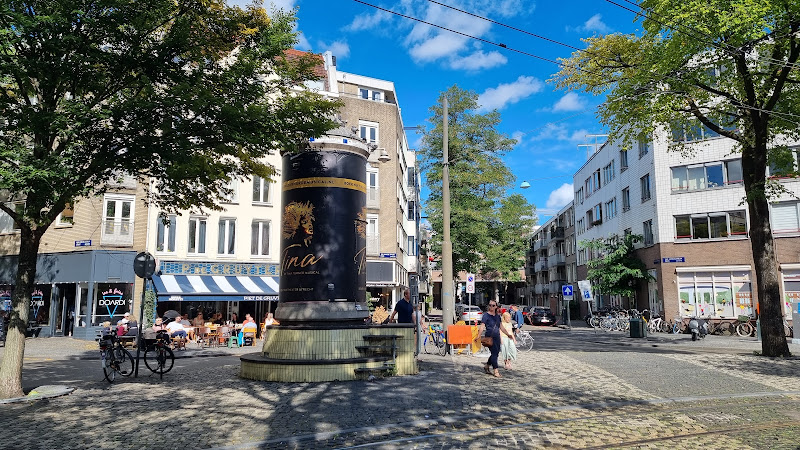
Kunsttoepassing Abri en peperbus is a 1997 public artwork by Dutch artist Frank Halmans on Van Limburg Stirumplein, in the Staatsliedenbuurt in Amsterdam-West. It has two parts: a round tram shelter (the abri) that turns a living room inside out, and one of the city’s old peperbus advertising columns, which Halmans saved from removal and raised onto a tiled plinth with a small speaker’s platform.
It is still a working tram stop, now served by tram 5, and plenty of people wait there every day without realising it is art. As a local, I’ve passed it countless times, and it rewards the few minutes it takes to look properly.
| Artist | Frank Halmans (born 1963) |
| Year | 1997 |
| Location | Van Limburg Stirumplein, Staatsliedenbuurt, Amsterdam-West |
| Commissioned by | Amsterdams Fonds voor de Kunst and the former Westerpark borough |
| Materials | Concrete, steel, glass and tiles, with bronze houseplants |
| Tram | Line 5, stop Van Limburg Stirumstraat |
| Cost | Free; it stands in a public square |
Halmans made it as part of the square’s redesign after a long period of urban renewal in the Staatsliedenbuurt. His architectural work keeps returning to the blurry line between private and public space, and to in-between places such as waiting rooms and window sills. This piece puts both on a street corner.
Key Features
The abri: a living room turned inside out
The shelter starts from a simple idea of Halmans’: waiting for public transport begins at home. You pace, glance out of the window, then walk to the stop and carry on waiting there. So he gave the stop a living-room feel. Two curved, tiled benches run around the outside, and their tops are shaped like window sills. On the sills stand bronze houseplants, sansevierias (snake plants), complete with pots and saucers.
The shelter stands on a circular base about 5 metres across. Glass fills the gaps between steel columns, and a tiled central column supports a saucer-shaped roof that is wider than the floor. Inside you are out of the wind and rain, but there is nowhere to sit: you stand and look out through the glass at the window sills. It is a bit like being a goldfish in a bowl, looking out at your own living room. Inside becomes outside, and outside feels like home.
The peperbus: a rescued street icon
The second half stands across the tram tracks, which run through a channel that cuts the square in two. A peperbus is one of Amsterdam’s round poster and advertising columns; this one also houses electrical equipment for the area. It was due to be removed, but Halmans saw it as an icon of the city, kept it, and set it on a plinth that matches the shelter’s bench.
Look closely at the plinth. Its tiled bench is broken by two small sets of steps leading up to a speaker’s platform, with a lectern and a reading lamp above it. That nod to the neighbourhood’s past was requested by the artwork’s advisory committee: in the late 1970s the Staatsliedenbuurt was Amsterdam’s best-known squatters’ stronghold. Halmans described the spot as a place where the next revolution could break out.
Why so many people miss it
The brief was to design a tram shelter, so the artwork has to work as ordinary street furniture. It does that well enough that many regulars never notice the joke. City curator Annemarie de Wildt told AT5 that this is exactly what makes it fun: plenty of people have no idea it is art. A plaque from the City of Amsterdam on the peperbus explains the work.
Best Time to Visit
You can see it at any hour, and ten to fifteen minutes is enough to take in both parts. A few conditions make a visit better:
- Daylight is best for the details: the bronze plants, the tile colours and the lectern on the plinth are easier to read.
- Early mornings and weekend mornings are quieter if you want photographs without waiting passengers in every frame.
- Try a rainy day. Standing dry inside while the outdoor window sills get soaked makes the inside-out idea click.
- Avoid the morning and evening rush if you want space; it is a working stop.
Cars circle the square as a roundabout and trams run through the middle, so cross carefully when moving between the shelter and the peperbus.
How to Get There
The artwork is on Van Limburg Stirumplein, between Van Limburg Stirumstraat and Van der Hoopstraat, a short walk south of the Westerpark neighbourhood and part of our wider Amsterdam-West guide.
- By tram: take tram 5 towards Westergasfabriek and get off at Van Limburg Stirumstraat. The shelter is the stop itself; look for the bronze plants. Tram 5 runs from Amstelveen via Museumplein, Leidseplein and the Marnixstraat, but it does not stop at Centraal Station. Older guides mention tram 10, which was discontinued in 2018.
- On foot from Centraal: allow about 35 minutes. Walk west along Haarlemmerstraat and Haarlemmerdijk to Haarlemmerplein, cross the Singelgracht onto the Haarlemmerweg, then turn left into Van Limburg Stirumstraat and follow it to the square.
- By bike: roughly 10 to 15 minutes from the centre. Cross tram tracks at a steep angle so your tyres don’t catch.
Trams and buses don’t take cash; tap in and out with a contactless bank card or a GVB ticket. Check live times in the GVB journey planner. For the full experience, wait for the tram inside the shelter at least once; using it as intended is part of the point.
What to See Nearby
- Drie figuren op straat (2001): Peter Erftemeijer’s three bronze figures walking along Van Limburg Stirumstraat, just off the square.
- Poort (1988), known locally as the Blauwe Poort: Dicky Brand’s blue arch where Van Beuningenstraat meets Van Boetzelaerstraat.
- Westerpark, across the Haarlemmerweg, for a walk or picnic, and the Gashouder at the Westergasfabriek.
- Plenty of cafés in Amsterdam for a coffee afterwards, plus more street-scale Amsterdam landmarks.
Abri en peperbus is also a stop on the borough’s self-guided Westerpark and Staatsliedenbuurt art walk (PDF, in Dutch), a loop of about two and a half hours past some 35 public artworks.
Frequently asked questions
Does tram 10 still stop at Abri en peperbus?
No. Tram 10 was discontinued in July 2018. Tram 5 now serves the stop, listed as Van Limburg Stirumstraat.
Is the speaker’s platform on the peperbus meant to be used?
Yes. The steps, lectern and reading lamp were designed as a speaker’s platform referring to the neighbourhood’s activist past. Use it considerately, as it sits in a busy square.
Does it cost anything to see Abri en peperbus?
No. It stands in a public square and doubles as a tram stop, so you can see it at any time for free. You only need to pay if you board the tram.