Description
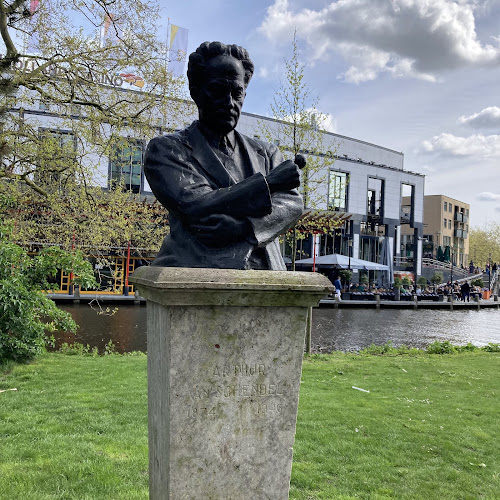
The Arthur van Schendel statue is a bronze portrait bust of the Dutch novelist Arthur van Schendel (1874–1946). It stands in the Leidsebosje, a small park on the Stadhouderskade beside Leidseplein. The sculptor Jobs Wertheim made it, and it was unveiled on 5 March 1952, which would have been the writer’s 78th birthday. The bust is outdoors in a public park, so you can see it for free at any time.
Van Schendel was born in Batavia, in what was then the Dutch East Indies and is now Jakarta, and he died in Amsterdam on 11 September 1946. Britannica counts some of his books among the greatest Dutch novels of his period. His best-known novel is Het fregatschip Johanna Maria (1930), published in English as The Johanna Maria. It tells the story of a sailing ship and the sailmaker devoted to her. Een Hollands drama (1935), published in English as The House in Haarlem, was another popular success.
He is much better known in the Netherlands than abroad. During the Second World War, the occupying authorities banned his books. In 1947, he was awarded the P.C. Hooft Prize, the Dutch state prize for literature, after his death. Several of his novels stayed on the Dutch literary canon for decades after the war.
Arthur van Schendel statue at a glance
| What it is | Bronze portrait bust of novelist Arthur van Schendel |
| Sculptor | Jobs Wertheim |
| Unveiled | 5 March 1952 |
| Location | Southern part of the Leidsebosje, Stadhouderskade, Amsterdam (Oud-West) |
| Nearest landmark | Leidseplein, across the Leidsebrug |
| Cost | Free; outdoor public artwork |
| Time needed | 5–10 minutes, or longer if you also see the park’s other artworks |
Why the bust stands in the Leidsebosje
The spot has a personal link to the writer. For a short time, Van Schendel lived at Leidsekade 89. From there, he regularly walked through this green strip to read the newspaper at the Park Hotel. His widow, a son and a granddaughter attended the 1952 unveiling, along with an Amsterdam alderman.
The bust has had an eventful life since then. It was once pulled off its pedestal, and in 1981 it disappeared altogether. It later turned up at a scrap dealer and was put back in the 1980s. Sources give different years for when it was found and returned. When the bust was first placed, it stood in open space. In the early 21st century, part of the park was built on, so today it sits among the park’s small buildings and is easy to miss.
Key Features
- The bronze bust: Wertheim’s portrait sits on a plain pedestal and is modest in scale. It’s a quiet tribute rather than a grand monument.
- A second writer nearby: The Leidsebosje also has a bust of the playwright Herman Heijermans by Joseph Mendes da Costa, so the park honours two Dutch writers.
- Het Boomzagertje: Look up into the plane trees for a small iron figure sawing off the branch he stands on. An artist known only as “De Onbekende Beeldhouwer” (the Unknown Sculptor) placed it here in 1989.
- Some of Amsterdam’s thickest trees: Two old hybrid plane trees in the park, planted in the mid-19th century, are probably the thickest trees in the city. In the 1920s, when the Leidsebrug was widened, they were moved rather than cut down.
- Centuries of history: A 1737 map already shows greenery here, outside the old Leidsepoort city gate. The park’s long-standing informal name, Leidsebosje, became official only in 2017.
The park’s other public artwork is Henk Zweerus’s abstract Horizontale compositie (1958), in the northern half. If you like finding small artworks around Leidseplein, the bronze lizards of Blauw Jan are a short walk away.
Best Time to Visit
You can see the bust at any time of year, and it costs nothing, so the best time is whenever you’re already near Leidseplein or heading to Vondelpark. Daylight makes the details of the bronze easier to see and photograph. Leidseplein gets very busy in the evening, when its bars, theatres and music venues fill up.
From late spring to early autumn, the plane trees give the park shade, and it makes a pleasant stop before or after a walk in Vondelpark. If you want to mark an anniversary, 5 March is Van Schendel’s birthday and also the date the bust was unveiled in 1952. Amsterdam weather changes quickly, so bring a rain layer whatever the season.
How to Get There
The bust is in the southern part of the Leidsebosje, the narrow park between the Stadhouderskade and the Singelgracht. Starting from Leidseplein, cross the Leidsebrug towards the Stadhouderskade and walk into the park. It takes only a few minutes. The concert hall Paradiso is just across the canal on the other side of Leidseplein.
- By tram: Take a tram to the Leidseplein stop. GVB lines 1, 2, 5, 7 and 19 all serve it. Tram routes can change during roadworks: tram 1 is scheduled to run a diverted route from Leidseplein until 1 May 2027. Check the GVB or 9292 journey planner before you travel.
- On foot: From the canal ring, walk along the Leidsestraat to Leidseplein, then cross the Leidsebrug.
- By bike: Leidseplein has an underground bicycle parking garage. Our Amsterdam cycling routes guide includes a Vondelpark loop that passes nearby.
- With a map app: Search for “Leidsebosje” rather than the statue name. Coordinates: 52.3628, 4.8814.
If you can’t spot the bust, look around the small pavilions in the southern half of the park, towards the Max Euweplein side. For more to do in the area, see our Leidseplein neighbourhood guide or our list of free sights in the Amsterdam budget guide.
Frequently asked questions
Is the Arthur van Schendel statue free to visit?
Yes. The bust stands outdoors in the Leidsebosje, a public park, so there is no ticket or entry fee.
Which Arthur van Schendel book should I read first?
Start with Het fregatschip Johanna Maria (1930), his best-known novel, published in English as The Johanna Maria. Een Hollands drama (1935), published in English as The House in Haarlem, is another good choice.
Is there an Arthur van Schendel street in Amsterdam?
Yes. The Arthur van Schendelstraat is in the Geuzenveld-Slotermeer area of Amsterdam Nieuw-West, far from the bust. The town of Ede, where he lived for many years, also has an Arthur van Schendellaan.
What else is in the Leidsebosje?
The park also has a bust of playwright Herman Heijermans, Henk Zweerus’s abstract Horizontale compositie, the small Boomzagertje figure in a plane tree, and two of Amsterdam’s thickest trees.