Unus Mundus is a walk-around light sculpture by Amsterdam artist and musician Renata Mandić. It stands on the northern bank of the IJ beside FC Hyena, Aambeeldstraat 24, in Amsterdam-Noord. It is not in Westerpark. It is shaped like a rhombohedron, a steel frame faced with colour-shifting dichroic glass, and LED strips inside its edges light it up after dark. Seeing it costs nothing, and the easiest route from Centraal Station is the free F2 ferry to IJplein, followed by a short walk or bike ride east.
The work dates from 2022. The City of Amsterdam commissioned it together with Makers aan het IJ as part of the MooiMakers public-art programme. Mandić developed it with Dilara Kivanç, a young participant who joined through the community organisation DOCK.
Unus Mundus at a glance
| Detail | What to know |
|---|---|
| Artist | Renata Mandić, with Dilara Kivanç (DOCK youth participant) |
| Year | 2022 |
| Commissioned by | City of Amsterdam with Makers aan het IJ (MooiMakers programme) |
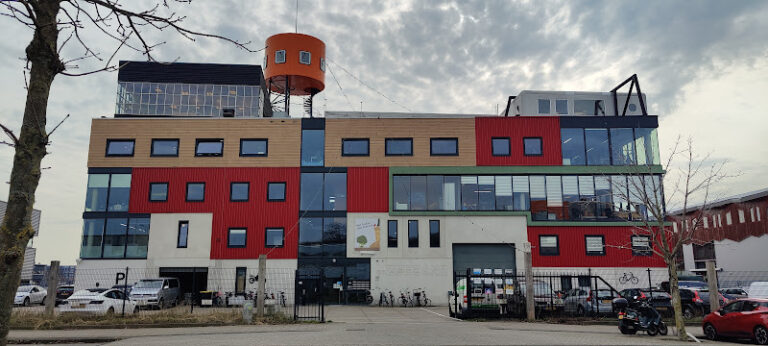
| Location | IJ bank beside FC Hyena, Aambeeldstraat 24, 1021 KB Amsterdam-Noord (Hamerkwartier) |
| Form | Rhombohedron with golden-rhombus faces |
| Materials | Steel frame with holographic car paint, dichroic glass surfaces and custom LED strips |
| Cost | Free; it is an outdoor public artwork |
| Nearest transport | F1 ferry to Zamenhofstraat (about 5 minutes’ walk); bus 35 to Johan van Hasseltweg (about 10 minutes); Metro 52 to Noorderpark (about 15 minutes) |
What the sculpture is
A golden rhombohedron
The artist describes the shape as a rhombohedron: think of a cube pushed out of square, with two opposite corners where three identical faces meet in triangular points. Each face is a golden rhombus, which means the ratio between its two diagonals is the golden ratio. The idea began with origami folds that Mandić explored with the DOCK youth group. It then grew into a full-scale sculpture.
Makers aan het IJ links the form to the mysterious polyhedron in Albrecht Dürer’s 1514 engraving Melencolia I. If you know that print, you will recognise the family resemblance.
Colour-shifting glass and LED light
The steel frame is sprayed with holographic car paint, and the panels are dichroic glass. As you walk around the work, the panels shift from a golden opal tone to blue-green and violet. The sponsor ChameleonLAB supplied the dichroic film, and LED-Gigant supplied the custom lighting: a network of LED strips running along the inside of the crystal-like edges.
After dark, the lights turn the piece into what Mandić calls an “optic crystal”. Colour and reflection bounce between the angled panels. Because the colours depend on where you stand, it pays to walk slowly all the way around it rather than viewing it from one spot. That goes for photos too.
What “Unus Mundus” means
Unus mundus is Latin for “one world”. Mandić presents the work as a tribute to an idea of a single, unified reality that goes back at least to Plato’s allegory of the cave. In her framing, the sculpture is about the link between outer appearance and inner process, and about how connected systems and communities can cooperate. You don’t need the philosophy to enjoy it, but it explains why the piece invites you to keep moving and looking.
Where to find it in Amsterdam-Noord
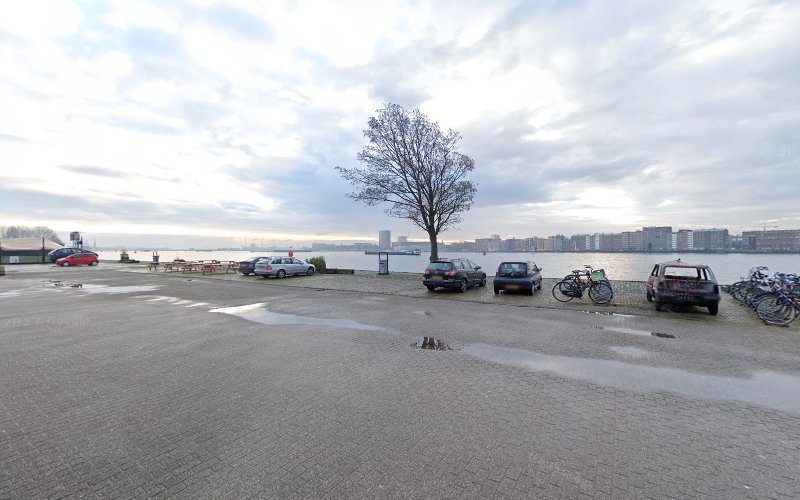
Unus Mundus stands on the Hamerkop site, by the water in front of FC Hyena at Aambeeldstraat 24. This is in the Hamerkwartier, a former industrial area of Amsterdam-Noord, looking south across the IJ towards Java-eiland. Makers aan het IJ also includes the spot on its MooiMakers history route, which places public artworks at seven locations around Oud-Noord.
Several online listings, including an earlier version of this page, have placed the sculpture near Westerpark. The artist and the commissioning organisation both give the IJ bank location in Noord, so aim for FC Hyena.
The Hamerkwartier is being rebuilt as a mixed residential and working district. The Hamerkop part is planned for about 1,200 homes between 2025 and 2035. A February 2026 revision of the plan keeps the buildings that house FC Hyena. Even so, the surroundings will keep changing, and the sculpture could be moved at some point. If you are crossing the city just to see it, ask FC Hyena whether it is still in place.
How to get there
All of the GVB ferries across the IJ are free for pedestrians and cyclists. The walking times below come from FC Hyena’s own directions, except where marked as an estimate.
- From Centraal Station: take ferry F2 to IJplein. It runs about every 6 minutes, the crossing takes about 5 minutes, and the last boat leaves Centraal at 23:56. From IJplein, walk or cycle east through the neighbourhood to Aambeeldstraat. Our estimate is 15–20 minutes on foot.
- From Amsterdam-Oost: ferry F1 (the Oostveer) crosses from Azartplein on the KNSM/Java-eiland side to Zamenhofstraat in about 6 minutes, roughly every 20 minutes. FC Hyena is about 5 minutes’ walk from the landing. F1 stops running around 22:30.
- By metro: take Metro 52 to Noorderpark, then walk about 15 minutes.
- By bus: take bus 35 to Johan van Hasseltweg, then walk about 10 minutes.
- By bike: this is the most flexible option. Both the F1 and F2 ferries carry bikes, and you can combine the trip with other stops in Noord.
- By car: parking is available in front of the building or at the neighbouring Hamerkop car park. FC Hyena lists a starting rate of €5 for the first three hours, then €1.60 per hour, paid by debit card at the barrier.
When to visit
Go after dark to see the LEDs, and go before sunset if you also want to see the glass change colour in daylight. No official lighting schedule is published, so plan your visit around sunset.
- Winter: darkness comes early. Amsterdam’s earliest sunset is around 16:29 in mid-December, which makes an evening visit easy on any ferry.
- Midsummer: sunset is as late as about 22:09 in late June, and it gets properly dark later still. By then the F1 has stopped, so plan to return via the F2 from IJplein, Metro 52 or bus.
- Spring and autumn: sunset falls around dinner time, so you can eat at FC Hyena and then walk out to see the lights.
Make an evening of it
FC Hyena is a boutique cinema, restaurant and wine bar right next to the sculpture. According to its website, it opens at 10:00 on weekdays and around 11:30 at weekends, and closes around 01:00. Lunch is served from 12:00 to 17:00 and dinner from 18:00 to 22:00. It is closed on 25 December and 1 January. The same stretch of waterfront has the restaurant De Goudfazant and the Monk bouldering gym.
For a longer day in Noord, add the Eye Film Museum or the viewing deck at A’DAM Tower, both on the waterfront opposite Centraal Station. For other outdoor artworks and memorials around the city, see our list of Amsterdam monuments.
Frequently asked questions
Is the Unus Mundus sculpture in Westerpark?
No. Unus Mundus stands on the IJ bank beside FC Hyena, Aambeeldstraat 24, in Amsterdam-Noord. Listings that place it near Westerpark are incorrect.
Does it cost anything to see Unus Mundus?
No. It is an outdoor public artwork commissioned by the City of Amsterdam, and the GVB ferries that reach it are free for pedestrians and cyclists.
Is Unus Mundus lit every night?
The sculpture is designed to light up after dark, but no official lighting schedule is published. Plan to arrive after sunset for the best chance of seeing the LEDs.
How do I get back to Centraal Station late in the evening?
Ferry F1 stops running around 22:30. After that, walk to IJplein for ferry F2, which runs to Centraal Station until about midnight, or take Metro 52 from Noorderpark.