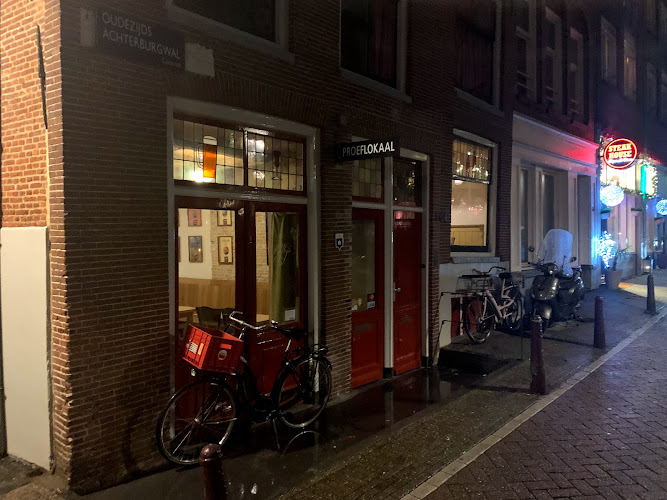
Proeflokaal ‘t Kelkje is a small jenever tasting room at Oudezijds Achterburgwal 164 in De Wallen, open Thursday to Sunday from 15:00 to 21:00. It opened in early 2016 as the city-centre outlet of Distilleerderij ‘t Nieuwe Diep, so you can taste the Flevopark distillery’s genevers, liqueurs and bitters without travelling out to Amsterdam-Oost.
‘t Kelkje at a glance
| Address | Oudezijds Achterburgwal 164, 1012 DW Amsterdam, on the corner of Prinsenhofssteeg (some listings use 164A) |
| Opening hours | Thursday to Sunday, 15:00–21:00; closed Monday to Wednesday |
| Phone | 06 253 781 04 |
| What it pours | Genever, liqueurs, fruit spirits, bitters, eaux de vie and a short list of specialty beers |
| Size | Very small, with room for roughly 15 guests |
| Good for | Tasting several jenevers side by side in a quiet room |
What to drink at ‘t Kelkje
The list runs to more than 80 drinks, almost all from Distilleerderij ‘t Nieuwe Diep. The distillery has worked since June 2010 in the former Oetewaler Polder pumping station in Flevopark, a building from 1880, and makes around 100 jenevers and liqueurs. The two businesses are family-linked: the distiller is the father of the man who runs ‘t Kelkje.
Jonge vs oude jenever
The labels have nothing to do with age. Jonge (young) jenever follows the newer recipe, with no more than 15% malt wine, so it tastes cleaner and lighter. Oude (old) jenever follows the older style, with more than 15% malt wine, which gives it a fuller, grainier flavour. Korenwijn goes further still, with at least 51% malt wine. If you’re new to jenever, ask for a jonge and an oude side by side and the difference is obvious within a sip.
Liqueurs, bitters and fruit spirits
Beyond genever, the shelves hold liqueurs, herbal bitters, 20% fruit spirits and eaux de vie. These are an easier way in if a straight jenever sounds too strong, and the staff can suggest one to follow a first tasting.
Beer
There’s a small selection of specialty beers rather than a long craft list. Amsterdam’s beer guide says ‘t Kelkje carries the same range as the distillery’s tasting room, which leans toward German and Czech beers. That suits the house ritual below.
How to drink a kopstoot
A kopstoot (literally “headbutt”) is a jenever served next to a small glass of beer. The two are drunk alternately, never mixed.
- Order a jenever and a small beer together.
- The jenever arrives in a tulip-shaped glass filled right to the rim.
- Because the glass is too full to lift, lean forward and take the first sip without using your hands.
- After that, alternate between jenever and beer at your own pace.
- Don’t pour the jenever into the beer; the point is the contrast between the two.
The building’s history
‘t Kelkje occupies a rijksmonument (national monument) with a neck gable from the third quarter of the 18th century, facing the Oude Waalse Kerk across the canal. Heritage restorer Stadsherstel Amsterdam acquired the run-down building in 2001 and began restoring it in 2006. The work stripped layers of white paint from the façade and uncovered original fireplaces, panelling and plasterwork inside.
The corner building has served drinks for more than a century. It was a bookshop in the late 19th century, then briefly a cooperative kitchen with Café Moderne upstairs from 1905, and Café ‘t Raedthuis from at least 1932. The stained-glass windows decorated with jenever glasses were designed by the owner’s mother, who also designs the bottle labels.
The name comes from Jaroslav Hašek’s The Good Soldier Švejk, in which the soldier promises to meet his friend for a drink at “the Chalice” in Prague after the war.
Planning your visit
- Getting there: From Dam Square, walk down Damstraat and Oude Doelenstraat, then turn right before the second bridge. The bar sits on the quieter stretch of the canal.
- Timing: With space for about 15 people, seats go fast. Arriving close to 15:00 gives you the best chance of a spot at the bar.
- Closing time: Last pours are before 21:00, so plan it as an afternoon or early-evening stop.
- Neighbourhood etiquette: Photographing sex workers in De Wallen is illegal. Read our Red Light District guide before you go.
- Prices: The bar doesn’t publish prices online, so check the board when you arrive.
More jenever stops nearby
- Wynand Fockink: a historic tasting room off Dam Square, founded in 1679.
- Café ZILT: a Zeedijk bar with a deep Dutch and Belgian jenever shelf and set tastings.
- Flevopark: home of the ‘t Nieuwe Diep distillery and its lakeside tasting room.
- Cheese and jenever loop map: a self-guided tasting route through the centre.
- De Wallen neighbourhood guide: more places to eat, drink and visit around the canal.