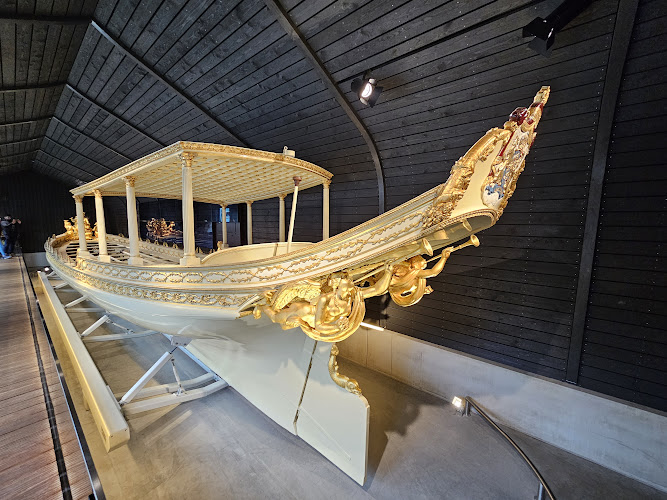

The Maritime Museum sits at the calm eastern edge of Amsterdam’s old harbour, on Kattenburg beside broad water rather than the tight lanes of the canal belt. Its immense former Admiralty storehouse is part of the experience: the courtyard’s glass canopy, thick walls and waterside setting give the visit a strong sense of the city as a working port, not merely a postcard capital.
This is an especially good choice for travellers who want context for Amsterdam’s canals, trade routes and seafaring past without staying in the busiest museum quarter. Galleries combine objects, maps and hands-on interpretation, while the full-scale replica merchant ship moored outside supplies the memorable, physical counterpoint. The surrounding Oostelijke Eilanden feel residential and spacious, making the museum easy to fold into a slower eastern-centre walk.
Key Highlights & What to Expect
Allow time to move between the grand building, the ship and the changing displays rather than treating this as a quick rainy-day stop. The museum is strongest when approached as a story of navigation, empire, labour, migration and maritime technology; it does not reduce Amsterdam’s relationship with the sea to golden-age spectacle. Labels and interactive elements make it accessible to mixed-age groups, though visitors seeking only fine art may prefer a more collection-led museum.
- The building itself: The former naval storehouse frames the visit from the moment you enter. Pause in the covered inner courtyard to appreciate how its historic geometry meets contemporary glasswork.
- Aboard the replica ship: Walking its decks gives scale to long-distance commerce and shipboard life in a way models cannot. Narrow passages and steps are part of the atmosphere, so it may not suit every mobility need.
- Maps and world views: Maritime charts and navigation stories reveal how Amsterdam was connected to wider seas, while also opening questions about colonial power and whose journeys were recorded.
- Interactive family appeal: Digital voyages and tactile displays help younger visitors engage. Families should still leave room for the galleries rather than heading straight to the ship.
- Waterfront breathing space: Outside, the open quays offer a welcome reset after the galleries. The light, wind and passing boats make this a markedly different museum setting from Museumplein.
Practical Planning Snapshot
| Planning Factor | What to Expect | Local Tip |
|---|---|---|
| Best Time / Timing | Weekday mornings generally feel calmer, while wet-weather days and school breaks can concentrate visitors indoors. | Start with the ship or the main galleries first, then use the courtyard and waterfront as a mid-visit pause. |
| Typical Duration | A focused visit can cover the headline spaces; curious visitors and families can comfortably make an afternoon of it. | Build in unhurried time for the ship, which is more rewarding when you can linger over the details. |
| Crowd & Booking Reality | It is a major family-friendly museum, so popular periods can feel lively, particularly around interactive areas. | Check current entry arrangements before setting out and avoid planning a tightly timed connection immediately afterwards. |
| Getting There & Terrain | The site is east of the historic centre, reached easily by bike, on foot from the eastern canal belt, or via nearby public transport connections. Quays are largely level, though the ship has steps. | Cycle via the quieter eastern waterfront rather than weaving through central shopping streets; use care around tram tracks and cobbles. |
| Ideal Pairing Nearby | It pairs naturally with a walk around the Oostelijke Eilanden, the Entrepotdok waterfront or a canal-side route back toward Plantage. | Continue toward the Plantage for a contrast between harbour history, leafy streets and the eastern edge of central Amsterdam. |
Who It Suits Best & Honest Trade-Offs
The Maritime Museum suits families, design-minded visitors, history lovers and anyone wanting a substantial indoor stop beyond the usual central circuit. It is also a smart pick for first-time visitors trying to understand why water shapes Amsterdam so completely. The trade-off is location: it is not something to pop into between Dam Square and the major canal-belt sights, and the subject matter rewards attention rather than a rushed photo stop. Those with limited time should choose between a deep visit here and a broader sweep of the central museums. For many, the quieter harbour setting and chance to board the ship make that choice worthwhile.