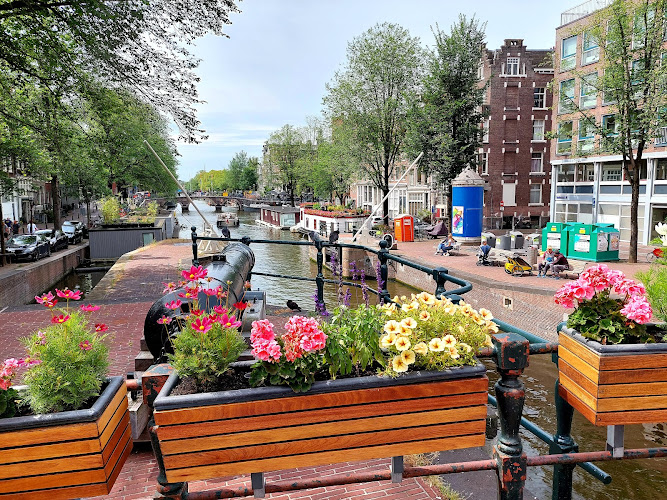
Het Kanon bij de sluis is a small old cannon on the quay where the Korte Prinsengracht meets the Brouwersgracht, on the northern edge of the Jordaan. It’s free, it sits on a public street you can reach at any hour, and you only need a couple of minutes to see it. The better reason to come is the corner around it: two 18th-century arch bridges, one of the city’s best-known brown cafés, and some of the calmest canal views in the center.
It’s a minor landmark, not a headline tourist attraction. Don’t cross town for it. If you’re already walking the Brouwersgracht, going to the Noordermarkt or stopping at Café ‘t Papeneiland, it’s worth the short detour.
Quick facts
| Location | Quay at the junction of the Korte Prinsengracht and Brouwersgracht, Amsterdam-Centrum |
|---|---|
| Neighborhood | Northern edge of the Jordaan, where it meets the western canal belt |
| Cost | Free |
| Opening hours | None. It stands on a public street. |
| Time needed | A few minutes, or 30 to 60 minutes with the surrounding bridges, café and canal walk |
| Nearest public transport | Bus 18, 21 or 22 to Buiten Brouwersstraat; tram 13 or 17 to Westermarkt |
| Combine with | Café ‘t Papeneiland, the Noordermarkt, a Brouwersgracht walk |
What we know about the cannon
The cannon is small and stands on a stone base beside the water. None of the public sources we checked record its age, where it came from or what it was originally used for. Be wary of confident dates, including the common claim that it’s a 17th-century ceremonial gun.
What is well documented is the Dutch habit of reusing retired guns. All over the Netherlands, old cannons were set into the ground as corner posts, curb posts and mooring posts. In 1872, the specifications for the canal between Middelburg and Vlissingen called for 254 cannons to be installed as mooring posts, partly because iron didn’t rot the way timber posts did. We can’t confirm whether this cannon ever had a practical job like that or was put here later as decoration.
It’s tempting to connect it to the Amsterdammertje, the city’s brown street bollard. The popular story says the first ones were old VOC ship cannons plugged with a cannonball. Historian Anneke van der Stoel looked into this in 2015 and concluded the bollards more likely descend from older stone street posts.
Why the name says “sluis”
Amsterdammers traditionally called fixed stone bridges a sluis (lock), even where no working lock survived. This corner has several of them:
- Papiermolensluis (bridge 57): a 1781 brick-and-stone arch bridge over the Brouwersgracht that links the Prinsengracht and Korte Prinsengracht quays. A 1647 map calls it the Brouwers Sluys, a real lock that kept the canal belt’s water level separate from the Jordaan’s. Its current name comes from a paper merchant’s shop sign, and it was once called the Oliekoekensluis after the pancake bakers who had stalls here.
- Lekkeresluis (bridge 59): a 1754 arch bridge where the Prinsengracht runs into the Brouwersgracht, named after bakers who sold food there, with views toward the Westertoren.
- Eenhoornsluis: a little further north on the Korte Prinsengracht, where Haarlemmerstraat becomes Haarlemmerdijk.
The Papiermolensluis and Lekkeresluis have both been municipal monuments since 1995. The cannon is the small detail; the bridges carry most of the history. Browse more of the city’s historic bridges and monuments if this corner appeals to you.
What to see nearby
The Brouwersgracht, named after the breweries that once lined it, forms the border between the Jordaan and the canal belt. It’s one of the canals featured in our guide to the best Amsterdam canals. These are all within a few minutes’ walk of the cannon:
- Café ‘t Papeneiland at Prinsengracht 2, an old brown café on the canal corner, known for its apple pie.
- The Noordermarkt, which holds markets on Saturday (9:00 to 16:00) and Monday (9:00 to 14:00). Read our Noordermarkt Saturday market guide before you go.
- Korte Prinsengracht 6, a national monument (rijksmonument) restored by the heritage organization Stadsherstel Amsterdam.
When to go
Any time works, because there’s nothing to open or book. Early mornings and weekdays are usually the quietest. Saturdays are the busiest, since the Noordermarkt draws crowds a couple of blocks away.
In autumn and winter, the cafés nearby make it easy to pair a quick look with somewhere warm. For photos, frame the cannon against the bridges and gabled houses behind it. A tight close-up of the cannon on its own tells you much less about the place.
How to get there
| From | Route | Approximate time |
|---|---|---|
| Amsterdam Centraal (on foot) | Walk west along Haarlemmerstraat, turn left onto the Korte Prinsengracht at the Eenhoornsluis, then follow it to the Brouwersgracht. | About 15 minutes |
| Dam Square (on foot) | Walk west on Raadhuisstraat, turn right onto the Prinsengracht, then follow it north past the Westerkerk to where it ends at the Brouwersgracht. | About 20 minutes |
| Bus | Take bus 18, 21 or 22 from Centraal to Buiten Brouwersstraat, one stop along, then walk south to the canal. | A few minutes’ ride, then under 10 minutes on foot |
| Tram | Take tram 13 or 17 to Westermarkt, then walk north along the Prinsengracht. | About 12 minutes on foot from the stop |
To pay on GVB trams, buses and metro, tap in and out with a contactless bank card or phone (OVpay), or use an OV-chipkaart. Use the same card or device to tap in and out, or you’ll be charged incorrectly.
Driving isn’t worth it for a stop this short. If you’re cycling, pull fully out of the bike lane before you stop to look, because the quays and bridges here are narrow and busy.
Frequently asked questions
Is Het Kanon bij de sluis free to visit?
Yes. It stands on a public quay, so there’s no ticket, no opening hours and no queue.
Is the area around the cannon accessible for wheelchairs and strollers?
The quay is at street level, but expect uneven paving, humped bridges and heavy bike traffic. The flattest approach is along the quays rather than over the bridges.
Can you see the cannon from a canal boat?
Boats do use the Brouwersgracht and Korte Prinsengracht, but tours don’t stop here, and a small object on the quay is easy to miss from the water. Walk here if you want a proper look.