Begijnhofkapel is a Roman Catholic chapel at Begijnhof 30 in central Amsterdam, inside the private Begijnhof courtyard just off Spui. It was created in 1665 when two houses were joined into a single church room for the Catholic Beguines, then enlarged from 2 July 1671 to a design by architect Philips Vingboons so that it would not look like a church from the street. Its official name is the HH. Johannes en Ursulakapel, and it is still used daily for Mass, adoration and prayer.
Visiting is free, takes about 10 to 15 minutes, and depends on one practical detail most guides get wrong: the door you use changes during the day. Before 09:30 you enter the chapel through the door at the Spui gate; from 09:30 to 18:00 you use the door at Gedempte Begijnensloot on the Kalverstraat side. Access and service details on this page were checked against the chapel’s own information and the Begijnhof’s visitor rules on 15 September 2026.
Begijnhofkapel at a glance
| Official name | HH. Johannes en Ursulakapel (Saints John and Ursula Chapel) |
| What it is | Working Roman Catholic chapel and former schuilkerk (concealed church) |
| Address | Begijnhof 30, 1012 WT Amsterdam, inside the Begijnhof courtyard |
| Founded | 1665 as a church room in two joined houses; enlarged from 1671 |
| Architect | Philips Vingboons (1671 rebuilding) |
| Protection | Rijksmonument, monument number 368 |
| Run by | Congregation of the Blessed Sacrament, within the St Nicholas Parish of Amsterdam |
| Entrance before 09:30 | Door at the Spui gate, push the black button |
| Entrance 09:30 to 18:00 | Door at Gedempte Begijnensloot, on the Kalverstraat side |
| Admission | No ticket and no entrance fee; the chapel relies on donations and Mass intentions |
| Time to allow | 10 to 15 minutes for the chapel, 30 minutes with the courtyard |
| Courtyard hours | Daily 10:00 to 18:00 according to the Begijnhof, closed to tourists on King’s Day, 27 April |
Where Begijnhofkapel is and how to get in
The Begijnhof has two gates. One opens onto the north side of Spui, next to the Friday book market; the other is at Gedempte Begijnensloot, in the extension of Begijnensteeg off Kalverstraat. The Begijnhof itself now directs tourists to the Gedempte Begijnensloot entrance during opening hours.
The chapel is easy to walk past. From the courtyard it reads as an ordinary brick house, and the stylised windows and small porch you see today were added in the 19th century. Look for number 30. The chapel’s own instructions are specific: use the Spui door until 09:30 and press the black button, waiting until the door closes fully behind you, then switch to the Gedempte Begijnensloot door from 09:30 until 18:00. In the evening the Spui gate is used again, with the doorbell at number 30, until roughly 18:30.
Getting there is straightforward on public transport. Tram 2, 11 and 12 stop at Spui; tram 4 and 14 and metro 52 stop at Rokin, two minutes away. From Amsterdam Centraal it is about a 15-minute walk. Full details for the chapel are published on the chapel’s English information page, and the courtyard rules are on the Begijnhof’s own visitor page.
Opening hours, Mass times and prayer times
Two sets of hours apply, and they do not match. The Begijnhof states that the courtyard is open daily from 10:00 to 18:00, including public holidays, while many third-party listings still publish 09:00 to 17:00. The chapel is open daily until 18:00 or 18:30. Treat 10:00 to 17:30 as the reliably safe window for a casual visit, and check the notice at the gate on the day, because hours shift around religious observances and private events. Times below use the 24-hour clock, as local signage does.
| Service | When |
|---|---|
| Mass, Monday to Friday | 09:00 and 17:00 (Dutch) |
| Mass, Saturday | 09:00 (Dutch) |
| Mass, Sunday | 10:00 in Dutch, 11:15 in French |
| Morning prayer (Lauds) | 07:30 Monday to Saturday, 07:45 Sunday, entrance via the Spui gate |
| Evening prayer (Vespers) | 18:15 Monday, Tuesday, Wednesday and Friday; 18:10 Thursday; 17:40 Saturday and Sunday |
| Adoration of the Blessed Sacrament | Weekday afternoons and evenings, with longer Thursday and first-Friday hours; Sunday 16:45 to 18:00 |
New Year’s Day, Easter Monday, Whit Monday, 25 December and 26 December follow the Sunday schedule. If you want to see the interior without interrupting anyone, come mid-morning on a weekday, after the 09:00 Mass and before the afternoon adoration hours begin.
What to look at inside the chapel
The interior is small, restrained and layered with four centuries of additions. Five things reward a slow look:
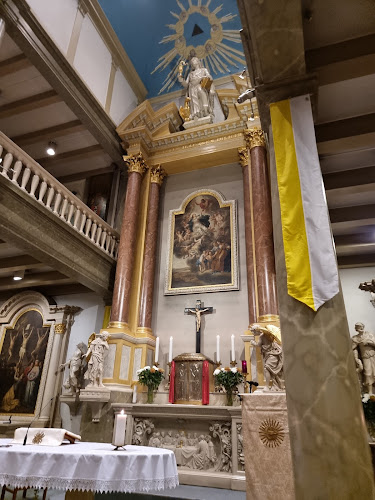
- The neoclassical high altar, with a painting of the Assumption of Mary above the tabernacle and, above that, a statue of John the Evangelist holding his attributes: a book, an eagle, and a chalice with a snake. Between painting and statue runs a chronogram, hIC apostoLUs ILLe qUeM DILIgebat IesUs, whose capital letters encode the year the altar was built.
- The built-in gallery along both sides, added purely to fit more worshippers into a very small room, which tells you how many people once crowded into a church that was not supposed to exist.
- The side chapel on the left, dedicated to the Miracle of Amsterdam, with a statue of Saint Nicholas of Myra, the city’s patron, above the entrance arches and Miracle imagery around the walls.
- De processie, the long painting on the right-hand wall by Antoon Derkinderen, depicting the procession held in honour of the Miracle. It was cleaned, restored and specially lit in 2015 so the narrative can be read again. The paintings above the side altars are by the 17th-century Amsterdam painter Nicolaes Moeyaert.
- The stained glass designed and made by artist Gisèle d’Ailly van Waterschoot van der Gracht in the late 1940s and early 1950s. She put her own portrait into the 1950 window. The Cavaillé-Coll organ is also a transplant, taken over when the Huize St. Bernardus care home was demolished.
Details older guides get wrong
Three claims circulate widely and are worth correcting before you plan a visit. The chapel is usually dated to 1672, but the church room was formed in 1665 and the Vingboons enlargement began on 2 July 1671, reaching its present form in 1682.
The high altar painting is often described as the Miracle of Amsterdam; the Miracle imagery is in the left side chapel and the Derkinderen procession painting, while the altar painting shows the Assumption of Mary. And the windows are frequently called medieval gothic glass, when they date from around 1948 to 1952.
The history behind a concealed church
A chapel has stood on this spot since the Begijnhof was established in the early 14th century, home to Beguines: devout laywomen who lived in community, cared for the sick and taught, without taking permanent monastic vows. The medieval stone chapel of 1419 passed to English-speaking Protestants in 1604 and is now the English Reformed Church, still standing in the same courtyard. The Catholic Beguines moved their worship elsewhere in the hof.
Because only the Reformed church was officially permitted, the replacement had to be invisible from outside. Two houses were combined in 1665, and the 1671 Vingboons rebuilding produced a full church interior behind a domestic facade, the classic Amsterdam schuilkerk solution. When freedom of religion returned in 1795, the concealed church became an openly Catholic one. In the 1880s, as devotion to the Miracle of Amsterdam revived, Catholics looked for a church to serve as its centre; after failing to obtain the medieval Nieuwezijds Kapel, they settled on Begijnhofkapel. The annual procession commemorating the Miracle, now known as the Stille Omgang, still starts here.
Today the chapel is one of four rectorate churches in the St Nicholas Parish, cared for by the Congregation of the Blessed Sacrament. It is headed by a rector rather than a parish priest; Father Pieter van Wijlick sss was appointed in January 2014.
Etiquette and courtyard rules
The Begijnhof is privately owned, occupied housing rather than a museum site, and the rules are enforced by hosts on busy days and weekends. Read them before you arrive so you are not turned away at the gate:
- Behave as you would in someone’s front garden. Keep voices low and stay on the accessible part of the courtyard shown on the map at the entrance.
- Bicycles, dogs and wheeled suitcases are not allowed inside the hof.
- Eating and drinking are not permitted, and there are no bins.
- Groups are limited to a maximum of 12 people.
- Inside the chapel, put your phone away during Mass, adoration and the prayer hours, and do not photograph people at prayer. Discreet photography of the interior outside service times is generally tolerated; if in doubt, ask.
What to combine with your visit
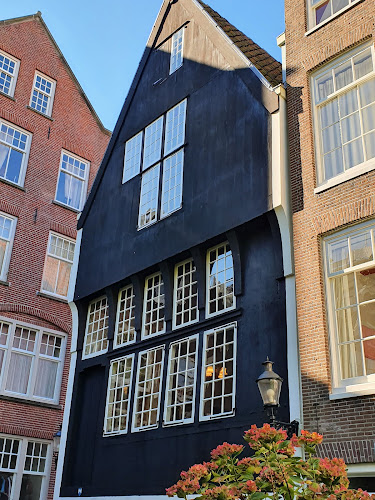
The Begijnhof sits between Spui and Kalverstraat, so a visit slots into almost any central itinerary. The Spui book market runs every Friday from 10:00 to 18:00 with around 25 antiquarian booksellers, directly outside the Spui gate. In the courtyard itself, the English Reformed Church holds English-language services, and Amsterdam’s oldest surviving wooden house, Het Houten Huys, stands a few doors along.
One common itinerary needs updating: the Amsterdam Museum building on Kalverstraat is closed for a major renovation and is expected to reopen around 2028. Until then its exhibitions run at H’ART Museum on Amstel 51 and at Museum Willet-Holthuysen. For more places within walking distance, see our guide to places in Amsterdam Centrum.
Frequently asked questions
Is Begijnhofkapel free to visit?
Yes. There is no ticket and no entrance fee for the Begijnhof courtyard or the chapel. The chapel is funded by donations and Mass intentions, so a contribution in the box is welcome.
Which entrance should I use?
Use the chapel door at the Spui gate before 09:30, pressing the black button. From 09:30 until 18:00 use the door at Gedempte Begijnensloot on the Kalverstraat side. In the evening the Spui gate is used again, with the doorbell at number 30.
Can you take photos inside Begijnhofkapel?
Discreet photography of the interior is generally tolerated outside service times. Do not photograph during Mass, adoration or prayer hours, and do not photograph people at prayer or residents’ homes in the courtyard.
Is Begijnhofkapel the same as the English Reformed Church?
No. Both stand in the Begijnhof courtyard. Begijnhofkapel is the Catholic HH. Johannes en Ursulakapel, created in 1665. The English Reformed Church is the medieval chapel of 1419, which passed to English-speaking Protestants in 1604.
Are services held in English?
No. Mass at Begijnhofkapel is in Dutch on weekdays and Saturdays, with Sunday Mass at 10:00 in Dutch and 11:15 in French. English-language services are held in the English Reformed Church in the same courtyard.
How long should I allow for a visit?
About 10 to 15 minutes inside the chapel, or roughly 30 minutes including a walk around the courtyard, Het Houten Huys and the English Reformed Church.