Frederik Hendrikplantsoen is a small public park in Amsterdam-West, in the Frederik Hendrikbuurt neighbourhood, sitting between Frederik Hendrikstraat and the Nassaukade — just across the water from the edge of the Jordaan. It is best known for two things: a group of five coral-red sculptures called De Stam by Atelier Van Lieshout, and a suspended playground called the Speelslinger that hangs several metres above the ground between the park’s mature trees. Both arrived in a 2015 redesign that transformed a worn patch of urban green space into the neighbourhood’s active centre.
The park is a compact, walkable space — ten minutes covers the full circuit — but it rewards attention. Nearly everything in it connects to what this part of Amsterdam used to be for a living. Coordinates: 52.3788°N, 4.8770°E.
The sawmill history this park was built to remember
The park takes its name from Frederik Hendrik, Prince of Orange, and the streets around it carry names from the same period. In the eighteenth and nineteenth centuries, the heart of this neighbourhood was Amsterdam’s timber and sawmill trade — known then as the Zaagmolenbuurt, or sawmill quarter. Wood processed here was used for housing, furniture, and the ships that made the Dutch maritime republic a global power. The Dutch word for this collective effort — samenwerking, cooperation — runs through the story of the whole neighbourhood.
Almost no physical trace of that industry remains above ground today. The street names are the main surviving signal, which is precisely why the artwork installed in 2015 matters: it is the one thing that tells the story out loud in the city itself.
The park also holds one historical footnote. It was chosen as a prominent location for Amsterdam’s Liberation festivities from 26 to 28 June 1945, when the city publicly celebrated the end of the German occupation. Nothing on site marks this directly, so it is useful to know before you arrive rather than expecting to find it there.
De Stam: five red figures hauling tree trunks
De Stam is a five-part sculpture group designed and produced for this park by Joep van Lieshout and Atelier Van Lieshout, installed in 2015. Each figure is made of coral-red polyester and fibreglass, and each one is engaged in hauling, lifting, or carrying a tree trunk. The five figures are distributed across the park rather than clustered together, so you encounter them one at a time as you walk.
The Dutch title works on two levels. Stam means “tree trunk” — pointing directly at the sawmill history of the Zaagmolenbuurt — and it also means “tribe.” The work is explicitly conceived as a tribute to collective labour: the kind of cooperation that built Amsterdam’s dikes, reclaimed its land, and raised its city. Van Lieshout’s stated intention was for the figures to embody both meanings simultaneously.
One practical detail surprises first-time visitors: these are not look-only sculptures. They were designed to be climbed on and sat on, and children treat them as play equipment. That was a deliberate brief. Residents of the Frederik Hendrikbuurt voted on the design before it was commissioned — the figures reflect the neighbourhood’s own choice, not a top-down art placement.
A second, older sculpture also stands in the park: Droombeeld (Dream Image) by Cephas Stauthamer, a figurative bronze predating the 2015 redesign. It receives far less attention than De Stam but is worth noticing on the way round.
The Speelslinger: a playground in the tree canopy
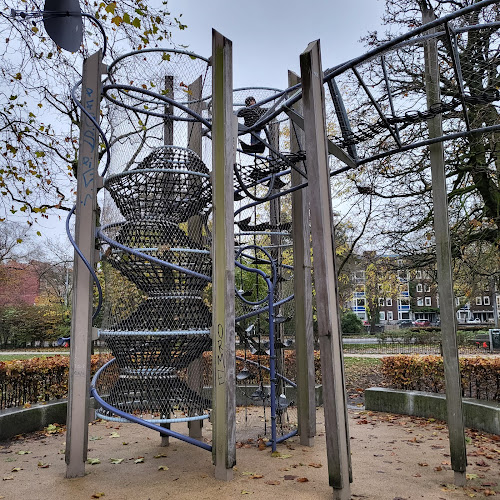
The park’s second landmark is the Speelslinger (play garland), designed by Amsterdam playground studio Carve. It is a suspended cable walkway that runs several metres above the ground through the canopies of the park’s older trees, connecting three age-differentiated play towers at ground level. The total walkway runs roughly 50 metres; the play zone it anchors covers approximately 450 square metres.
Each of the three towers is designed for a different age group, so toddlers and older children are not competing for the same equipment. If you are visiting Amsterdam with young children, this is the single strongest reason to route through the park. Very few Amsterdam playgrounds put children up among the branches at this height.
The full redesign was a co-production led by landscape architects Buro Sant en Co, working alongside neighbourhood residents, local business owners, the City of Amsterdam, Carve, and Atelier Van Lieshout. The result reads as a coherent landscape rather than a park with public art dropped into it.
Practical details
| Detail | Information |
|---|---|
| Location | Frederik Hendrikplantsoen, Frederik Hendrikbuurt, Amsterdam-West (52.3788°N, 4.8770°E) |
| Bordering streets | Frederik Hendrikstraat and the Nassaukade |
| Access and cost | Open public park, no gates, no admission fee, no fixed hours |
| Time needed | 10–20 minutes to walk the full circuit; longer with children using the playground |
| Best for | Families with young children, public-art walks, a break between Jordaan stops |
| Artworks | De Stam (Atelier Van Lieshout, 2015); Speelslinger play garland (Carve, 2015); Droombeeld (Cephas Stauthamer) |
| Facilities | Benches, paths, playground; cafés and shops on the surrounding streets |
| Nearest landmark | Jordaan (across the Nassaukade); Noordermarkt (~15 min walk) |
When to visit
There is no closed season and no ticket. Timing is about atmosphere and photography rather than access. The park is busiest on weekday afternoons after school and on warm summer weekends, when the playground fills and the lawns get claimed for picnics.
- Spring: the mature trees leaf out and the park opens up considerably; the canopy is still light enough to see the Speelslinger’s cable structure clearly from the ground.
- Summer: full shade and the liveliest crowd. Good for a sit-down visit; less ideal for unobstructed photographs of the sculptures, as the canopy closes in.
- Autumn: the strongest visual contrast of the year. The coral-red polyester of De Stam against yellowing leaves is the most distinctive photographic window the park offers.
- Winter: quiet and bare, with the full cable geometry of the Speelslinger exposed against the sky. Worth a visit if the design itself interests you more than the greenery.
For photography, early morning on a weekday gives an empty park and softer light. The red polyester is highly saturated and tends to blow out in direct midday sun — this matters whether you are shooting on a phone or a camera.
How to get there
The park sits just outside the Singelgracht ring, roughly a fifteen-minute walk west of the Jordaan’s main streets. It is not signposted as a tourist destination, so set the name in a maps app to navigate directly.
- On foot from Dam Square: approximately 30 minutes. Head west along Raadhuisstraat, continue as it becomes Rozengracht, cross the Lijnbaansgracht and the Nassaukade, then turn right onto Frederik Hendrikstraat.
- By bike: 10–15 minutes from the centre. Bike racks are positioned around the park’s edges; do not lock to the sculptures or the play structure.
- By tram: a tram stop named Frederik Hendrikplantsoen serves the park directly on the Nassaukade side. Check the current GVB route planner before you travel, as Amsterdam reroutes tram lines periodically.
- From Amsterdam Centraal: no single direct tram connects the station to the park on every timetable. The reliable options are a short tram or bus to Marnixstraat followed by a five-minute walk, or a 25-minute walk straight through the Jordaan.
Driving is not recommended. The Frederik Hendrikbuurt is a paid-parking residential zone with very limited kerb space, and Amsterdam’s on-street rates are among the highest in Europe.
What is nearby
The park works best as a stop on a longer walk rather than a standalone trip. The Jordaan begins immediately across the Nassaukade, putting the Westerkerk, the Noordermarkt, and the historic canal belt within fifteen minutes on foot. Frederik Hendrikstraat itself has a run of neighbourhood cafés and independent shops — where most locals end up after a loop through the park.
Frequently asked questions
Is Frederik Hendrikplantsoen free to enter?
Yes. It is an open public park with no gates, no admission fee, and no fixed opening or closing hours.
What are the red sculptures in Frederik Hendrikplantsoen?
They are De Stam, a five-part group by Joep van Lieshout and Atelier Van Lieshout, installed in 2015. The coral-red polyester figures each carry a tree trunk, referencing the neighbourhood’s former sawmill industry — the Zaagmolenbuurt. The Dutch word stam means both tree trunk and tribe.
Can children climb on the De Stam sculptures?
Yes. The figures were specifically designed to be sat on and climbed, functioning as part of the park’s play area rather than as untouchable artworks.
What is the Speelslinger?
The Speelslinger is a suspended cable walkway designed by playground studio Carve, installed in 2015. It hangs several metres above the ground between the park’s mature trees and connects three age-differentiated play towers. The total play zone covers around 450 square metres.
Is the park in the Jordaan neighbourhood?
Not quite. It sits in the Frederik Hendrikbuurt in Amsterdam-West, directly across the Nassaukade from the edge of the Jordaan. The two areas are within a short walk of each other.
Is it worth visiting without children?
Yes, as a short detour. De Stam and the 2015 landscape design by Buro Sant en Co are genuinely interesting, and the park’s historical connection to Amsterdam’s sawmill trade adds context. Treat it as a stop on a Jordaan walk rather than a standalone destination.
What is the historical significance of the park?
The park was chosen as a prominent location for Amsterdam’s Liberation festivities from 26 to 28 June 1945, marking the end of the German occupation. The surrounding streets also preserve the names of the neighbourhood’s eighteenth and nineteenth-century sawmill heritage.