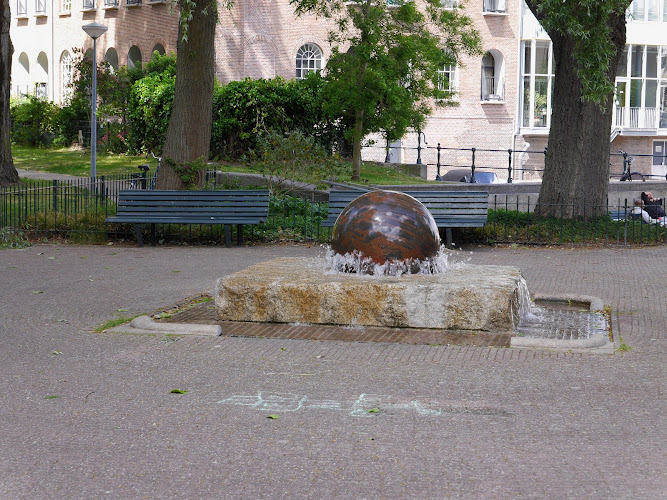
Fonteinbal (“fountain ball”) is the name some map listings use for the Kogelbron, a granite fountain sculpture in Oostenburgerpark, a small neighbourhood park on Oostenburg, one of Amsterdam’s Eastern Islands. German sculptor Christian Tobin made it in 1987. When the water is running, it lifts a heavy stone ball just enough that you can turn it by hand.
| What it is | Kogelbron (also listed as Waterbal), a kinetic granite fountain by Christian Tobin, 1987 |
| Where | Oostenburgerpark, Oostenburg (Eastern Islands), Amsterdam-Centrum, between Compagniestraat and Conradstraat |
| Nearest stop | Bus 22, Oostenburgergracht, about a 5-minute walk |
| Cost | Free; it is a public neighbourhood park |
| Time needed | 20–45 minutes, longer with a picnic or a book |
| Good to know | The water is not always on; without it, the ball will not turn |
What Fonteinbal actually is
Fonteinbal isn’t a plaza full of fountains. It is one sculpture made of four parts: a water basin, a carved stone block with a channel for the water pipe, a cup-shaped hollow, and a granite ball resting in that cup. Water pushed up through the cup forms a thin film under the ball, so it appears to float, and a gentle push from your hand sets it rotating.
Tobin is known for this kind of kinetic stone sculpture. The Oostenburgerpark piece is the older of two in Amsterdam; its younger sibling stands by the RAI convention centre.
I found it by accident on a jog, trying to shake off a stressful workweek, and ran almost straight into it. Since then it has been one of my favourite places to sit for a while. Set your expectations accordingly, though. This is a small, quiet local park, good for half an hour of calm, not a full afternoon of sightseeing.
What to see around the park
Oostenburg had been built up for centuries before a large-scale renewal in the late 1980s. Run-down homes and business premises were cleared, and the open space left behind became Oostenburgerpark. The park and its street were named on 18 October 1989, and the park was laid out around 1990. That explains the mix you see from the benches: modern housing on one side, far older maritime buildings on the other.
- The Oost-Indisch Pakhuis: the back of this former Dutch East India Company (VOC) warehouse faces the park along Compagniestraat. It dates from the early 1720s and was converted into apartments in the late 1990s, so you can admire it only from outside.
- The llama mosaic: since 2021 the park has been a stop on the Mozaïekroute Oostelijke Eilanden, a trail of five mosaic sculptures through the neighbourhood started by Jos Zandvliet and Septimia Kuhlman. The one here shows two llamas.
- Water and skyline: a basin of the Wittenburgervaart lies just north-east of the park, and the large INIT building is visible from the lawns.
- Lawns and benches: there is room for a picnic blanket or a bench with a book, and you’ll share it mostly with residents, from families with kids to dog walkers and people working on laptops.
If you like tracking down public art, the fountain is also part of our list of monuments and memorials in Amsterdam.
Best time to visit
Go between late spring and early autumn if you want to see the ball turning. I couldn’t find a published schedule for when the water runs, and one visitor review has reported the fountain dry, so treat a working fountain as a bonus rather than a guarantee.
- Spring (April–May): the trees come into leaf and the lawns start filling up on sunny weekends.
- Summer (June–August): the busiest season, with picnics and long evenings, but still calm by city-centre standards.
- Autumn (September–October): fewer people and changing leaves; bring a thermos and a book.
- Winter (November–March): chilly and grey, but the bare trees open up the views of the old warehouse.
Early mornings bring joggers and dog walkers, and late afternoon gives you the softest light for photos. Weekdays are usually quieter than weekends.
How to get there
Oostenburgerpark sits east of Amsterdam Centraal, reached via the islands of Kattenburg and Wittenburg. Check the GVB or 9292 app for live times before you go, since routes and stops in this area have changed in recent years.
- Bus: take bus 22 from Centraal Station to the Oostenburgergracht stop, a ride of roughly 6–7 minutes. The park is about a 5-minute walk from the stop.
- Tram: tram 7 runs along Czaar Peterstraat, east of Oostenburg, and tram 26 stops at Kattenburgerstraat to the north. Both leave a longer walk than the bus, so use the app to pick the nearest stop.
- Bike: from the centre it’s roughly a 10–20 minute ride depending on where you start. Watch out for tram tracks, which can catch a bike wheel.
- On foot: allow about 30 minutes from Centraal Station, heading east along the water past the old naval and shipping buildings.
- Taxi: ask for Oostenburgerpark. It’s convenient but rarely worth it for such a short distance.
If you’ll be riding trams and buses several times during your stay, a GVB 1–7 day public transport ticket (affiliate link) is usually simpler than paying per ride.
Once you’re in the park, look for the low stone basin with a ball on top. Fonteinbal pairs well with a longer walk through Amsterdam’s eastern green spaces, such as Oosterpark or Flevopark. For more ideas, browse our full list of parks in Amsterdam.
Frequently asked questions
Is Fonteinbal the same as the Kogelbron?
Yes. Fonteinbal is a map-listing name for the Kogelbron, also listed as Waterbal, a 1987 granite fountain sculpture by Christian Tobin in Oostenburgerpark.
Can you spin the ball at Fonteinbal?
Yes, when the water is running. The water lifts the granite ball on a thin film so you can turn it by hand. When the fountain is off, the ball will not move.
Is there another floating ball fountain in Amsterdam?
Yes. Christian Tobin also made a Kogelbron on Europaplein by the RAI convention centre in 1993, a short walk from Beatrixpark.
Does it cost anything to visit Oostenburgerpark?
No. Oostenburgerpark is a public neighbourhood park, so there is no ticket or entry fee to see the fountain.