The Dubbeltjespanden (“dime houses”) are a short row of 28 small workers’ houses in a side street off Mauritskade in Amsterdam-Oost, between Alexanderplein and Oosterpark. They were built from the early 1870s and are among the first social housing projects in the Netherlands. Most people walk straight past them, because the entrance is hidden behind a blank wall.
Description
I’ve lived in Amsterdam for years, and this is still one of my favorite small detours in Oost. There’s no ticket desk, no queue, and no sign pointing the way. Just a tiny residential street with a story that explains a lot about how this city thinks about housing.
Why they’re called the “dime houses”
A dubbeltje was the 10-cent coin of the old Dutch guilder. The houses were built by the Bouwmaatschappij tot Verkrijging van Eigen Woningen (BVEW), roughly the “Construction Company for the Establishment of Privately Owned Homes.” Its members paid a weekly dubbeltje in dues. The plan was that rent plus this small weekly contribution would make residents the owners of their homes after 20 years.
That promise was never fulfilled. The houses stayed rental homes and are now owned by housing foundation De Key, for which the Dubbeltjespanden were the very first property.
A short history
Workers founded the BVEW in 1868 to escape the expensive, run-down housing many of them lived in. It became Amsterdam’s first cooperative housing association. Architect J.W. Zoutseling designed the street. The first four houses were finished in March 1872, but financial problems slowed construction. Most of the street was ready by 1878, and the last two houses followed in 1885.
Each house holds a ground-floor and an upper-floor home with its own front door, so the 28 houses contain 56 small homes of roughly 30 to 50 square meters. In 1878 the rent was 1.75 guilders a week. De Key renovated the houses thoroughly in 2012.
A second BVEW block, on Czaar Peterstraat and Blankenstraat, was also known as the Dubbeltjespanden. It was built between 1878 and 1880, badly damaged in a gas explosion in 2001, and demolished in 2006. The residential and care complex De Keyzer now stands on the site. So today, the Mauritskade street is the only Dubbeltjespanden you can visit.
Dubbeltjespanden quick facts
| Detail | Information |
|---|---|
| Location | Mauritskade 29–54, Amsterdam-Oost |
| Built | 1872–1885 (most houses finished by 1878) |
| Builder | Bouwmaatschappij tot Verkrijging van Eigen Woningen (BVEW), founded 1868 |
| Architect | J.W. Zoutseling |
| Homes | 28 houses containing 56 upper and lower homes |
| Current owner | Woonstichting De Key |
| Artwork | Het begon met een dubbeltje by Marjet Wessels Boer |
| Access | Private homes; view from the street only; free |
Key Features
The giant brick type case
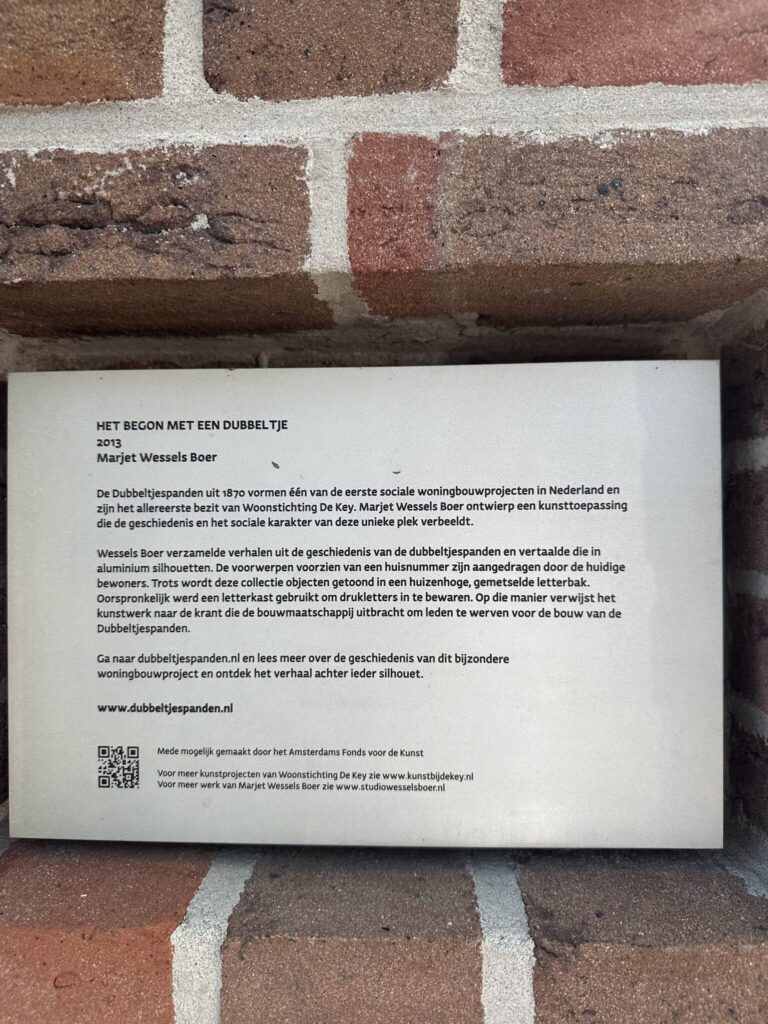
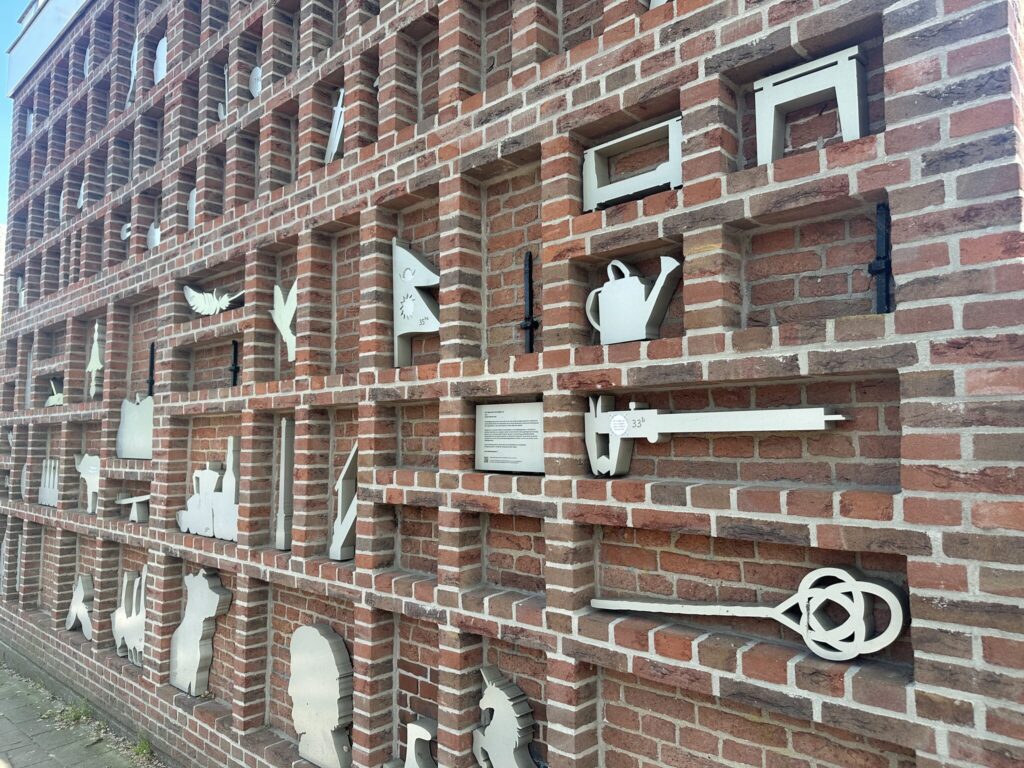
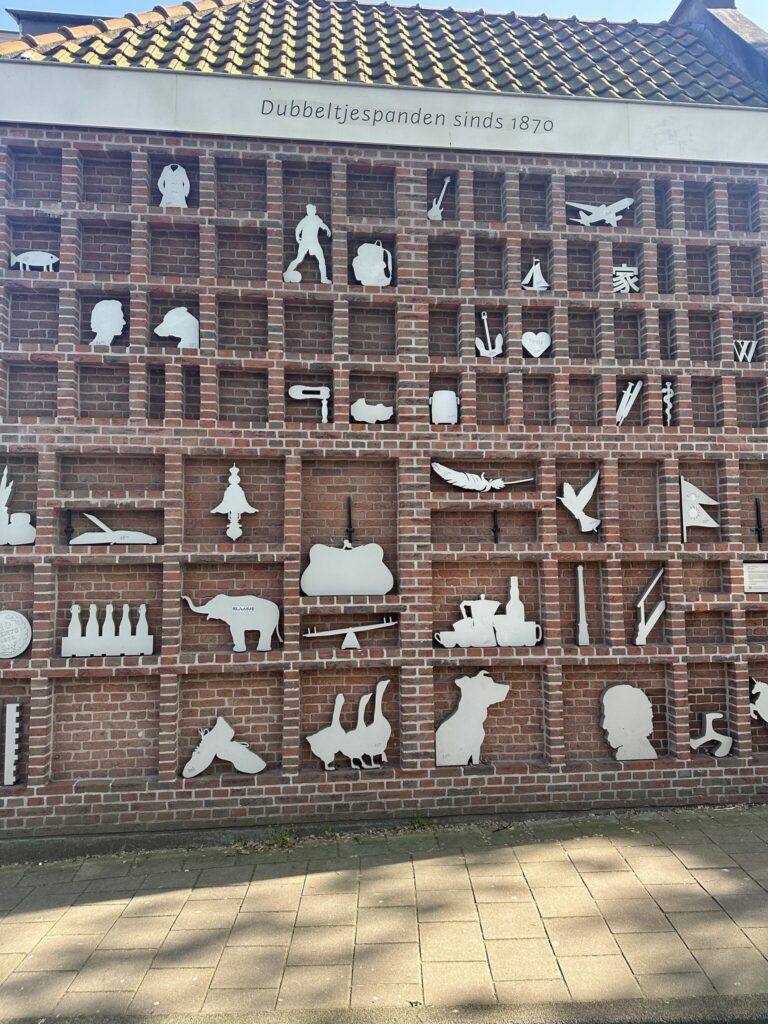
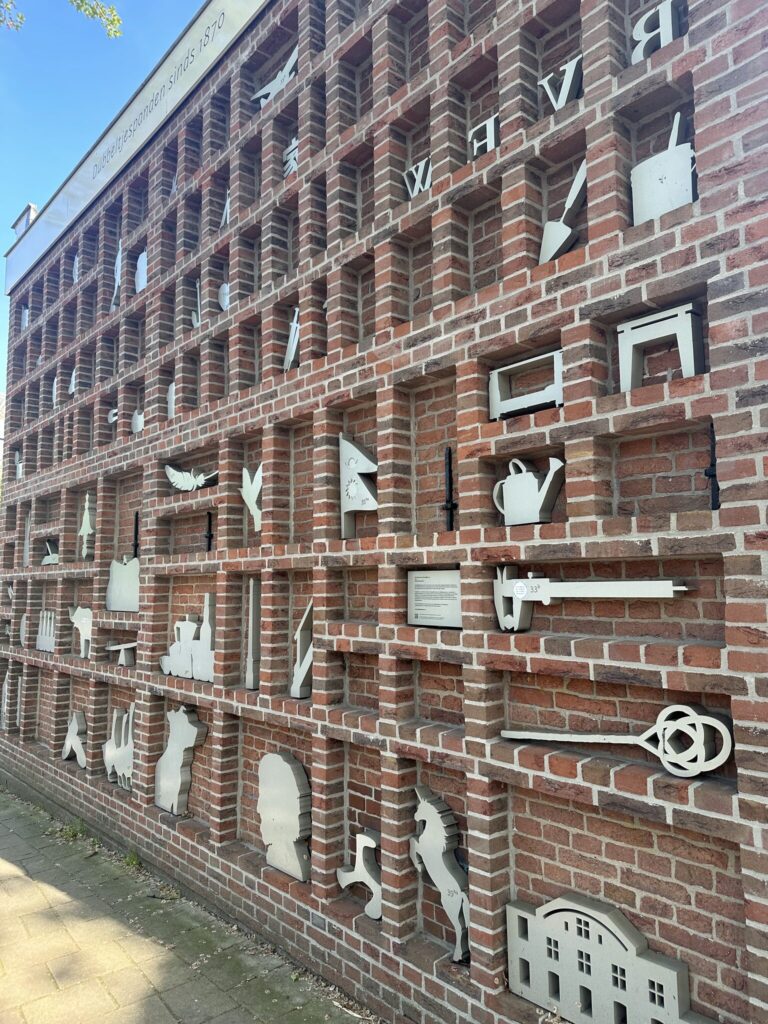
The first thing you’ll notice is the artwork on the side walls: a house-high, bricked-in printer’s type case called Het begon met een dubbeltje (“It Started with a Dime”). De Key commissioned artist Marjet Wessels Boer to mark the renovation, and the work was unveiled in December 2013. I remember spotting it for the first time while cycling past and nearly falling off my bike when I did a double-take.
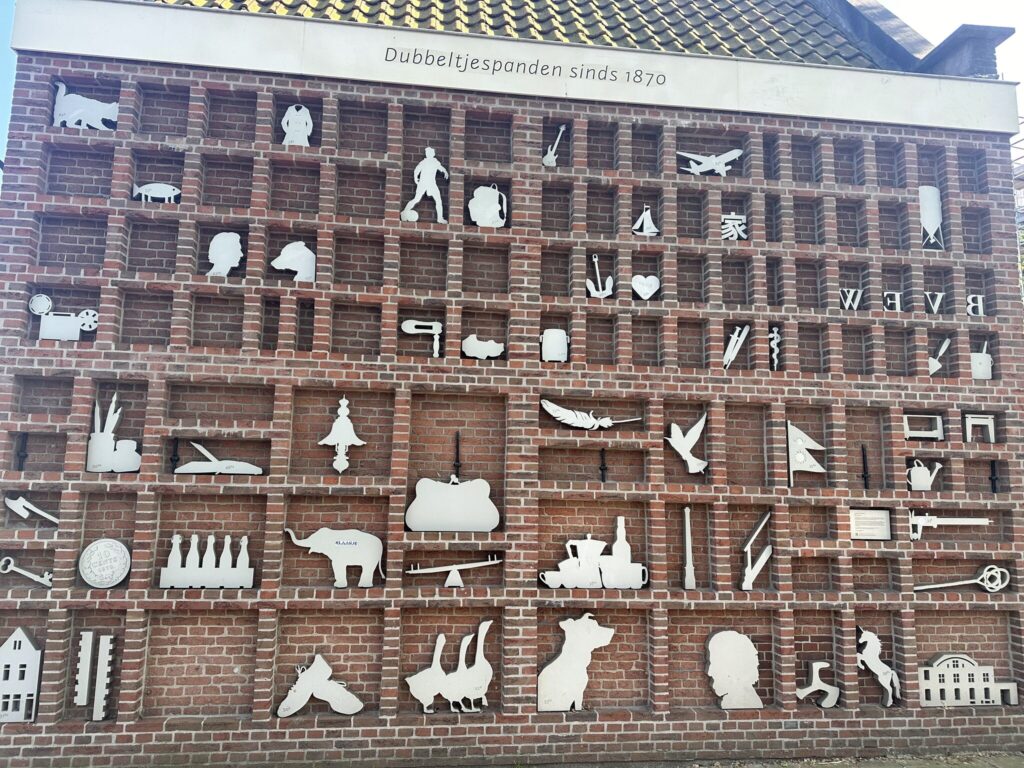
The type case is a nod to the newspaper the BVEW printed to recruit members. Its compartments hold aluminium silhouettes based on the street’s history and on stories from residents, from a carpet beater to an elephant. Silhouettes marked with a house number were suggested by current residents, and some compartments were left empty for stories still to come.
The street itself
Behind the wall, two rows of modest brick houses face each other across a narrow dead-end street. The homes are so small that residents have long treated the street as a shared living room, with chairs, plants, and decorations outside their front doors. It’s a rare, intact glimpse of 19th-century workers’ housing, and it’s still very much lived in.
Visiting respectfully
These are private homes, so you can’t go inside. Admire the artwork from Mauritskade and, if you look into the street, keep your voice down, don’t block doorways, and avoid photographing residents or their windows. Ten to fifteen minutes is plenty of time.
Best Time to Visit
You can see the Dubbeltjespanden at any time of year, since there’s nothing to book and no opening hours. Go in daylight so you can make out the silhouettes in the type case, and be considerate of residents early in the morning and in the evening.
Late spring and early autumn are my favorite times to go. The weather is usually mild enough for a slow walk that includes Oosterpark next door. In summer, pair the visit with a picnic in the park. In winter, keep it short and warm up in a café nearby.
For photos, early morning or late afternoon gives softer light on the brickwork. I once spent a whole afternoon trying to get the perfect shot of the type case in golden-hour light. My friends thought I was crazy, but this wall does that to you.
How to Get There
The Dubbeltjespanden are at Mauritskade 29–54, a few minutes’ walk east of Alexanderplein toward the Royal Tropical Institute (KIT) building and Oosterpark. Look for the brick type case on the wall facing Mauritskade.
- Tram 14: From Amsterdam Centraal Station, take tram 14 toward Flevopark via Dam, Waterlooplein, and Artis. Get off at the stop at Alexanderplein/Mauritskade and walk a few minutes east.
- Tram 19: Coming from Leidseplein or the Rijksmuseum stop, tram 19 serves the same Alexanderplein/Mauritskade stop.
- Train: Amsterdam Muiderpoort station is roughly an 8-minute walk away.
- Bike: From Centraal Station, ride east through the Plantage neighborhood along Plantage Middenlaan to Alexanderplein, then follow Mauritskade. Allow about 15 minutes.
- Walking: Follow the same route through the Plantage, past Artis. It’s about a 35-minute walk from Centraal Station.
Alexanderplein and the northern part of Sarphatistraat have been rebuilt recently, and the stops for trams 14 and 19 are moving from Alexanderplein to Mauritskade. Stop names and routes may have changed, so check the GVB journey planner before you set off.
What to combine it with
The Dubbeltjespanden work best as a stop on a wider walk through Amsterdam Oost. Oosterpark is right next door, and Artis Zoo is a short walk back toward the Plantage.
They’ll never be as famous as the Anne Frank House or the Van Gogh Museum, and they don’t need to be. Stand in front of the type case for a few minutes and you’ll understand a promise made to Amsterdam’s workers more than 150 years ago, one dime at a time.
Frequently asked questions
Can you go inside the Dubbeltjespanden?
No. The Dubbeltjespanden are private rental homes owned by housing foundation De Key. You can view the street and the artwork from Mauritskade for free, but please respect residents’ privacy.
Is the second Dubbeltjespanden complex still standing?
No. The BVEW’s second Dubbeltjespanden block on Czaar Peterstraat and Blankenstraat was damaged in a 2001 gas explosion and demolished in 2006. Only the Mauritskade 29–54 street remains.
How long do you need at the Dubbeltjespanden?
About 10 to 15 minutes is enough to see the type-case artwork and the street. Combine it with a walk through Oosterpark or a visit to Artis Zoo.