Café Karpershoek sits at Martelaarsgracht 2, a two-minute walk from Amsterdam Centraal, and it has served drinkers on that corner since 1606 — when the harbour lapped almost at its door and the customers were crew of the Dutch East India Company. It is the café most often called the oldest in Amsterdam, and the sand still on its floor is the reason people keep arguing about it.
Café Karpershoek at a glance
| Address | Martelaarsgracht 2, 1012 TP Amsterdam |
| Nearest station | Amsterdam Centraal (about 200 m) |
| Founded | 1606 by the café’s own account; earliest confirmed licensed inn on the site, 1641 |
| Type | Bruine kroeg (brown café) and praatkroeg — no background music |
| Drinks | Dutch lager on tap, jenever, spirits, coffee; simple Dutch bar snacks |
| Website | cafekarpershoek.nl |
| Hours | Vary by listing and season — check the café’s own site or Google before travelling |
Is it really the oldest pub in Amsterdam?
Partly. Karpershoek has the strongest paperwork of any contender, and the current owner, Peter Brugman, puts the claim plainly: it was the first café in the city to pay tax. The café also holds what is generally accepted as Amsterdam’s oldest liquor licence, dated 1606.
Historians are more cautious. The 1606 evidence traces back to a lottery rhyme written by a married couple living at the address — proof that people lived there, not conclusive proof that drink was sold. The earliest firm documentary record of a drinking house on the site is September 1641, when it operated as the Oldenburger Kelder, a favourite of Frisian and German skippers. By that stricter standard, a tavern on the Gravenstraat, first mentioned in 1618, edges ahead.
So the honest framing is this: Karpershoek is Amsterdam’s oldest continuously licensed café, and quite possibly its oldest full stop. If you want a bar that has poured drinks longer than the Netherlands has existed as a kingdom, you are in the right place either way.
Why there is sand on the floor
The pale silver sand scattered across the boards is not decoration and not a mess. In the seventeenth century, sailors chewed plug tobacco and spat it out where they stood. Sand absorbed the tobacco juice, spilt beer and whatever else ended up on the floor, and could simply be swept out and replaced at closing time.
Nobody chews tobacco at the bar any more, but the sand stays as a deliberate marker of continuity — a working detail kept alive rather than a prop installed for tourists. It is also the quickest way to tell a genuinely old brown café from a themed imitation.
What the inside is actually like
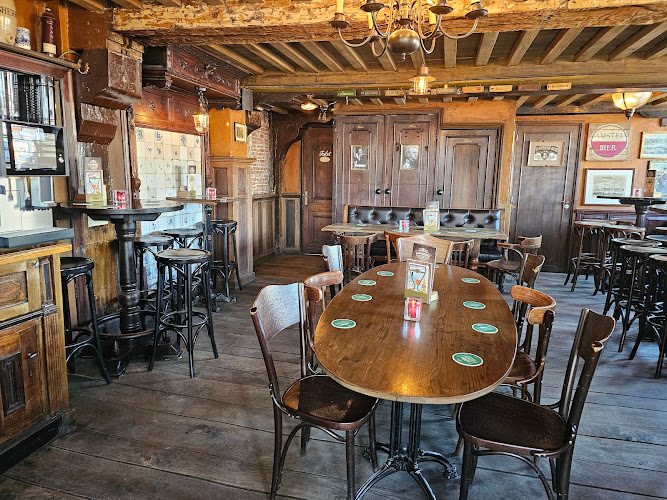
Expect a small, dark, wood-heavy room: antique Delft blue wall tiles, carved timber, hanging lamps, and walls covered in photographs, paintings and old Dutch sayings. The layout is tight, so a busy evening means standing.
- >No music. Karpershoek is a praatkroeg — a talking café. Nothing is playing, and conversation carries the room.>Delft tiles and carvings. The interior was refreshed in recent years, but in period style rather than modernised away.>Long-serving staff. Bartenders here tend to stay for years, and several know the building’s history in detail.>A terrace on the Martelaarsgracht. Filled canal, busy pavement, constant flow of people between Centraal and the Nieuwezijds.>Beer, jenever and spirits. This is not a cocktail bar. Order a pils or a jenever and you are ordering correctly.
The Martelaarsgracht, and one myth worth correcting
Martelaarsgracht means “Martyrs’ Canal”, and the canal itself was filled in during the nineteenth century, which is why the address now reads as an ordinary street. You will frequently read — in reviews, and in older versions of this article — that criminals were hanged here as a public warning. That story circulates widely but is not supported by documented sources, and the street name refers to martyrs rather than to executions. Treat it as pub folklore, which is arguably the most appropriate kind of history to hear in a pub.
What is documented is the location’s relationship with water. In 1606 the site stood directly on the IJ, at the working harbour, which is precisely why an inn for VOC crews made commercial sense there. Centraal Station now occupies the water that used to bring the customers.
How to get there
- >On foot from Amsterdam Centraal. Leave by the main city-centre exit, cross Prins Hendrikkade and head down Martelaarsgracht. It is roughly two minutes and the café is on the corner.>Tram. Several city lines stop at Nieuwezijds Kolk and Martelaarsgracht, both under three minutes’ walk. Check the current GVB route map, as Amsterdam tram numbering changes periodically.>Metro. Any line to Amsterdam Centraal, then follow the walking directions above.>Bus. Stops on Prins Hendrikkade put you almost at the door.>Bike. There is racking near the station forecourt. Use a frame lock and a chain — this is one of the highest-theft areas in the city.
Best time to visit
Because the room is small and sits on the main pedestrian route out of Centraal, timing changes the experience more than season does.
- >Late morning to mid-afternoon, weekdays. Quietest window, best chance of a seat and of actually talking to the bar staff.>Early evening. Local after-work crowd mixes with arrivals; lively but still navigable.>Friday and Saturday night. Standing room, high tourist share, longer waits at the bar.>Summer. The terrace is the draw, and it fills first on any dry afternoon.
Practical tips before you go
- >Bring a card. Dutch bars are overwhelmingly card- and PIN-first; some venues no longer take cash at all. Carry a debit card and treat cash as the backup, not the default.>Check hours the same day. Published opening times for Karpershoek differ substantially between directories, so use the café’s own site or a live Google listing.>Order simply. Beer, jenever, coffee and Dutch bar snacks are the strength here.>Expect the sand. It is fine underfoot, but it is real sand — worth knowing if you are in open shoes.>Ask before photographing people. The interior photographs beautifully; the regulars did not sign up to be content.>Say “proost”. A single Dutch word goes a long way in a talking café.
Frequently asked questions
How old is Café Karpershoek?
The café dates its founding to 1606, when the site stood on the IJ harbour and served crews of the Dutch East India Company. The earliest confirmed record of a licensed drinking house at the address is from September 1641.
Why is there sand on the floor of Café Karpershoek?
Silver sand was spread on seventeenth-century tavern floors to soak up chewing tobacco, spilt beer and dirt so it could be swept out easily. Karpershoek keeps the sand today as a link to that period.
Is Café Karpershoek the oldest bar in Amsterdam?
It holds the city’s oldest liquor licence and was the first café in Amsterdam to pay tax, which is the basis of its claim. Historians note that a tavern on the Gravenstraat has an earlier documented mention, from 1618, so the title is disputed.
Where is Café Karpershoek and how do I get there?
It is at Martelaarsgracht 2, 1012 TP Amsterdam, about a two-minute walk from Amsterdam Centraal via Prins Hendrikkade. Trams and buses stop at Nieuwezijds Kolk and Prins Hendrikkade nearby.
Does Café Karpershoek play music?
No. It is a praatkroeg, or talking café, so there is no background music and conversation is the point.
What should I order at Café Karpershoek?
Stick to Dutch lager on tap, jenever, other spirits or coffee, with simple Dutch bar snacks. It is a brown café rather than a cocktail bar.