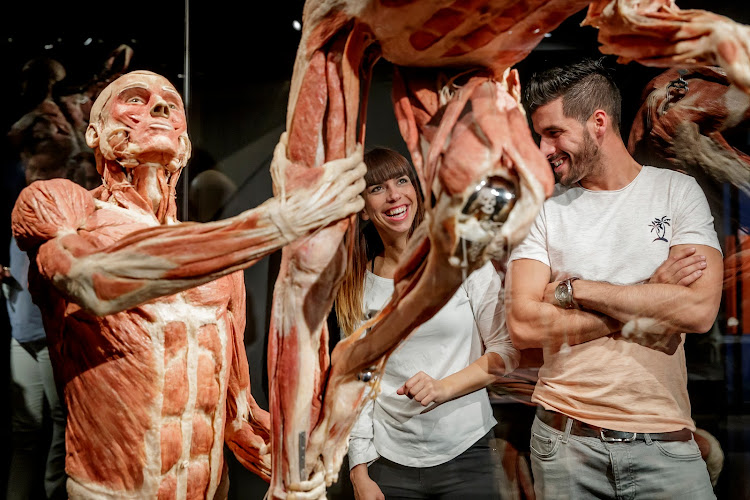
BODY WORLDS Amsterdam is an anatomy exhibition at Damrak 66, a few minutes’ walk from Amsterdam Centraal, where real human bodies preserved by plastination are displayed across seven levels. The long-running edition, The Happiness Project, uses those specimens to ask a specific question: how do mood, stress, love and health physically change the body you live in?
BODY WORLDS Amsterdam at a glance
| Address | Damrak 66, 1012 LM Amsterdam |
| Exhibition | BODY WORLDS: The Happiness Project |
| Opening hours | Daily 10:00–22:00, last admission 21:00 |
| Adult ticket | Around €23 online |
| Youth ticket (6–17) | Around €14; under 6 free |
| Typical visit | 60–120 minutes |
| Nearest tram | Dam / De Bijenkorf, 1-minute walk |
| I amsterdam City Card | Accepted |
What plastination actually is
Plastination is the preservation method that makes the whole exhibition possible, and understanding it changes how the displays read. Anatomist Dr. Gunther von Hagens developed the technique at Heidelberg University in 1977 after watching medical students work with cadavers that decayed too quickly to study properly. His insight was to reverse the standard approach: instead of embedding tissue inside a block of plastic, he put the plastic inside the tissue.
- Fixation. The body is injected with formalin to halt decomposition, then dissected to expose the systems a specimen is meant to show.
- Dehydration. The specimen sits in an acetone bath, where acetone replaces all water and fat.
- Forced vacuum impregnation. In a vacuum chamber the acetone boils off as gas and liquid polymer is drawn into every cell in its place, a step that can take weeks.
- Positioning. Full-body plastinates are posed with wires and clamps, often mid-stride or mid-gesture, so muscle and organ relationships stay legible.
- Curing. Light, heat or gas hardens the polymer. Roughly 70 percent of the specimen is now resin, and it no longer decays.
That last figure explains the odd sensation most visitors describe. You are not looking at a model or a wax replica, and you are not looking at something wet and clinical either. You are looking at a real person whose cells have been individually filled with plastic.
Where the bodies come from
This is the question most visitors want answered before they buy a ticket, and it deserves a direct answer rather than a euphemism. The specimens on display come from the Institute for Plastination’s body donation programme, meaning donors consented during their lifetime to have their remains preserved and exhibited for public anatomical education. Donors are not identified, and the exhibition does not disclose personal histories.
If the ethics of displaying human remains are a sticking point for you, that is a reasonable position and this exhibition will not resolve it. Read the operator’s donor documentation before booking rather than after arriving.
What The Happiness Project explores
Unlike earlier BODY WORLDS editions that were organised purely by anatomical system, the Amsterdam exhibition frames its material around a theme: the physical footprint of emotional life. The seven levels move from the mechanics of the body outward to the question of what makes a life feel good.
- Core anatomy. Skeletal, muscular, nervous, respiratory and circulatory systems shown as whole-body plastinates rather than isolated parts.
- The brain and mood. Displays connecting neurochemistry, stress response and emotional regulation to visible physical structures.
- Health and damage. Direct comparisons such as healthy versus smoker’s lungs, and organs affected by disease, which are consistently the displays visitors remember longest.
- Love and attachment. Material on bonding, intimacy and their measurable effects on cardiovascular and hormonal function.
- Lifestyle and longevity. Sleep, movement, diet and social connection presented as inputs with physical outputs.
The through-line is honest but not subtle: your emotional state is not separate from your tissue. Whether that lands as profound or as wellness-adjacent messaging depends largely on what you bring to it.
Tickets and how to book
Adult admission runs around €23 when booked online, with youth tickets aged 6 to 17 at roughly €14 and free entry for children under 6. Online booking includes skip-the-line entry and ties your ticket to a specific date and time slot, which matters more than it sounds on a rainy Amsterdam afternoon when Damrak fills with people looking for indoor options.
- There are no student or senior discounts.
- Disabled visitors and their companions pay the reduced rate, available at the ticket counter rather than online.
- The I amsterdam City Card covers entry, so check whether you already hold one before paying separately.
- An audio guide costs around €3 at the box office in English, Dutch, German, French, Italian and Spanish.
- Combination tickets pairing BODY WORLDS with the nearby Moco Museum are widely sold and usually cheaper than buying both separately.
- Refund windows are typically 48 hours before your slot, but verify at checkout.
Getting there
BODY WORLDS is under 500 metres from Amsterdam Centraal, which makes it one of the easiest attractions in the city to reach on foot straight off a train. Tram stop Dam / De Bijenkorf, served by lines 4, 9, 16 and 24, is a one-minute walk. Tram stop Dam in front of Magna Plaza, served by lines 1, 2, 5, 13, 14 and 17, is about five minutes away.
Driving into the centre is a poor idea, but if you must, Q-Park De Bijenkorf on Beursplein and Q-Park Nieuwendijk on Nieuwezijds Kolk are the two closest garages. Expect central-Amsterdam parking rates.
Planning a comfortable visit
- Go late. Closing at 22:00 daily is unusual for an Amsterdam museum. An 19:00 or 20:00 slot is far quieter than midday and turns the exhibition into a genuine evening activity.
- Budget 60 to 120 minutes. Seven levels sounds like a lot, but the floors are compact. Rushing it in 40 minutes is possible and wasteful.
- Signage is bilingual. Wall text appears in English and Dutch, so the audio guide is an enhancement rather than a necessity for English speakers.
- Think about children. There is no age restriction and under-6s enter free, but the specimens are unambiguously real human bodies, including diseased organs and prenatal displays. Curious older children usually do well; sensitive younger ones may not.
- Photography rules change. Confirm the current policy at the entrance rather than assuming.
- Pair it with something nearby. Dam Square, the Royal Palace and Moco are all within a short walk, which makes this an easy anchor for a half-day in the centre.
Who should skip it
An honest recommendation needs an honest exclusion. Skip BODY WORLDS if you are squeamish about human remains, if you object to the display of donated bodies on principle, or if you are looking for the kind of art-and-canals Amsterdam day that the Rijksmuseum and Van Gogh Museum deliver. It is also the wrong choice if you want deep clinical detail, because the exhibition is pitched at general audiences rather than medical students.
Go if you want something in central Amsterdam that is genuinely unlike anything else in the city, that stays open late, and that most people are still thinking about the next morning.
Frequently asked questions
Are the bodies at BODY WORLDS Amsterdam real?
Yes. Every full-body specimen and organ on display is genuine human tissue preserved through plastination, sourced from the Institute for Plastination’s body donation programme. Donors gave consent during their lifetime and are not identified.
How much are BODY WORLDS Amsterdam tickets?
Adult admission is around €23 online, youth tickets for ages 6 to 17 are around €14, and children under 6 enter free. There are no student or senior discounts, and the I amsterdam City Card is accepted. Confirm current pricing on bodyworlds.nl.
What are the opening hours?
BODY WORLDS Amsterdam is open daily from 10:00 to 22:00, with last admission one hour before closing at 21:00. Reduced hours apply around Christmas and New Year.
How long does a visit take?
Most visitors spend 60 to 120 minutes across the seven levels. Allow closer to two hours if you plan to use the audio guide and read the wall text in full.
Is BODY WORLDS suitable for children?
There is no minimum age and under-6s enter free, but the exhibition displays real human remains including diseased organs. Older children who are curious about biology generally do well; younger or sensitive children may find it distressing.
Where is BODY WORLDS Amsterdam located?
The exhibition is at Damrak 66, 1012 LM Amsterdam, less than 500 metres from Amsterdam Centraal. The nearest tram stop is Dam / De Bijenkorf, served by lines 4, 9, 16 and 24, a one-minute walk away.