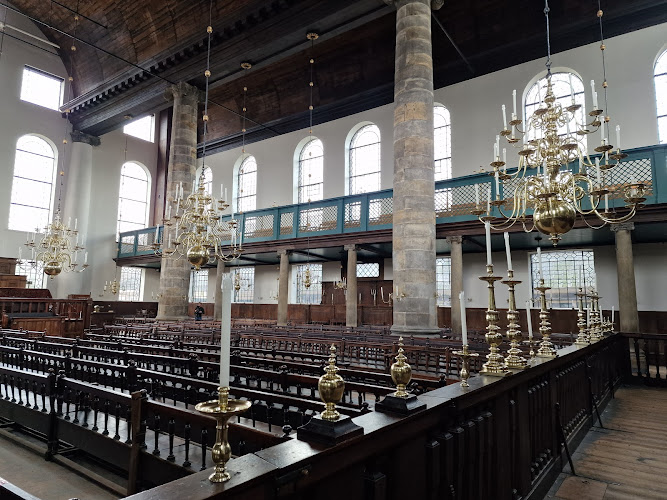
The Portuguese Synagogue of Amsterdam—also called the Esnoga or Snoge—is worth visiting for its exceptionally intact 1675 sanctuary, brass chandeliers, sand-covered pine floor, holy ark and treasure chambers. It remains an active Sephardic place of worship, so public access changes around Shabbat, Jewish festivals and services. Check the official calendar before setting out.
Portuguese Synagogue Amsterdam at a glance
| Detail | What to know |
|---|---|
| Address | Mr Visserplein 3, 1011 RD Amsterdam |
| Visitor hours | Generally Sunday to Friday; closed Saturday. Seasonal hours, Friday closing times and Jewish holiday closures vary, so check the official opening calendar. |
| Adult tickets | €20 duoticket for the Jewish Museum and Portuguese Synagogue, or €30 combiticket for all four Jewish Cultural Quarter locations. Tickets bought at the desk carry a €2 surcharge. |
| Time to allow | About 45–75 minutes for the synagogue; allow two to three hours if you also visit the Jewish Museum. |
| Audio guide | Free and available in several languages. |
| Accessibility | Step-free entrances and lifts are available across the Jewish Cultural Quarter. |
| Dress | Men must wear a head covering inside; kippot are available at the entrance. Head coverings are optional for women. |
| Payment | Debit and major credit cards only; the Jewish Cultural Quarter is cashless. |
Is the Portuguese Synagogue worth visiting?
Yes, especially if you are interested in Amsterdam architecture, Sephardic Jewish history or places that still serve their original purpose. The main sanctuary has changed remarkably little since 1675. Its wooden furnishings, central reading platform and candlelit chandeliers create a sense of continuity that a conventional museum display cannot reproduce.
The visit is quieter and more contemplative than many major Amsterdam attractions. It is also compact: most visitors can see the sanctuary, women’s gallery and treasure chambers in about an hour. The standard ticket includes the Jewish Museum, making the two sites a practical pairing.
What to see inside the Portuguese Synagogue
The 1675 sanctuary and brass chandeliers
The main hall is the defining space. Hundreds of candles in polished brass chandeliers provide the historic form of illumination, while daylight enters through tall windows. The pews, central tebah where services are led and pinewood floor date to the synagogue’s opening period.
At the eastern end stands the hechal, the large holy ark that houses the Torah scrolls. Look at the relationship between the ark, the central tebah and the surrounding galleries: the layout makes the room feel ceremonial without relying on dense decoration.
The sand-covered floor
The fine sand spread across the pine floor is one of the synagogue’s most discussed features. According to the Jewish Cultural Quarter’s permanent exhibition notes, its purpose is practical rather than symbolic: the sand softens footsteps and absorbs dirt and damp brought in from the street. By reducing the sound of footsteps, it also helps preserve the calm atmosphere of the sanctuary.
The women’s gallery and winter synagogue
The upper women’s gallery gives a broad view across the chandeliers, seating and tebah. The complex also contains a smaller winter synagogue, historically used when the vast main hall was less practical in cold weather. Access can depend on services, tours and temporary arrangements.
Treasure chambers and ceremonial objects
The surrounding buildings contain treasure chambers with Torah scrolls, silver ritual objects, pointers, finials and textiles. The collection remains closely connected to worship rather than being a group of objects assembled later for display. Highlights include Torah scrolls with centuries of history and a textile collection numbering almost 600 items.
In 2022, restorers working near the hechal found a concealed storage space containing original printed linen wall hangings dated to roughly 1740–1760. These can now be seen in the treasure chambers when that area is open to visitors.
Ets Haim–Livraria Montezinos Library
Ets Haim is recognized by UNESCO’s Memory of the World Programme and ranks among the world’s most significant Jewish libraries. Its collection contains about 30,000 printed works dating from 1484 onward and 500 manuscripts dating from 1282 onward. The library is part of the synagogue complex, but ordinary admission does not provide unrestricted entry: visitors need to join a scheduled guided tour.
Check the Jewish Cultural Quarter’s tour schedule before building your day around the library. Researchers have separate access procedures.
A concise history of the Esnoga
Amsterdam’s Portuguese Jewish community, Kahal Kados Talmud Tora, was formed in 1639 when three Sephardic congregations merged. Many members descended from Jews who had left Spain and Portugal under persecution and later moved from Antwerp to Amsterdam. According to the Portuguese Jewish community’s historical account, construction of the present synagogue began in 1671 under architect Elias Bouwman.
The building was inaugurated on 2 August 1675. A detailed print by Romeyn de Hooghe in the Rijksmuseum collection records the ceremony and shows a procession carrying Torah scrolls toward the hechal. At the time, the Esnoga was the largest synagogue in the world.
The community was devastated during the Holocaust. Its own historical account records that 3,700 of 4,300 Portuguese Jews were murdered. The synagogue building and ceremonial objects survived, and services resumed on 9 May 1945, four days after the liberation of the Netherlands. The Esnoga remains a functioning synagogue rather than a monument frozen in the past.
Planning your visit
Tickets and passes
The lowest standard adult option is the €20 duoticket, which includes one visit to the Portuguese Synagogue and one to the Jewish Museum within a week. The €30 combiticket also includes the National Holocaust Museum and Hollandsche Schouwburg. Buying at the ticket desk adds €2, so online booking is the better-value option.
- Adults: €20 duoticket or €30 four-location combiticket
- Students: €10 with valid student identification
- Ages 13–17: €8
- Ages 6–12: €6
- Under 6: free
- Museumkaart and I Amsterdam City Card: free admission, subject to current conditions
These prices were verified on 15 August 2026 and can change. Use the official Jewish Cultural Quarter ticket page as the final authority.
Opening hours and closures
The synagogue normally welcomes visitors from Sunday through Friday and closes on Saturday for Shabbat. Friday hours become shorter in parts of the year, winter closing times can be earlier, and the building closes for several Jewish holidays and memorial days. In August 2026, the published schedule was 11:00 to 17:00 from Sunday through Friday.
Because this is an active place of worship, do not rely on a generic attraction listing or an old screenshot. Check the date-specific opening calendar shortly before your visit.
How to get there
The Portuguese Synagogue stands at Mr Visserplein 3 in Amsterdam’s old Jewish neighbourhood, opposite the Jewish Museum. From Amsterdam Centraal, take metro 51, 53 or 54 to Waterlooplein and use the Nieuwe Amstelstraat exit; the walk takes about two minutes. Tram 14 also stops at Waterlooplein.
The site is within the eastern side of the city centre. The Amsterdam Centrum guide can help you connect the visit with other nearby stops without unnecessary backtracking.
Accessibility, dress and photography
- Wheelchair access: The Jewish Cultural Quarter states that its locations have step-free entrances and lifts. Essential companions can receive free admission at the desk.
- Head coverings: Men must cover their heads in the synagogue. A hat is acceptable, and kippot are available at the entrance. Women may cover their heads but are not required to do so.
- Audio guide: A free audio guide is available in English and several other languages.
- Photography: Personal photography and video are allowed unless a sign states otherwise. Do not use flash, a tripod or a selfie stick.
- Payment: The Jewish Cultural Quarter accepts debit cards and major credit cards, not cash.
Best time to visit and how long to stay
Allow about an hour if the synagogue is your main focus. Arriving near opening usually gives you more time to use the audio guide without watching the clock. If your priority is the candlelit atmosphere, the interior becomes more dramatic as daylight fades, especially in winter—but confirm that day’s closing time before planning a late visit.
Candlelight concerts and guided tours appear on the official agenda at selected times and may require separate booking. Treat them as special events rather than a feature of every general-admission visit.
How to combine the synagogue with nearby Jewish history sites
The duoticket makes the Jewish Museum the most logical companion visit. Start at the synagogue near opening, then cross to the museum for broader context on Jewish religion, culture and life in the Netherlands. A two- to three-hour block is realistic for both if you keep a steady pace.
The full combiticket adds the National Holocaust Museum and Hollandsche Schouwburg, and remains valid for one week. Spreading these sites across two days can make the experience more manageable, particularly because the Holocaust locations require time and emotional attention.
For a wider account of occupation and resistance in the Netherlands, the Verzetsmuseum Amsterdam is another relevant stop. It is not part of the Jewish Cultural Quarter ticket.
FAQs
Can non-Jewish visitors enter the Portuguese Synagogue?
Yes. The Portuguese Synagogue is open to everyone when it is not being used for services or closed for a Jewish holiday.
Is the Portuguese Synagogue open on Saturday?
No. The synagogue is closed to general visitors on Saturday for Shabbat. It also closes for certain Jewish holidays, services and memorial days.
How much does the Portuguese Synagogue cost?
As of 15 August 2026, the adult duoticket for the Portuguese Synagogue and Jewish Museum costs €20. The four-location Jewish Cultural Quarter combiticket costs €30. Tickets bought at the desk carry a €2 surcharge.
Is the Portuguese Synagogue included with Museumkaart or the I Amsterdam City Card?
Yes. Both cards currently provide free admission, subject to the Jewish Cultural Quarter’s current ticket conditions. Museumkaart holders can collect a free ticket at the desk; advance reservations are advisable when combining the visit with the National Holocaust Museum.
Do men need to wear a kippah?
Men must wear a head covering inside the synagogue. Visitors may wear their own hat, and kippot are available at the entrance. Head coverings are optional for women.
Is the Portuguese Synagogue wheelchair accessible?
The Jewish Cultural Quarter states that its locations have step-free entrances and lifts. Essential companions can receive a free ticket at the desk.
Can visitors enter the Ets Haim Library?
Only on a scheduled guided tour. General synagogue admission does not provide unrestricted access to the library, so check tour availability before visiting.
Can you take photos inside the synagogue?
Personal photography and video are generally allowed unless a sign states otherwise. Flash, tripods and selfie sticks are not permitted. Commercial or professional work requires permission.
How long should you spend at the Portuguese Synagogue?
Plan about 45–75 minutes for the sanctuary, gallery, treasure chambers and audio guide. Allow two to three hours if you are also visiting the Jewish Museum.
The Portuguese Synagogue rewards a focused visit: give the sanctuary time, use the audio guide and include the treasure chambers rather than treating it as a quick photo stop. Verify the calendar, choose the ticket that matches the sites you will actually visit, and approach the active religious space with the same respect you would expect at any place of worship.