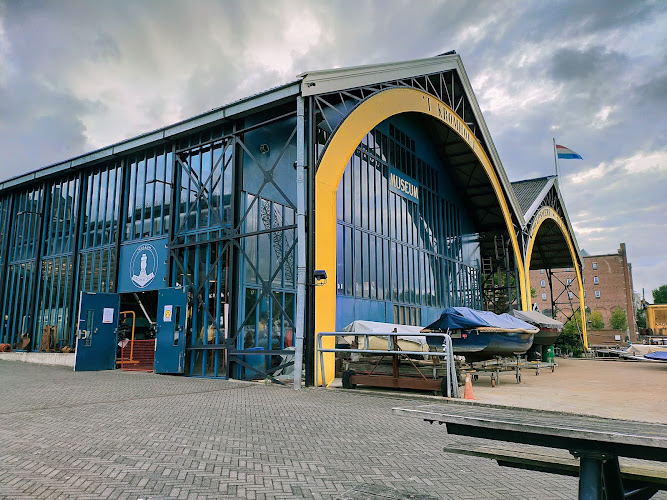
Museum ‘t Kromhout is a volunteer-run engine museum inside a working 19th-century Amsterdam shipyard at Hoogte Kadijk 147, and its historic Kromhout ship engines are still started for visitors. It opens one weekday and one Sunday a month: Tuesdays from 10:00 to 15:30, and every third Sunday of the month from 12:00 to 16:00. Adult admission is EUR 10, children aged 6 to 15 pay EUR 5, and under-6s enter free.
The yard sits on the Nieuwe Vaart in the Plantage and Kadijken area, a fifteen to twenty minute walk east of Amsterdam Centraal. It is one of the last surviving pieces of the shipbuilding industry that once lined this stretch of water, and the only place in the city where you can hear pre-war Dutch marine diesels running under their original roof.
Visitor essentials at a glance
- Address: Hoogte Kadijk 147, 1018 BJ Amsterdam. The visitor entrance is on the Kruithuisstraat side of the yard.
- Open: every Tuesday 10:00 to 15:30, and every third Sunday of the month 12:00 to 16:00. Closed the rest of the week to individual visitors.
- Admission: EUR 10 from age 16, EUR 5 for ages 6 to 15, free for ages 0 to 5, free with a green-dot Stadspas. A friends membership costs EUR 30 a year.
- Included in the ticket: an explanation or guided walk-through by a volunteer, where one is available, plus an information booklet.
- Engine demonstrations: no engines are started after 15:00 on Tuesdays or after 15:30 on Sundays.
- Groups of visitors and school or college groups can be received on other weekdays by arrangement, with tours priced on request.
- Contact: [email protected], 020 627 6777 on Tuesdays, or 06 5332 1957.
Hours and prices here were checked against the museum’s own opening-hours page in September 2026. Some third-party listings, including I amsterdam and Stadsherstel, still show a 9:30 Tuesday opening and older EUR 5 to EUR 7 prices, so treat the museum’s own page as the authority and confirm before you travel.
Opening hours and tickets
| Detail | Tuesday | Third Sunday of the month |
|---|---|---|
| Opening times | 10:00 to 15:30 | 12:00 to 16:00 |
| Last engine start | 15:00 | 15:30 |
| Volunteers on site | Full team, including restoration work | Smaller team |
| Adult ticket (16+) | EUR 10 | EUR 10 |
| Child ticket (6 to 15) | EUR 5 | EUR 5 |
Times and prices as published by Museum ‘t Kromhout, September 2026.
Tickets are sold at the museum desk and online. The remaining third Sundays in 2026 fall on 20 September, 18 October, 15 November and 20 December. One demonstration to keep expectations realistic: the large A-frame engine that was normally started at 13:00 on Sundays cannot currently be run because the museum is short of qualified operators. The other engines still run on both opening days.
What you see inside the Oosthal
The yard has two halls. The Westhal is still a functioning shipyard, now used for electric-boat conversion work, while the museum occupies the Oosthal, the old machine factory with cast-iron trusses and a long glazed roof light. Almost every Kromhout engine in the hall is in working order, which is what separates this collection from a static display of polished metal.
Working Kromhout marine engines
The core of the collection is the engine line Kromhout built for inland barges, tugs and fishing boats: four-stroke petroleum engines, two-stroke types from the RO1 and M-series, two-stroke diesels such as the K1, 2K1, K2, 2KS2, 2K3 and 2H3, and four-stroke diesels including the 4LW, 6LW, 3GS and 12TV117. A two-cylinder 80 hp 2H3 is among the machines volunteers demonstrate. Starting these engines is a physical process of priming, heating and compression, and the volunteers talk you through each step as they do it.
The unusual engines Kromhout also built
Kromhout was not only a marine-engine maker, and the oddities in the collection are the surprise of the visit. They include a ramjet built for the Kolibri helicopter, a Genet Major aircraft radial made under licence for the 1939 Fokker S9 trainer, a flat engine from the company’s truck-chassis period, and the Wingwheel, a tiny auxiliary motor mounted in a bicycle’s front hub.
The forge and the restoration bench
A blacksmith works in the hall on opening days, and children can be invited to help with the forging. Tuesday is also the main maintenance day, so you are likely to find volunteers with an engine partly dismantled and be able to ask what they are doing and why. For children there is a scavenger hunt that runs through the whole museum.
Best time to visit
Choose Tuesday if your priority is seeing and hearing engines run with the full volunteer team present. Arrive between 10:00 and 12:00: you get the longest run of the day before the 15:00 cut-off for starts, and the volunteers have more time to talk before the midday arrivals.
Choose the third Sunday if a weekday visit does not fit your itinerary or you are combining the museum with other Plantage stops that are busier midweek. The window is shorter, the team is smaller, and the last start is 15:30, so aim to arrive by 13:30.
Season matters less than the day of the week, since the whole visit is indoors. Winter visits are comfortable because the hall is sheltered and the working engines generate heat, and Amsterdam’s museums are quieter between November and March. In July and August the city is at its busiest, but the museum itself stays small-scale. Spring and autumn give you mild weather for the canal-side walk from Centraal, which is half the appeal of the trip.
Allow 60 to 90 minutes inside. Engine enthusiasts who want to watch several starts and talk to the volunteers should budget two hours.
How to get there
The museum lies between Amsterdam Centraal and Muiderpoort station, on the north bank of the Nieuwe Vaart. The gate that visitors use is on Kruithuisstraat rather than directly on Hoogte Kadijk, which is the detail most people miss on arrival.
Walking and cycling from Centraal
It is about a 20 minute walk or a 5 minute cycle. Leave Centraal by the left-hand exit, follow Prins Hendrikkade east, turn right across Kadijksplein at the Nieuwe Herengracht, then left onto Hoogte Kadijk. Coming from the Stadhuis, follow the Nieuwe Herengracht past Mr. Visserplein, go right over Kadijksplein onto Laagte Kadijk, then left through Tussen Kadijken and immediately right. Bicycles may not be parked on the yard itself except on the Kruithuisstraat side.
Public transport
- Tram 7 to the Hoogte Kadijk stop, which is the closest option and leaves a walk of a minute or two.
- Tram 14 to Mr. Visserplein, then roughly a 10 minute walk east along the Kadijken.
- Bus 22 to Wittenburgergracht, a short walk from the yard.
By car
Driving is the weakest option in this part of the city, and street parking around the Kadijken is scarce and expensive. If you must drive, the nearest paid garages are Markenhoven and Parking Cruquiuskade, and there is a car park beside Artis within walking distance. Published tariffs at these garages have changed over time, so check current rates in your parking app before you set off.
By boat
The yard is reachable over water. From the Oosterdok you sail along the Nieuwe Vaart past Het Scheepvaartmuseum and can moor beside the museum, which is how some visitors arrive in their own sloops. A water taxi can also drop you at the wharf.
Who this museum suits, and what to pair it with
It rewards anyone interested in industrial heritage, maritime history, mechanical engineering or Amsterdam’s working past, and it works well for children who like machinery, noise and hands-on activity. It is a poor fit for visitors who want polished interpretation panels, a café and a large gift shop, because this is a small association-run site staffed by enthusiasts rather than a municipal museum.
Because the museum only opens for part of the day, build it into a wider route through the Plantage or Oost. Het Scheepvaartmuseum, Artis and the NEMO Science Museum are all within a short walk or cycle, and the museum itself points visitors toward them. A morning at the engine hall followed by lunch on Kadijksplein and an afternoon at NEMO makes a coherent day for anyone travelling with children.
A short history of the Kromhout yard
Shipbuilding has taken place on this stretch of the eastern islands since the seventeenth century. The Kromhout family gave the yard its name, and in 1870 the Goedkoop family bought it to maintain their fleet of steam tugs. Around 1900 a machine factory was set up in a newly built covered hall, where the first Kromhout engines were developed; engines have been built on the site since 1895.
Demand outgrew the site by about 1906 and engine production moved to larger halls in Amsterdam-Noord, where Kromhout went on to build engines for trucks, aircraft and industry as well as ships. Cheap foreign competition ended the company in the late 1960s. Ship repair and tarring continued at Hoogte Kadijk until 1970, and the yard was saved from demolition when the Werf ‘t Kromhout foundation took it over in 1973, followed a year later by the friends association that owns the collection.
In 1996 the site and buildings passed to the Amsterdam Monuments Fund, which merged into Stadsherstel Amsterdam three years later. Stadsherstel holds the buildings and the association, renamed Vereniging Museum ‘t Kromhout in 2012, runs the museum in the Oosthal. The shipyard business in the Westhal is legally separate from the museum.
Accessibility and practical notes
- I amsterdam lists the museum as well accessible for visitors with reduced mobility; the exhibition is on one level in a former factory hall. Contact the museum in advance if you need specific arrangements, since the site is an industrial monument.
- Running engines are loud. Bring ear protection for young children or anyone sensitive to noise.
- The hall is unheated beyond the warmth of the machinery. Dress for the season, and expect oil and diesel smells throughout.
- There is no full café. Plan food around Kadijksplein or the Plantage.
- Souvenirs and merchandise are sold at the museum desk and in the online shop, and purchases support the association.
- The phone line is staffed on Tuesdays only; email reaches the volunteers on other days.
Confirm current times, prices and demonstration details on the museum’s own opening hours and rates page before travelling, especially around public holidays and events.
Frequently asked questions
Is Museum ‘t Kromhout open every day?
No. The museum opens every Tuesday from 10:00 to 15:30 and every third Sunday of the month from 12:00 to 16:00. Groups of visitors and school groups can be received on other weekdays by prior arrangement.
How much does a ticket cost?
Admission is EUR 10 from age 16, EUR 5 for ages 6 to 15 and free for ages 0 to 5. A green-dot Stadspas gives free entry, and an annual friends membership costs EUR 30. Tickets are available online and at the museum desk.
Will I actually see the engines running?
Yes, on both opening days volunteers demonstrate the historic Kromhout engines. No engines are started after 15:00 on Tuesdays or after 15:30 on Sundays, so arrive early in the opening window. The large A-frame engine cannot currently be started because the museum is short of qualified operators.
What is the easiest way to reach Hoogte Kadijk 147?
Take tram 7 to the Hoogte Kadijk stop, or walk about 20 minutes east from Amsterdam Centraal via Prins Hendrikkade and Kadijksplein. Tram 14 to Mr. Visserplein and bus 22 to Wittenburgergracht also work. The visitor entrance is on the Kruithuisstraat side of the yard.
How long should I plan for a visit?
Most visitors need 60 to 90 minutes. Allow two hours if you want to watch several engine starts, see the blacksmith at work and talk with the volunteers about restoration.
Is the museum suitable for children?
Yes. There is a scavenger hunt through the museum, children can help the blacksmith with forging, and under-6s enter free. Bring ear protection, because the running engines are loud.