Description
Zon’s Hofje sits behind a plain door at Prinsengracht 159–171, at the quiet northern end of the canal where Prinsenstraat crosses. Most people walk past it every day without noticing. Behind that door, a narrow passage runs the depth of the canal house and opens onto a small green courtyard ringed by low almshouse dwellings — one of roughly two dozen surviving hofjes in the Amsterdam canal district.
A hofje is not simply a courtyard, which is where a lot of English-language descriptions go wrong. It is a charitable almshouse complex: rooms built around a shared garden and funded by a church, guild, or wealthy benefactor to house people who could not support themselves. Zon’s Hofje was built for one specific group — unmarried Mennonite women aged 50 and over who had belonged to the congregation for at least three years.
The site has a layered history. Before the almshouse existed, this was the location of a clandestine Mennonite meeting house belonging to a splinter group known as De Kleine Zon, “the little sun.” When that congregation merged with a second one called De Arke Noach, the combined community decided in 1755 to convert the property into housing. The building permit followed in 1764 and the first residents moved in during 1765. A further wing was added along Prinsengracht 171–173 in 1893, designed by M.H. Ligthart, which brought the complex to its present size. Numbers 159–171 have been protected as a national monument (rijksmonument 4274) since 1 September 1970.
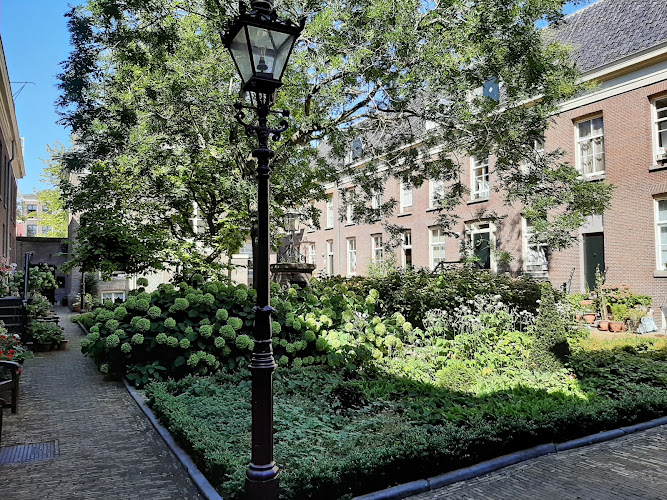
What you actually see today is modest, and worth setting expectations for. The passage in is dim and dusty enough that you may wonder whether you have walked into a private hallway. The courtyard beyond is small, roughly circular, and deliberately unmanicured — long grass, self-seeded wildflowers, a few trees. There are no fountains, no formal planting beds, and no visitor facilities. The interest is in the details and the quiet, not the horticulture.
It is also somebody’s home. Since the 1960s the buildings have housed students connected to the Amsterdam Mennonite congregation rather than elderly women — around thirty residents plus a caretaker. That single fact should shape how you visit: this is a working residential courtyard that tolerates respectful visitors, not an attraction with staff and a ticket desk.
Visit at a glance
| Address | Prinsengracht 159–171, 1015 DR Amsterdam |
| Admission | Free; a donation can hangs from a tree in the courtyard |
| Access hours | Weekdays only. Dutch route guides list Monday–Friday, about 8:00–18:00; Frommer’s lists 10:00–17:00. The passage can be locked without notice. |
| Built | Decided 1755, permit 1764, first residents 1765; wing added 1893 |
| Original purpose | Almshouse for unmarried Mennonite women aged 50 and over |
| Current use | Private student housing, roughly 30 residents and a caretaker |
| Protected status | Rijksmonument 4274, listed 1 September 1970 |
| Time needed | 10–15 minutes |
| Facilities | None — no toilets, café, shop, or staff |
Key features
Four things give the hofje its character, and three of them are easy to miss if you do not know to look.
- The Noah’s Ark gable stone. A carved tablet reading De Arke Noach sits above a doorway on the courtyard, showing animals paired two by two. It is not decoration — it commemorates the second of the two congregations whose merger created the almshouse.
- The 1765 clock. The clock on the courtyard wall carries the year the first residents arrived. Together with the gable stone, it is effectively the founding record of the place, mounted in plain sight.
- The entrance passage. The corridor from the canal was historically called the Zonnegang, “the sun passage,” after the De Kleine Zon meeting house, and later the Noachsgang. The awkward, tunnel-like approach is the original design logic of a hofje: charity housing was meant to be invisible from the street.
- The unmanaged garden. The overgrown lawn and wildflowers are the honest current state of the courtyard rather than a landscaping concept. An information sign hangs from one of the trees with background on the complex, and the donation can beside it goes toward upkeep.
The architecture around the courtyard is domestic in scale — low brick dwellings rather than grand canal-house façades, which is exactly what distinguishes almshouse building from the merchant architecture out on Prinsengracht. The 1893 wing is noticeably later and plainer in style than the 18th-century core, and once you know it was added you can read the two building phases from the courtyard in a few seconds.
The other feature is acoustic. Step through the passage and canal traffic drops away almost completely, because the surrounding buildings form a closed block. That contrast, more than anything you can photograph, is why the hofjes are still worth seeking out.
Visitor etiquette
Access to Amsterdam’s hofjes depends entirely on residents tolerating visitors, and several have restricted or closed their passages after problems with tourists. A few rules keep this one open.
- Keep your voice down and your visit short. Ten minutes in the courtyard is plenty.
- Do not photograph windows, doorways, or residents. Photograph the courtyard, the clock, and the gable stone.
- Do not enter in a large group. If you are more than three or four people, go in shifts or skip it.
- Do not sit on doorsteps, eat, drink, or smoke in the courtyard. There are no bins.
- If the passage door is closed or locked, walk away rather than trying the handle repeatedly. Closures happen, and they are not negotiable.
- Drop a coin or two in the donation can if you can. It funds maintenance of a listed building that charges no admission.
Best time to visit
The practical constraint matters more than the season: the passage is a weekday proposition. Published hours differ between sources, with Dutch walking-route guides giving Monday to Friday from around 8:00 to 18:00 and Frommer’s giving 10:00 to 17:00. Weekends are unreliable. Mid-morning to mid-afternoon on a weekday is the window that works across both listings.
Within that window, mid-morning is the better slot. Residents are out, the courtyard is empty, and the light reaches down into an enclosed space that is shaded for much of the day. Late afternoon works in summer, but you are more likely to be walking into people coming home.
Season by season
- Late spring and summer (May–August). The grass is high, the wildflowers are out, and the courtyard looks the way its description suggests. This is also peak season in the surrounding streets, though the hofje itself rarely gets crowded because so few people know it exists.
- Autumn (September–October). The strongest combination: leaf colour, low angled light through the trees, and thinner crowds on Prinsengracht. Bring a jacket and expect rain at short notice.
- Winter (November–February). Bare, grey, and cold, with nothing sheltered to stand under. Worth combining with an indoor stop nearby rather than treated as a destination in itself. Snow is uncommon in Amsterdam and does not last, so do not plan around it.
- Early spring (March–April). Bulbs appear before the grass takes over, and the courtyard is at its tidiest-looking point of the year.
How to get there
The entrance is at the northern end of Prinsengracht, on the stretch between Brouwersgracht and Prinsenstraat — not down by the Anne Frank House, which is where most visitors mistakenly start looking. Numbers 159 to 171 run along the canal here, and the doorway is unmarked apart from the house numbers.
- Walking from Centraal Station (about 12 minutes). The simplest route and the one worth using. Leave the station on the west side, follow Haarlemmerstraat west, then turn left down Prinsenstraat. Prinsenstraat ends at Prinsengracht; the hofje entrance is a few doors to your left.
- By tram. Take tram 2, 17, or 24 from Centraal Station one stop to Nieuwezijds Kolk, then walk west across Singel, Herengracht, and Keizersgracht to Prinsengracht — roughly eight minutes. Tram 13 runs through the Jordaan on the far side; the useful stops are Nieuwe Willemsstraat and Marnixplein, both about a ten-minute walk away.
- By bike. Park in the racks on Prinsenstraat or Brouwersgracht rather than directly outside the hofje door, and lock to a fixed object.
One current complication is worth checking before you plan a route. Under the city’s Oranje Loper bridge and street renewal programme, no trams run the Raadhuisstraat–Rozengracht corridor through Westermarkt until 28 February 2027, and roadworks on the north side of Westermarkt have closed sections of Prinsengracht and Keizersgracht there into the first quarter of 2027. If you were planning to arrive by tram near the Anne Frank House and walk north along the canal, check GVB’s current diversions first, or simply walk from Centraal instead.
Once you reach the right stretch of canal, look for the door rather than a sign. If it is open, walk in; if it is shut, it is shut. There is no bell to ring and no reason to knock — residents answer their own doors, not the hofje’s.
What else is nearby
Ten to fifteen minutes in a courtyard does not fill an afternoon, so it is worth stringing this together with the surrounding neighbourhood. Everything below is within a fifteen-minute walk.
- Noordermarkt (4 minutes). The square beside the Noorderkerk hosts a farmers’ and organic market on Saturday mornings and a general and antiques market on Mondays.
- Haarlemmerstraat and Haarlemmerdijk (3 minutes). The shopping and eating street you likely walked down from the station, and a better lunch option than the canal-side tourist cafés.
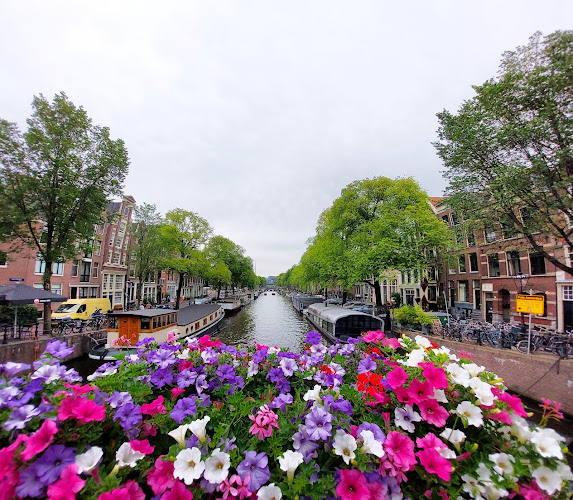
- Brouwersgracht (2 minutes). The cross-canal at the top of Prinsengracht, widely considered the best-looking canal in the city and a two-minute detour.
- The Nine Streets (10 minutes). The compact shopping grid between Singel and Prinsengracht, south along the canal.
- Anne Frank House and the Westerkerk (10–12 minutes). Further south along Prinsengracht. The Anne Frank House requires timed tickets booked online in advance. Expect construction hoardings around Westermarkt while the street works continue.
If the hofje passage turns out to be closed, or if the unmanaged garden is not what you were hoping for, the Begijnhof off Spui is the alternative: larger, formally planted, open to the public with posted hours, and considerably busier.
Frequently asked questions
Can you visit Zon’s Hofje?
Yes. The passage at Prinsengracht 159–171 is open to visitors on weekdays during daytime hours and entry is free. The courtyard is private student housing, so keep visits short and quiet, and expect the passage to be closed without notice at times.
What are Zon’s Hofje opening hours?
Dutch walking-route guides list the passage as open Monday to Friday from about 8:00 to 18:00, while Frommer’s gives 10:00 to 17:00. Weekend access is unreliable, so plan a weekday visit between mid-morning and mid-afternoon and treat any posted time as approximate.
How old is Zon’s Hofje?
The merged Mennonite congregation decided to build the almshouse in 1755, received the building permit in 1764, and welcomed the first residents in 1765. A further wing was added in 1893, and numbers 159–171 have been a national monument (rijksmonument 4274) since 1 September 1970.
What does the Noah’s Ark stone at Zon’s Hofje mean?
The carved “De Arke Noach” gable stone and the 1765 courtyard clock refer to the two Mennonite congregations, De Kleine Zon and De Arke Noach, whose merger created the hofje. The entrance corridor was historically called the Zonnegang and later the Noachsgang.
Who lives in Zon’s Hofje today?
Students connected to the Amsterdam Mennonite congregation, roughly thirty residents plus a caretaker. The complex was originally built for unmarried Mennonite women aged 50 and over who had belonged to the congregation for at least three years.
Is Zon’s Hofje worth visiting?
It suits travellers who enjoy short historical detours and quiet corners; ten to fifteen minutes is enough. Anyone expecting a formal, well-tended garden will prefer the Begijnhof off Spui, which is larger, planted, and openly signposted.